Land compensation delays disrupt LH housing supply; repeated failed bids at third-generation new towns put government-led expansion to the test
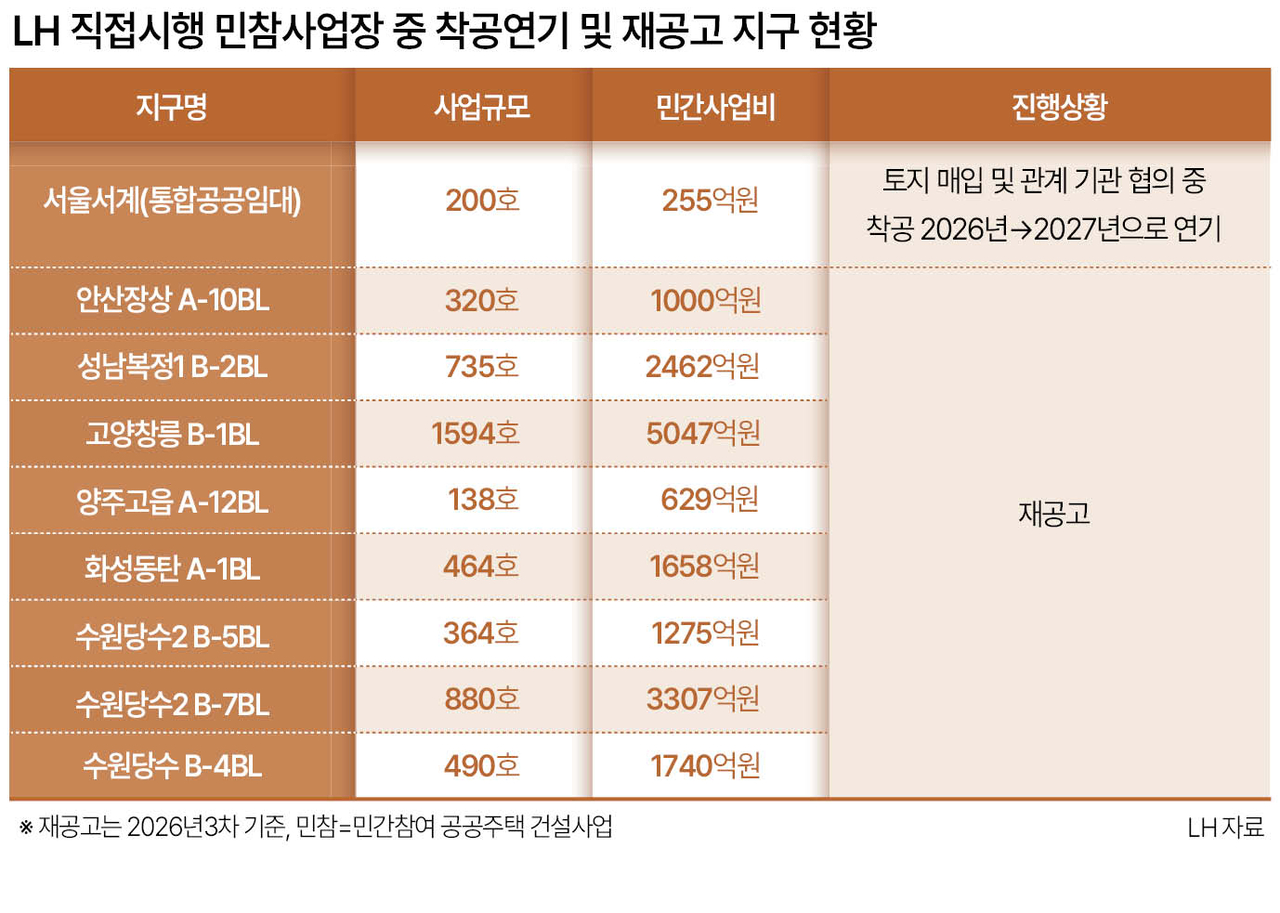
Korea Land and Housing Corp.'s only private-participation public housing project scheduled to break ground in Seoul this year has been pushed back to next year. Several sites in third-generation new towns — including Goyang Changneung — that solicited private partners in the first half of the year have also gone back out for rebidding, underscoring that government-led housing supply is falling short of expectations.
According to LH and other sources, the groundbreaking for the Seosegye private-participation public housing project in Seoul — which would build 200 integrated public rental units — has been delayed to next year. The project pairs artist rental housing with a mixed-use cultural facility near Seoul Station being developed by the Ministry of Culture, Sports and Tourism. A 2022 tender selected the HJ Heavy Industries consortium — comprising HJ Heavy Industries and Dongbu Construction — as the preferred negotiating partner, but construction has yet to begin.
The delay stems from difficulties compensating landowners for privately held parcels within the project site. "Private land beyond what is owned by the Ministry of Land, Infrastructure and Transport and Yongsan-gu is included in the site, and the compensation process is taking longer than planned," an LH official said. "Because this is not a standalone project but one coordinated with the Ministry of Culture, Sports and Tourism and the Seoul Metropolitan Government, the groundbreaking schedule has shifted."
While the Seosegye project's delay is tied to land compensation, a growing number of LH private-participation public housing projects are experiencing setbacks. LH solicited private partners in the first half of this year for sites in third-generation new towns including Goyang Changneung, as well as Gyeonggi Province locations such as Pyeongtaek Godeok and Suwon Dangsu, but some districts drew no bids and are now going through rebidding procedures.
Earlier this month, LH reissued tenders for four districts — including Pyeongtaek Godeok A-72BL and A-73BL, totaling roughly 3,300 units — that had been part of this year's second solicitation round. Sites in the third round, including Goyang Changneung B-1BL, Suwon Dangsu 2 B-7BL and Seongnam Bokjeong 1 B-2BL, also failed to attract bids, pushing their timelines behind schedule.
The government has been expanding the LH direct-implementation model through its Sept. 7 housing measures, but conditions on the ground vary considerably by site depending on project viability, compensation issues and coordination with partner agencies. "Private construction companies have no choice but to comprehensively review actual demand, construction costs and future pre-sale risks before deciding whether to participate," said Kim Hyo-seon, a senior real estate specialist at KB Kookmin Bank. "Supply can only be delivered reliably when projects move forward in areas where viability is secured and demand is there to support them."
Meanwhile, LH has set a target of launching new tenders for roughly 18,000 units this year and breaking ground on 16,000 of them. "Among the four districts — six blocks in total — converted to LH direct implementation in January, Incheon Yeongjong A-57 and A-63 and Yangju Hoecheon A-4 and A-23 have selected private partners and are on track to break ground by year-end," an LH official said. "We will continue to pursue new tenders for approximately 4,000 additional units after June and advance projects in line with our annual supply plan."
hope@heraldcorp.com