Our Neighborhood Police Station (8): Seoul's Gangbuk Police Station
Officer Yu Sang-beom saved a 100-day-old infant
Asked a local police box for help, rushed baby by patrol car
Covered a 30-minute route in 10 minutes — and saved a young life
Veteran detective Kim Seong-gil, who worked the Yu Yeong-cheol case
Experience remains a weapon as high-tech investigative tools advance
'Police must keep studying as crime keeps evolving'
Inspector Han Seok-gwon busted a gang that stole 800 million won in Tether
A major-crime investigation rare for a front-line station
A year-long pursuit that netted even the developer behind the scheme
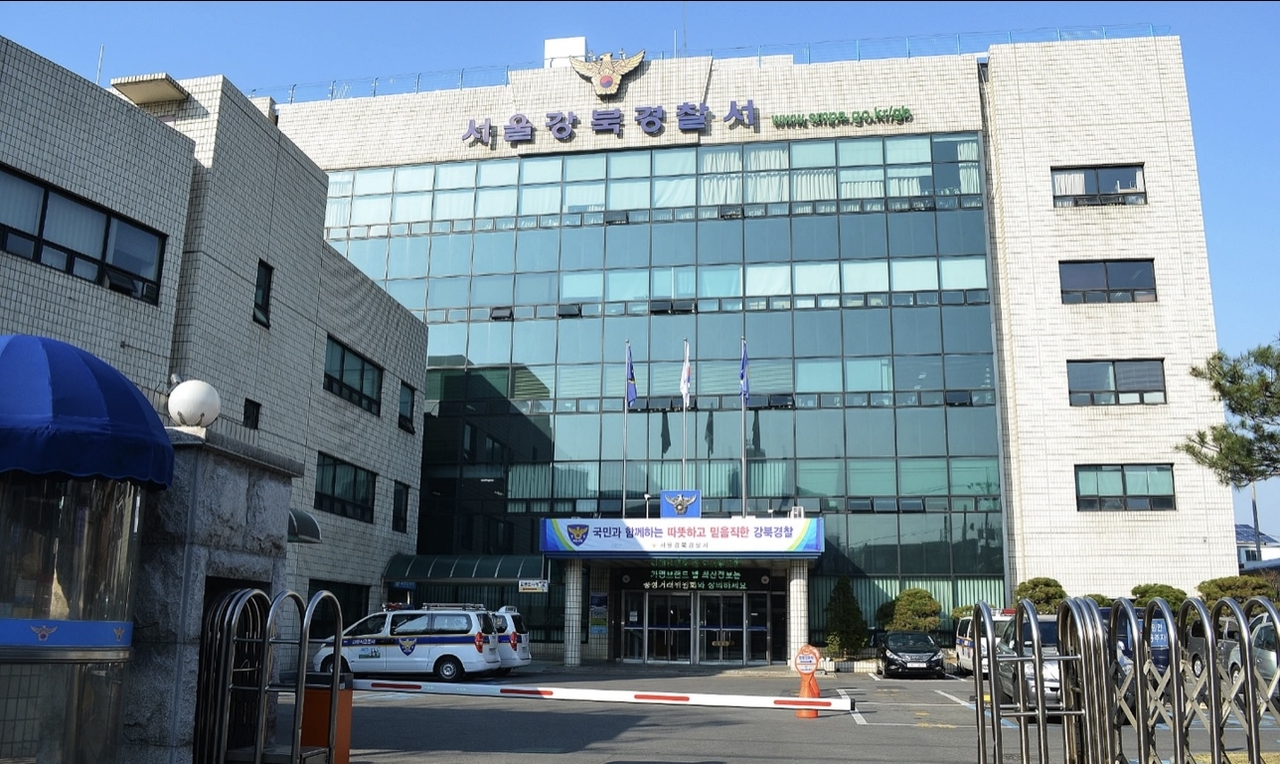
Seoul's Gangbuk Police Station is responsible for public safety across Gangbuk-gu, the northernmost district in the city. About 700 personnel work there, including 673 sworn officers, with the Mia and Solsaem district units and seven precinct offices covering the entire district.
According to the Seoul Metropolitan Police Agency, the station received 22,330 emergency calls this year through April alone. During the same period, 1,559 major crimes were reported, along with 315 traffic accidents and 46 rallies or protests. Last year, total emergency calls reached 76,590.
The station was established in 1969 as the "Bukbu Police Station" and took its current name in 2006. Its jurisdiction encompasses Bukhansan, the Suyu restaurant strip and aging residential neighborhoods — a mix that generates a wide range of policing demands, from mountain rescues to petty crime to serious violent offenses.
Gangbuk is known for having a relatively young workforce and a strong emphasis on field response. A culture has taken hold in which nearby patrol cars back each other up even when only one unit is formally dispatched, and club activities such as soccer and futsal are popular among staff. A memorial space honoring officers killed in the line of duty has also been set up on the first floor of the station building. "Putting residents' safety and well-being first is our top priority," station chief Kim Tae-hyeon said. "Protecting people's lives and property based on fundamentals and principles is the very reason police exist."

Officer Yu Sang-beom rushed a 100-day-old infant to a hospital in his patrol car in March after the child's parents turned up at the Mia district unit seeking help. The infant, just over three months old, had lost consciousness from a fever exceeding 40 degrees Celsius. The parents had already tried one hospital, only to be told no pediatrician was available, and were on their way to another when they stopped at the police box.
Yu determined that using a nearby 119 emergency center was not a viable option and immediately set off in his patrol car. Despite heavy weekend afternoon traffic, he covered a route that normally takes 30 minutes in about 10 minutes, with the cooperation of other drivers on the road.
"It could have turned into a real emergency, so when I heard the baby had received treatment and recovered, I felt proud to have been even a small help," Yu said. After the incident, he personally called the parents to check on the child's condition.
The call that has stayed with him most came in February — a search on Bukhansan for an active-duty soldier who had failed to return to base. After tracking the soldier's location, officers found him at a mountain observatory in a mental health crisis. "We searched the winter mountain for more than four hours and found the soldier hesitating at the observatory railing," Yu said. "A week later, his father came in person to thank us, and that meant a great deal to me." If you're thinking about self-harm or suicide, contact the Ministry of Health and Welfare's helpline 1393, available 24/7. Please request a translator for English-language services.
Having spent more than a decade on the front lines at district units and precinct offices, Yu said the field remains the most important place in any police organization. "The field is always unpredictable — you never know what situation will arise," he said. "Sound judgment requires experience and a thorough understanding of procedure, which is why I believe the best officers need to be out there in the field."
Kim Seong-gil, who leads Gangbuk Police Station's Intellectual Crime Investigation Team, is a veteran investigator who took part in the 2004 investigation into serial killer Yu Yeong-cheol, one of South Korea's most notorious murder cases. "Every part of that investigation was old-fashioned legwork — canvassing and talking to people," he recalled. When someone went missing, officers had to go out, walk the scene and meet people face to face to find any lead.
More than two decades on, the investigative landscape has changed completely. Profiling, digital forensics and virtual asset tracing technology have all advanced rapidly. Yet Kim said veteran investigators still have a role that no tool can replace.
"Younger investigators are strong on technology and digital investigation," he said. "On the other hand, someone who has been investigating for a long time has the experience to read the minds of suspects and victims and build a rapport with them." He added: "You can't get to the truth just by firing questions in an interview room. You have to listen to the other person and be able to move them."
The Intellectual Crime Investigation Team currently handles cases with significant public interest — crimes by civil servants, unlicensed financial solicitation, economic offenses and embezzlement of government subsidies. The cases tend to be large in scale and often involve complex legal analysis.
With two years left before retirement, Kim said his main focus these days is developing younger investigators. "When a difficult case isn't coming together, we talk it through and look for a way forward together," he said. "Investigation is ultimately not something you do alone — it's a team effort."
The advice he gives junior colleagues most often is that "knowledge is power." He practices what he preaches, checking the latest court rulings and investigative techniques every morning through an AI case-law search system. "Investigative methods have to keep pace with the speed at which criminals are moving," Kim said. "In the end, the most important weapon a police officer has is studying."
Inspector Han Seok-gwon led the investigation into a gang that stole virtual assets worth 800 million won (about $525,000) in Tether (USDT), a case that wrapped up in January. The perpetrators built a fake investment website, tricked victims into linking their personal virtual asset wallets to it, and then manipulated them into executing a malicious smart contract. To lower victims' guard, the gang even paid out small amounts of interest to make the scheme look like a legitimate investment product — then drained the accounts the moment victims deposited large sums raised through loans and borrowing.
"At first I thought it was just a run-of-the-mill investment chat-room scam," Han said. "But when we checked with a tracking program, 800 million won had actually been siphoned out. It was a scale of loss rarely seen at a front-line station."
The investigation team arrested and detained six people connected to the crime. Particularly notable was the team's success in tracking down and arresting the developer who had personally built the fake investment site and the malicious smart contract used in the scheme. "Cases where the developer is also detained are very rare," Han said.
The investigation ran for about a year. The ringleader was based in South Korea, but some members of the organization were abroad. The team ultimately brought in the entire group by working through Interpol channels and persuading the overseas members' families to cooperate.
Han urged the public to exercise caution with personal crypto wallets. "Using major exchanges like Upbit or Bithumb is relatively safe, but creating a personal wallet without a solid understanding of how it works, or connecting your wallet to an unfamiliar site, is extremely dangerous," he said. "In particular, any investment site that cannot be properly verified through a search should in effect be treated as a potential crime."
By Jung Joo-won
jookapooka@heraldcorp.com