Riding the hansik wave, traditional oil mills become tourist draws; sesame oil's deep, nutty aroma spurs a surge in foreign purchases; perilla oil's omega-3 profile earns health-food buzz; compatibility with Western cuisine points to global ingredient potential
"Just yesterday, an American and a Singaporean bought sesame oil and kept saying how incredibly nutty it smelled. Foreign visitors are always surprised by how different it is from the oils they use back home."
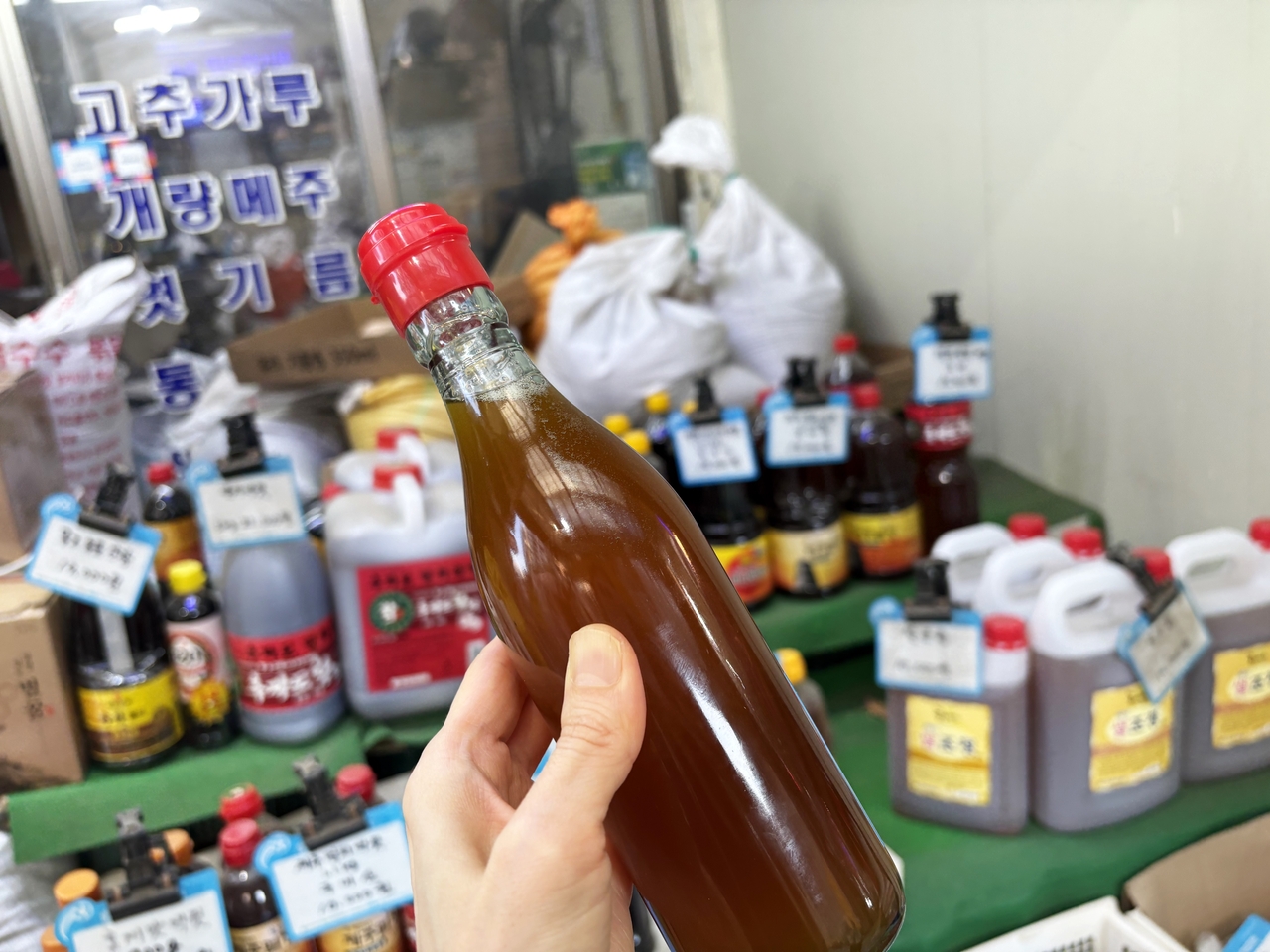
The speaker is Bae Cheol-gyu, who runs an oil mill inside Mangwon Market in Mapo-gu, Seoul. At the back of his shop, a press sits beside a pile of spent sesame solids left after the oil has been extracted. A bottle of domestic sesame oil sells for 30,000 won (about $20) — nearly three times the price of the Chinese-made alternative at 11,000 won — yet foreign buyers keep coming. "As more foreign visitors discover traditional markets, they're making their way to oil mills to pick up freshly pressed oil," Bae said.
While olive oil has dominated Korean pantries, Korean traditional oils are drawing international attention as "K-oils" — prized for their intense, nutty aroma and, more recently, their status as a traditional-market find.
The broader backdrop is the K-food wave spreading to traditional ingredients. Foreign visitors who try bibimbap or seasoned vegetable dishes grow curious about the Korean oils that give those dishes their characteristic nuttiness.
Shin Chang-ho, owner-chef of JOO Ok, a Korean fine-dining restaurant in New York, said Korean traditional oils are gaining recognition abroad for their distinctive aroma and flavor alongside the rising popularity of hansik. Shin earned two Michelin stars in New York for his Korean cuisine.
Korean traditional oils stand out for a nuttiness more pronounced than most other cooking oils, and that quality shapes how they are used. "While widely used oils abroad serve broadly as salad dressings or cooking fats, sesame oil and perilla oil are used mainly at the final stage of a dish to add fragrance," Shin said. Just as sesame oil is drizzled over a finished bowl of bibimbap, these oils function as a finishing touch that deepens flavor.
Sesame oil and perilla oil are used across Asia, not only in Korea. Sesame oil is common in China and Japan as well. According to a report by market research firm IndexBox, China ranked as the world's top sesame oil consumer as of 2024.
Korean sesame oil, however, is distinguished by its bold, nutty flavor — a result of roasting the sesame seeds at high temperatures. Chinese and Japanese sesame oils tend to be lighter in color and milder in aroma. Perilla oil tells a different story: Korean consumption is overwhelmingly dominant. A Market Growth report found that South Korea was the world's largest consumer of perilla oil in 2024, calling it the market leader.
A new tourism trend has also fueled interest in traditional oils. Traditional markets such as Gwangjang Market in Seoul and Gukje Market in Busan have emerged as tourist destinations where visitors experience Korean culture firsthand, and the oil mills inside them have spread by word of mouth. Visitors can smell freshly pressed oil on the spot and take home bottles of it. As foreign purchases have grown, some shops now offer individual bubble-wrap packaging so customers can carry bottles safely on the flight home.
Japanese visitors make up a large share of foreign buyers. Content mapping the locations of oil mills inside Korean traditional markets has appeared on Japanese social media. A YouTube video by Japanese singer Sashihara Rino featuring "sesame oil ramyun" — a bowl of ramyun finished with a drizzle of Korean sesame oil — drew particular attention. "The aroma is completely different from Japanese products," she said in the video. "It's freshly pressed, so it's absolutely delicious."
Traditional oils pair well with noodle dishes like ramyun. Bae Cheol-gyu of World Cup Gireeum said, "In summer, adding sesame oil to cold bibim ramyun makes it taste wonderful."
How do these oils stack up nutritionally? Compared with olive oil — long regarded as a health food — Korean traditional oils offer a different profile of omega-3 and omega-9 fatty acids, both of which tend to be lacking in modern diets. Perilla oil's key strength is omega-3. A paper from India published in the international academic journal Advances in Traditional Medicine (2011) found that perilla oil contains the highest omega-3 content of any plant-based oil, at 54 to 64 percent.
Olive oil's main component is not omega-3 but omega-9, which accounts for 70 to 80 percent of its composition. Sesame oil contains 35 to 45 percent omega-9 and 40 to 45 percent omega-6.
"Perilla oil is attracting attention for its health benefits due to its high omega-3 content, while sesame oil is valued for its distinctive nutty aroma as well as its range of antioxidant compounds," Shin said.
Both oils also show potential for broader use in global dining. "Chefs are increasingly using perilla oil in pasta, fish dishes and salads, expanding the reach of traditional Korean oils into Western cuisine," Shin said. "At our restaurant in New York, we don't limit ourselves to hansik — we combine these oils with a wide variety of ingredients and express them in new ways."
gorgeous@heraldcorp.com