
Sidecars triggered 23 times this year, approaching 2008 record; circuit breakers already tripped 3 times — matching all prior years combined
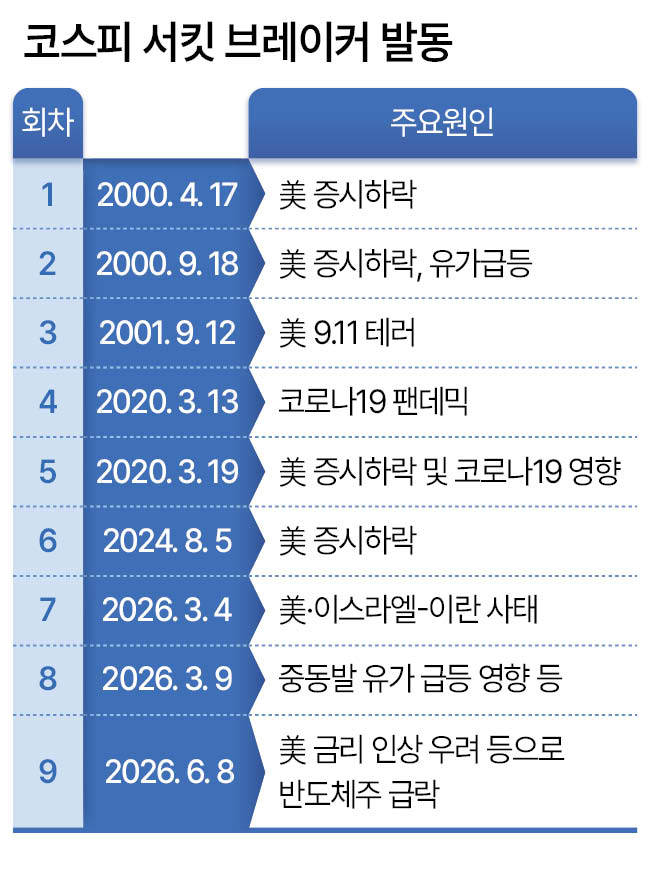
The Kospi has entered an era of unprecedented volatility. Circuit breakers have already been triggered three times on the market this year — a frequency with no historical precedent.
Sidecars have been activated 23 times so far this year, in a period of less than six months. That figure already approaches the full-year record of 26 set during the 2008 global financial crisis. By trading days, that works out to once every five sessions — in effect, once a week.
Market safeguards that once appeared only during events like the Sept. 11 attacks or the COVID-19 pandemic have become routine. Analysts warn that the Kospi has entered a "bipolar market," swinging between extreme gains and losses in rapid succession.
According to Korea Exchange data released Wednesday, sidecars were triggered a total of 23 times on the Kospi from the start of the year through Tuesday — 12 buy-side and 11 sell-side activations. That approaches the record set during the 2008 financial crisis, widely regarded as the most volatile period in the history of domestic markets, when sidecars were triggered 26 times for the full year (14 buy-side, 12 sell-side). With less than half of this year's trading days elapsed, the market has already reached roughly 90 percent of that crisis-era total. At the current pace, surpassing the 2008 record is a matter of time.
The frequency alone signals how severe conditions have become. Over roughly 160 calendar days from January through Tuesday, sidecars fired 23 times — once a week by simple calculation, or once every five trading sessions.
The volatility was on full display in recent days. Sell-side sidecars were triggered on consecutive sessions June 5 and June 8, followed by a buy-side sidecar on June 9. In a single day, market sentiment swung from fear to greed.
Sidecars are normally triggered when the market moves sharply in one direction. Recently, however, sharp drops and sharp rallies have alternated within short windows, causing sell-side and buy-side sidecars to fire in quick succession.
Even circuit breakers — a stronger safeguard than sidecars — have become frequent. While a sidecar temporarily restricts program-trade asking prices, a circuit breaker halts all trading across the market and is treated as a far more severe warning signal.
Circuit breakers have already been triggered three times on the Kospi this year, a record for a single calendar year in the history of domestic markets. Korea Exchange statistics show that circuit breakers have been activated just nine times in total on the Kospi — and three of those have come this year alone.
Circuit breakers have historically been viewed as symbolic events reserved for national or global crises. Even during the Sept. 11 terrorist attacks in 2001, the mechanism was triggered only once. During the COVID-19 pandemic shock that rocked financial markets in 2020, it fired just twice. This year, circuit breakers have been tripping repeatedly even without a single large-scale shock of the kind seen during Sept. 11 or the pandemic.
Choi Jae-man, a researcher at Kiwoom Securities, said the AI theme is in a transitional phase — shifting from a hardware and infrastructure build-out driven by large-scale investment from big tech companies toward a stage focused on productivity gains from corporate AI adoption and software sales expansion. "In this process, the market's alternating expectations and disappointments over the gap between the pace of technological advancement and actual monetization may intermittently fuel volatility," he said.
He added that given the pace of share price gains and sector concentration in the first half, investors should take preemptive steps to prepare for the possibility of greater portfolio volatility in the second half. "With geopolitical risk persisting, the possibility of prolonged inflationary pressure from energy supply shocks — and the resulting uncertainty over Federal Reserve monetary policy — stand as the key alert factors for financial markets in the second half," he said.
By Hong Tae-hwa
th5@heraldcorp.com




