
![[Generated with ChatGPT]](https://wimg.heraldcorp.com/news/cms/2026/06/09/news-p.v1.20260609.a996b18535584304a62a09ac0f54686c_P1.png)
Fears of a margin debt unwind are becoming reality as South Korea's stock market suffered back-to-back "Black Friday" and "Black Monday" sessions. With forced selling surging amid the market rout, concerns are growing that still-record levels of outstanding margin debt could pile further selling pressure on an already battered market.
Forced selling tied to unsettled brokerage trades reached 166.2 billion won (about $107 million) on June 5, according to the Korea Financial Investment Association — a roughly eightfold jump from the previous session's 24.3 billion won. Industry observers say the figure is in effect the highest on record.
The official all-time high stands at 548.7 billion won, set on Oct. 24, 2023, but that figure reflected a special circumstance. Forced-sell orders could not be executed due to a trading halt on Youngpoong Paper, causing uncleared amounts to accumulate. Excluding that episode, the industry views the recent forced-selling volume as exceptionally large.
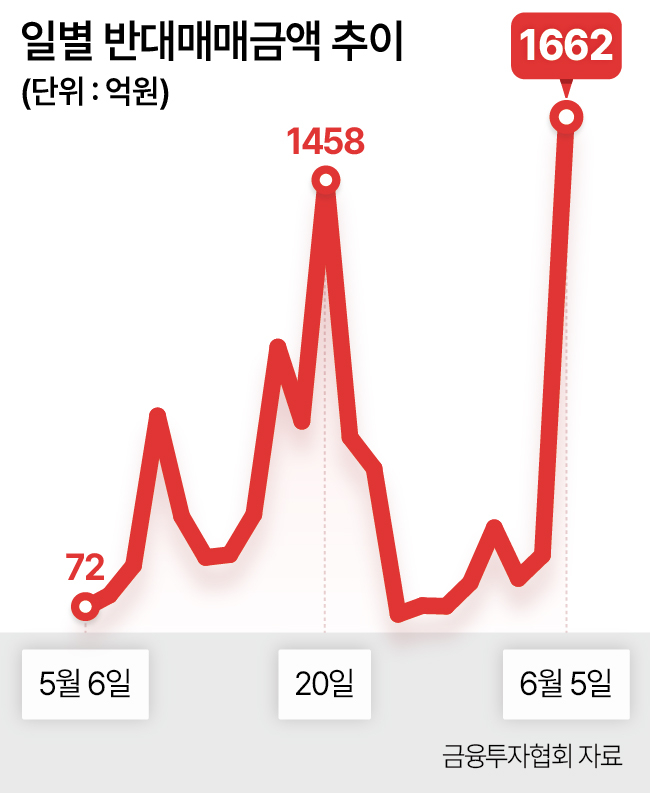
The surge in forced selling stems from the recent sharp market decline. The Kospi fell more than 5 percent on June 5, weighed down by a rapid rise in the exchange rate and weakness in semiconductor shares. Monday's session was even more turbulent, triggering both a circuit breaker and a sell-side sidecar simultaneously. The Kospi closed Monday down 676.18 points, or 8.29 percent, at 7,484.41 — the second-largest single-day point drop on record since March 4.
Forced selling occurs when an investor who has purchased shares using brokerage funds fails to repay the amount within the required period. In unsettled brokerage trades in particular, investors must settle within two trading days; if they fail to do so, the brokerage forcibly sells the held shares on the third trading day.
The concern is that leverage in the market remains substantial despite the selloff. Outstanding unsettled brokerage balances — a gauge of ultra-short-term margin borrowing — stood at 1.6885 trillion won as of June 5, down from 1.8292 trillion won the previous session but still more than 360 billion won above the June 2 level of 1.3277 trillion won.
Margin loan balances, the most widely watched indicator of leveraged investing, also remain near record highs. The outstanding balance stood at 37.8383 trillion won as of June 5, slightly below the all-time high of 38 trillion won set on May 29 but still the second-largest figure on record.
Market participants are now bracing for additional forced selling. The recent plunge has left a growing number of accounts below required collateral maintenance ratios, with more compulsory liquidations queued up. Monday's steep losses have yet to be fully reflected in forced-selling data, raising the prospect of further large-scale forced selling this week.
Experts advised investors to review their leveraged positions and build up cash holdings to manage risk, warning that volatility is likely to remain elevated for now. Stocks with high margin loan balances are particularly vulnerable to heightened volatility as forced-sell orders hit the market, and investors should exercise caution.
"Retail investors significantly ramped up leveraged positions during the recent rally, and an unexpected sharp downturn has triggered a surge in forced selling," a brokerage industry official said. "If additional forced-sell volume comes to market, falling share prices could trigger fresh collateral shortfalls, creating a vicious cycle."

th5@heraldcorp.com




