
Capital market revitalization
Kospi surges 212% in a year on Commercial Act reform
Retail investors flood in; market cap ranks 6th globally, ETF assets top 500 trillion won
Samsung, SK Hynix-led rally exposes limits of semiconductor concentration
Extreme volatility triggers sidecar 20 times this year
![Korea Exchange employees pose for a commemorative photo at the exchange's Seoul office on May 26, marking the Kospi's breakthrough above the 8000 level. [Korea Exchange]](https://wimg.heraldcorp.com/news/cms/2026/06/08/news-p.v1.20260605.eebab764d3c3490d9f1bcd0a757f454c_P1.jpg)
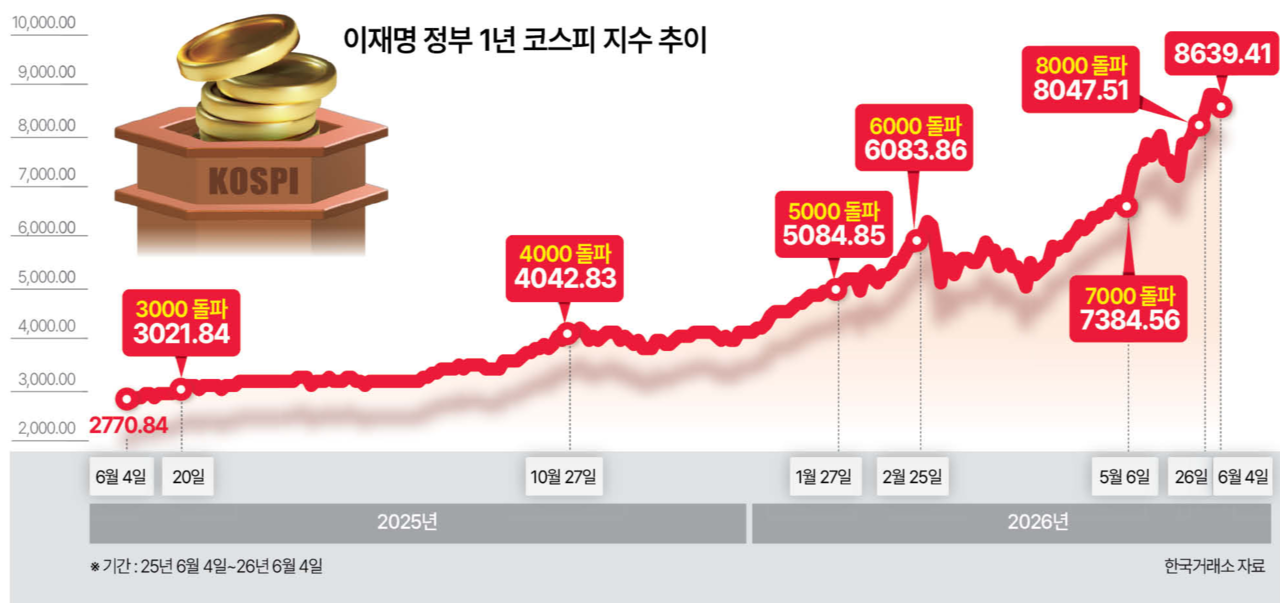
By far the most celebrated achievement of the Lee Jae-myung administration as it marks its first anniversary Thursday is the revitalization of South Korea's capital markets. The Kospi, which hovered around the 2700 level when President Lee took office, has surpassed 8000 for the first time in history, with market capitalization, trading volume and retail investor inflows all reaching record highs. The index has long since blown past the "Kospi 5000" campaign pledge Lee made during the presidential election. South Korea's stock market, once a backwater in global finance, has transformed into one that international investors are watching closely.
However, the rapid surge has deepened a "K-shaped" market in which capital has concentrated almost exclusively in large-cap semiconductor stocks. Record-high margin debt, known locally as "debt investing," and extreme volatility are cited as potential risk factors. Revitalizing the Kosdaq market, which remains relatively undervalued compared with the Kospi, is another challenge ahead.
The Kospi stood at just 2770.84 on June 4 last year, the day Lee took office. By Thursday it had reached 8639.41 — a gain of 212% in a single year, with the leading digit of the index changing six times over that span. The "Kospi 10000" level is now within sight.
Analysts credit the surge not only to the structural tailwind of an AI semiconductor supercycle, but also to the government's aggressive market-reform policies — including an amendment to the Commercial Act that expanded fiduciary duties to shareholders, measures to encourage companies to retire treasury shares, and a crackdown on unfair trading practices.
"The Commercial Act amendment had long been an unfinished task for the capital markets, and delivering results within a year deserves recognition," said Lee Chang-min, a professor at Hanyang University's business school. "The fundamental character of our capital markets is changing a great deal, and that is showing up in share prices. The recent rally has been led by Samsung Electronics and SK Hynix, but before that there was already an improvement in the market's underlying health," he added.
President Lee had made resolving the "Korea discount" a central theme of his presidential campaign, repeatedly vowing to "open the era of Kospi 5000." His first external engagement after taking office — attending a Korea Exchange forum on June 11 last year — reflected that priority.
The administration also sent a strong message that stock price manipulation would mean financial ruin, introducing a "one-strike-out" rule to eradicate unfair trading. More recently, it launched a Returning Investment Account program to lure retail investors who had been putting money into overseas markets back into domestic stocks, and introduced single-stock leveraged exchange-traded funds.
As a result, the Kospi's surge lifted South Korea's equity market capitalization to sixth in the world. According to Bloomberg, the market cap of South Korea's main bourse had soared 86% this year as of June 1 to $5.042 trillion (about 7,550 trillion won). That places it behind only the United States, mainland China, Japan, Hong Kong and Taiwan. The rally also drew a flood of money into domestic equity funds and ETFs: total ETF net assets, which stood at around 200 trillion won a year ago, surpassed 500 trillion won on May 27.
Semiconductors have been by far the driving force behind the Kospi's rise. Samsung Electronics and SK Hynix saw their share prices soar on the back of surging AI server investment and explosive demand for high-bandwidth memory. SK Hynix, which traded at 217,500 won on June 4 last year, closed Thursday at 2,298,000 won — a gain of 956.5%. Samsung Electronics rose 508.1%, from 57,800 won to 351,500 won over the same period.
Market participants expect the uptrend to continue for the time being, driven by the ongoing semiconductor rally, improving corporate earnings and the government's policy push. Goldman Sachs raised its 12-month Kospi target from 9000 to 12000 on Wednesday local time.
Beneath the celebratory headlines, however, the deepening concentration in large-cap semiconductor stocks and extreme market volatility present serious concerns.
Share prices have climbed at a pace many consider unsustainable, and the outbreak of the US-Iran war earlier this year compounded the turbulence. Sidecars — the mechanism that temporarily suspends program-trading orders — have been triggered 20 times on the main bourse this year, comprising 11 buy-side and nine sell-side halts. That is the highest frequency since the 2008 global financial crisis and accounts for 25 percent of the 80 total sidecar activations recorded since 2002. Circuit breakers were also triggered twice in March — the first time two circuit breakers fired in the same month since March 2020, during the COVID-19 pandemic.
The VKOSPI, South Korea's equivalent of the fear index, has also soared. As of Thursday, the VKOSPI stood at 73.44, up 31.4 percent from 55.87 on May 4, a month earlier.
The concentration of gains in Samsung Electronics and SK Hynix has sharpened a polarization across the broader market. According to Korea Exchange, the two chipmakers together accounted for roughly 60 percent — 94.8429 trillion won — of the 156.3194 trillion won in total operating profit posted by Kospi-listed companies in the first quarter of this year. As of May 27, Samsung Electronics and SK Hynix together made up 52 percent of the Kospi's total market cap. Late last month, 820 of the 922 stocks listed on the Kospi fell on a single trading day.
Record margin debt is also drawing warnings. The outstanding balance of credit-financed stock purchases surpassed 38 trillion won for the first time ever as of May 29 — more than double the roughly 18 trillion won recorded at the end of May last year. The figure represents the total amount investors have borrowed from brokerages to buy shares and have yet to repay.
"The unprecedented stock market rally reflects both the semiconductor supercycle and the policy work done to reshape the capital market environment through the Commercial Act amendment," said Lee Jun-seo, a professor at Dongguk University's business school. He added that the pattern of sidecar activations was itself a warning sign. "Normally sidecars fire in one direction — either buy or sell — but recently they have been going both ways, and short selling balances and margin loan balances are simultaneously at record highs," he said. "The government needs to think carefully about whether the current situation is heading in the right direction and how to handle the heightened volatility."
By Jung Yoon-hee and Moon Yi-rim
yuni@heraldcorp.com
moon@heraldcorp.com



