
Won weakens sharply on foreign capital flight; hits 17-year intraday high
Kospi plunges more than 6%, briefly threatening 8,000 level
Kosdaq falls below 1,000 during trading
Deputy PM Koo warns of 'heightened vigilance' on exchange rate volatility
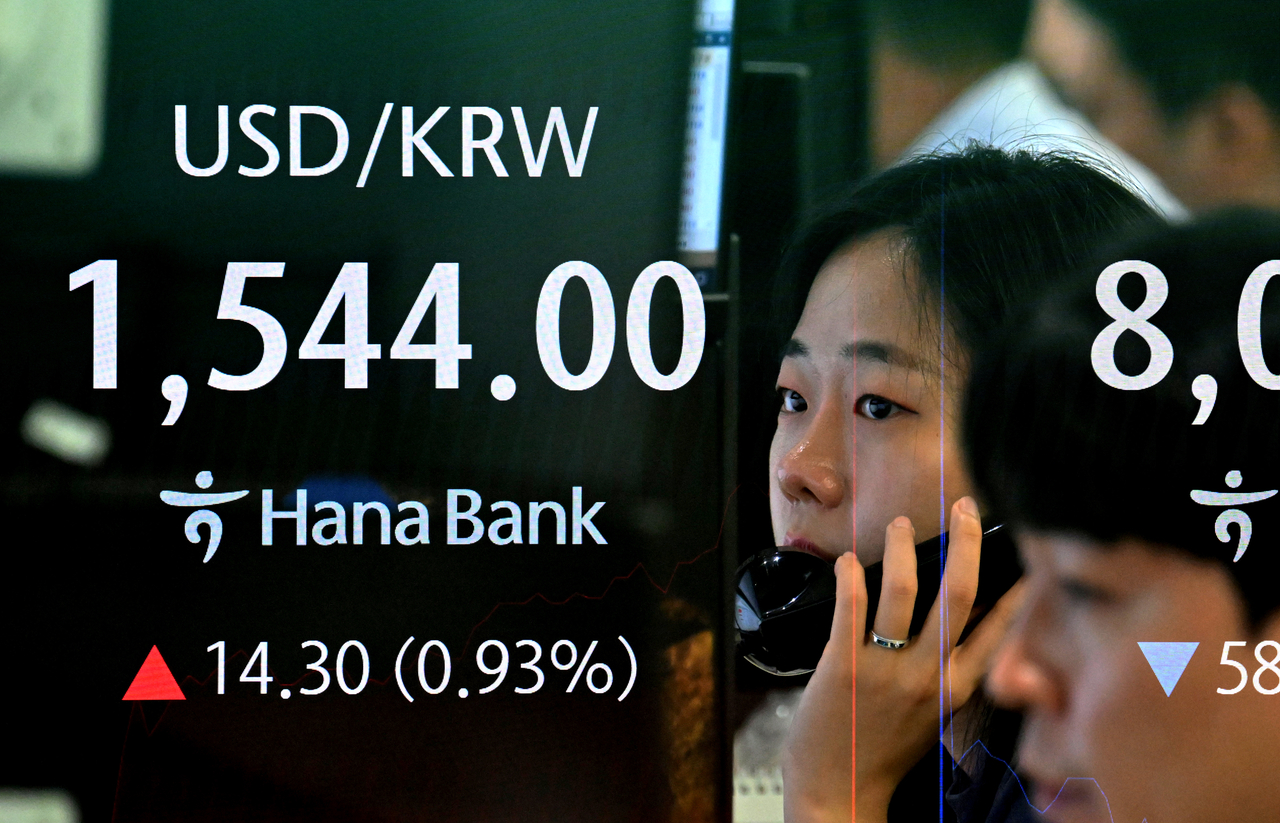
The won weakened to 1,549.25 per dollar at 10:28 a.m. Friday, breaching the 1,540-won level intraday for the first time in 17 years. The Kospi shed more than 6% in early trading, coming within striking distance of the 8,000 mark, while the Kosdaq tumbled more than 5% to fall below 1,000. Monetary authorities pledged heightened vigilance against the sharp volatility, but market anxiety showed little sign of easing.
The won opened at 1,529.0, down 0.7 won from the previous day's closing rate on the Seoul interbank market, but crossed 1,540 around 9:50 a.m. — a swing of roughly 11 won in less than an hour after the open. The currency then climbed to 1,542.6 at 10:06 a.m., 1,546.0 at 10:17 a.m. and 1,549.25 at 10:28 a.m., threatening to breach 1,550. That marks the highest intraday level since March 10, 2009 — during the global financial crisis — when the rate hit 1,561.0.
Markets are closely watching foreign capital outflows as the primary driver of the won's recent weakness. As of 10 a.m., foreign investors had net sold 1.4567 trillion won (about $953 million) worth of shares on the main bourse, with institutional investors adding to the selling pressure with net sales of 346.9 billion won. Retail investors absorbed the supply, posting net purchases of 1.71 trillion won.
The Kospi stood at 8,078.73 as of 10 a.m., down 560.68 points, or 6.49%, from the previous session, according to Korea Exchange. The index opened at 8,323.20, a drop of 316.21 points, or 3.66%, before sliding as far as 8,069.43 — a decline of 6.60%. Korea Exchange activated a sell-side sidecar on the main market at 9:08:25 a.m.
The Kosdaq also fell below 1,000, standing at 996.73 at the same time — down 53.00 points, or 5.05%, from the previous session. The index touched an intraday low of 998.40 before extending its decline to more than 5%.
Both the Kospi and Kosdaq partially recovered from their early lows during the session, clawing back above 8,300 and 1,000, respectively.
In the Kosdaq market, both foreign and retail investors were net sellers. As of 10 a.m., foreign investors had net sold 75 billion won worth of shares, while retail investors sold 21 billion won. Institutional investors were net buyers of 98.5 billion won.
According to KB Kookmin Bank, the correlation coefficient between cumulative net purchases of domestic shares by foreign investors and changes in the won-dollar exchange rate over the past year stood at minus 0.64 — meaning the more foreigners sold Korean stocks, the weaker the won became and the higher the exchange rate climbed. During that period, foreign investors net sold roughly 100 trillion won worth of shares, and the won-dollar rate rose by more than 100 won.
"Not all proceeds from stock sales immediately translate into demand for dollar conversion, but as net selling accumulates, the demand for dollars to repatriate funds inevitably grows," said Lee Min-hyuk, an economist at KB Kookmin Bank. "This can amplify upside volatility in the exchange rate during periods of elevated rates." He added that while the recent decline in global oil prices and a recovery in risk appetite are easing some dollar-strengthening pressure, foreign capital inflows ultimately remain the key variable for exchange rate stabilization.
Repeated verbal interventions by currency authorities appear to be losing their market impact. The Japanese yen also crossed 160 per dollar despite verbal warnings from Japan's prime minister and finance minister. Shin Se-don, a professor of economics at Sookmyung Women's University, said both South Korea and Japan maintain interest rates structurally lower than those in the United States, sustaining persistent capital outflow pressure. Without a change in interest rate policy, he said, market intervention by currency authorities alone is unlikely to reverse the trend in either country.
Some analysts warn the exchange rate could remain above 1,500 won for an extended period. "Even if Middle East risks and the large-scale foreign stock selloff subside, the exchange rate will not easily fall, given other factors such as pledged investment commitments to the United States," said Jeong Yong-taek, a researcher at IBK Investment Securities.
Deputy Prime Minister and Finance Minister Koo Yun-cheol said Friday the government is maintaining "heightened vigilance" in responding to widening volatility in financial and foreign exchange markets and the burden on household prices.
Koo made the remarks at an emergency economic task force meeting he chaired at the Government Seoul Complex, noting that market volatility remained high despite strong external indicators — including an April current account surplus of $28.29 billion and a record cumulative surplus for the January-April period.
forest@heraldcorp.com
hyuk@heraldcorp.com
kacew@heraldcorp.com
oskymoon@heraldcorp.com



