Analysis of Bank of Korea data by People Power Party lawmaker Kim Eun-hye's office shows remittances for overseas real estate purchases in the first four months of this year reached 319.1 billion won, about 35 percent of last year's full-year total; stricter rules on multi-home ownership are pushing buyers abroad, with Japan demand surging on the weak yen
![[AP]](https://wimg.heraldcorp.com/news/cms/2026/06/05/news-p.v1.20260601.c3147b9ff58f4a8fb3367c116f9b964c_P1.jpg)
South Korean residents sent nearly 320 billion won ($209 million) overseas to purchase foreign real estate this year, as tightening domestic regulations on multi-home and non-primary-residence ownership push buyers to look abroad. Analysts say buyers are deliberately targeting properties outside the country to sidestep rules that do not apply to foreign holdings. Particularly notable is a surge in demand for Japanese real estate, driven by the weak yen and expectations of economic recovery.
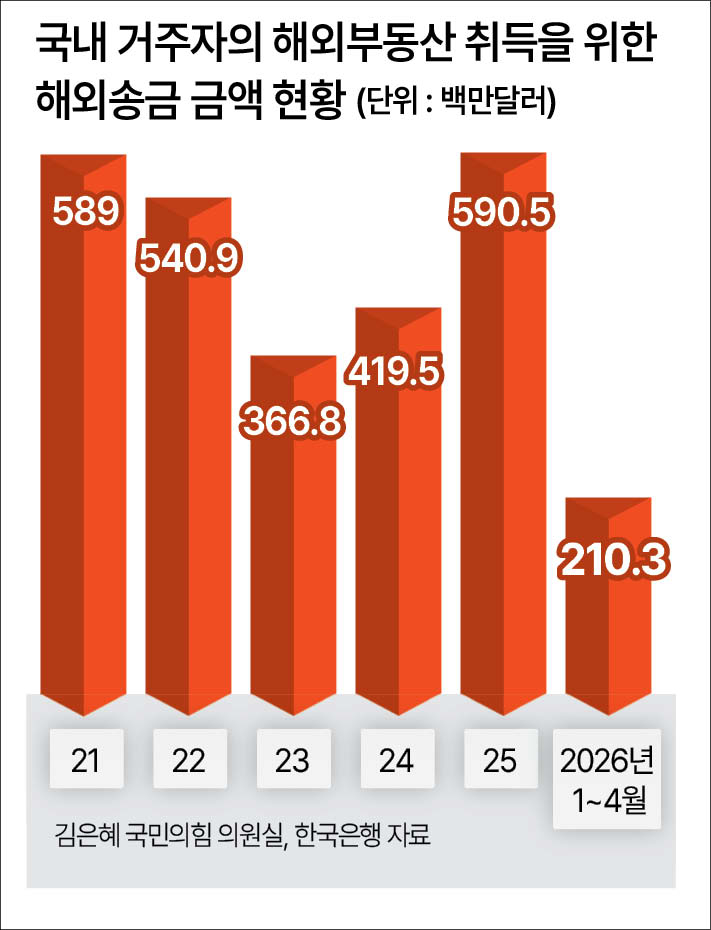
According to Bank of Korea data submitted to People Power Party lawmaker Kim Eun-hye of the National Assembly's Land, Infrastructure and Transport Committee, remittances by domestic residents for overseas real estate purchases totaled $210.3 million (319.1 billion won) in the first four months of this year. That figure represents roughly 35 percent of last year's full-year total of $590.5 million — itself the highest in the past five years. At the current pace, this year's overseas real estate remittances are likely to surpass last year's record.
Over the past five years, remittances for overseas real estate purchases fell from $589 million (903.8 billion won) in 2021 to $540.9 million (830 billion won) in 2022, then to $366.8 million (562.9 billion won) in 2023. They rebounded to $419.5 million (643.7 billion won) in 2024 before jumping to $590.5 million (906.1 billion won) in 2025.
Industry observers attribute the rise in overseas real estate investment to stringent domestic regulations and demand for asset diversification. Because foreign properties are not counted toward a buyer's domestic home tally, they carry a comparatively lighter tax burden. While the National Tax Service has tightened overseas trust reporting requirements to combat offshore tax evasion, buyers can still avoid the loan restrictions and tax levies that apply to acquiring multiple homes in South Korea.
By destination, the United States led all countries in remittances for overseas real estate purchases through April, at $112 million (171.9 billion won). Japan followed at $36 million (55.2 billion won), then other countries at $31.3 million (48 billion won), the United Arab Emirates at $13.9 million (21.3 billion won), Australia at $7.6 million (11.7 billion won), Malaysia at $2.5 million (3.8 billion won) and Canada at $2.2 million (3.4 billion won). Japan's growth stood out: remittances to Japan in the first four months of this year already amounted to nearly 46.3 percent of Japan's full-year total for 2024 ($77.7 million).
A buyer identified only as A, who purchased a tower apartment in Osaka, Japan, worth 150 million yen (about $937,000) earlier this year, said the decision came down to a desire to diversify beyond Korean won-denominated assets. "Japan is geographically close, and the yen is weak," the buyer said.
The buyer added that Japan imposes relatively few restrictions on foreign investors. "The more stable political landscape there compared to South Korea was also a reason to invest," the buyer said.
As more Koreans turn to overseas markets to escape domestic regulations, local real estate players are moving to court Korean landlords. Brokers affiliated with the Seoul Global Real Estate Association are organizing a five-night, six-day "Southeast Asia overseas real estate tour" from June 17 to 22. The trip comes roughly six months after a Malaysian real estate firm invited South Korean licensed agents to Kuala Lumpur, and is expected to be tied to marketing efforts linked to demand for international school enrollment.
Owning foreign real estate does not, however, mean escaping taxes entirely. Capital gains from overseas properties are subject to taxation. Under bilateral agreements to prevent double taxation, any tax paid in the country where the property is located is credited against the amount owed in South Korea.
Woo Byung-tak, a senior adviser at Shinhan Bank's Premier Pathfinder unit, said buyers should not assume that paying capital gains tax abroad eliminates their domestic liability. "You can claim a credit in South Korea for taxes paid overseas, but you still need to account for differences in each country's tax system and any additional burden arising from exchange rate fluctuations," he said.
By Seo Jeong-eun
lucky@heraldcorp.com