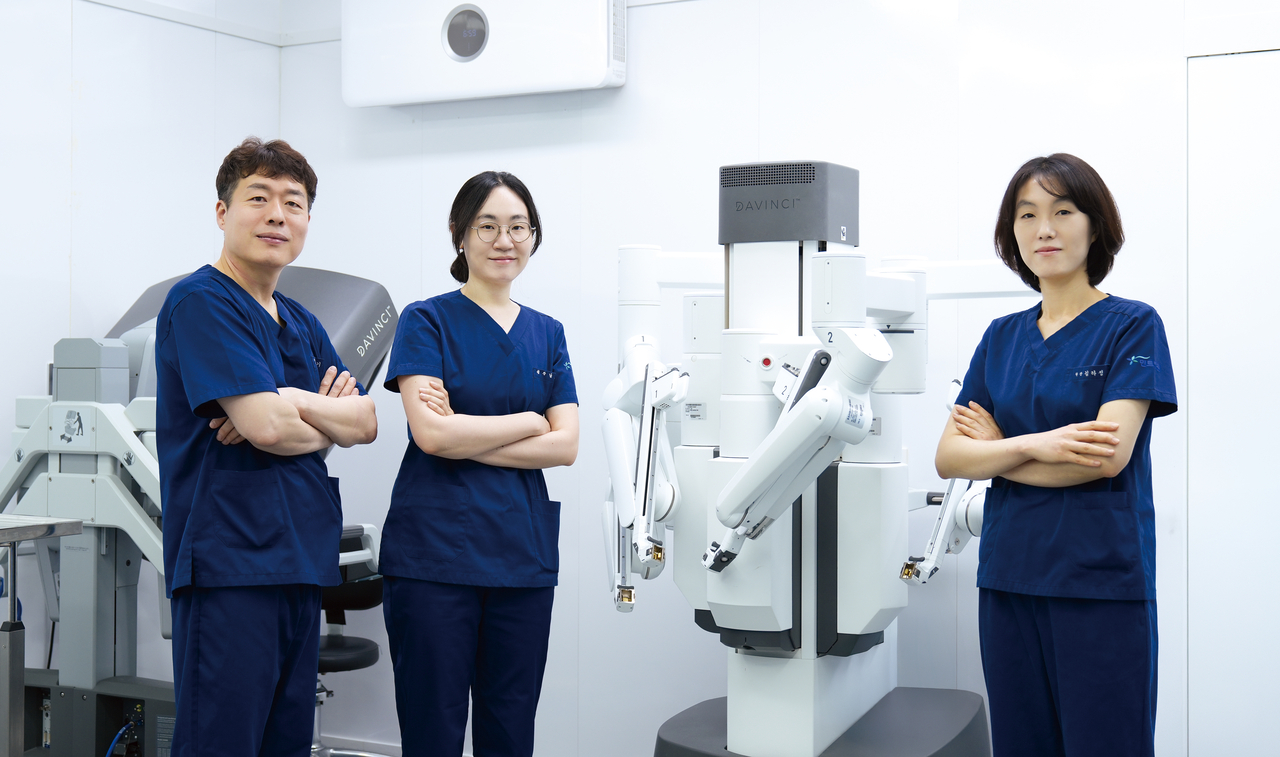
Robotic surgery has quietly become a fixture in the treatment of gynecological conditions such as uterine fibroids. As da Vinci robotic systems made by Intuitive Surgical have spread to private clinics, patients now have a broader range of treatment options. High-resolution three-dimensional imaging and precision robotic arms do in fact raise the quality of lesion removal and suturing. But with robotic procedures costing several times more than conventional surgery, whether every patient truly needs one is a question worth examining carefully.
Robotic surgery addresses the limitations of laparoscopy, which was itself a breakthrough compared with open surgery but still constrains surgeons in meaningful ways. Laparoscopic instruments are long and rigid, with tips that are nearly straight, making it difficult to change direction inside the narrow pelvic cavity or reach deep tissue. The near-flat imaging also means that judging tissue depth and blood vessel position depends heavily on the surgeon's experience.
Robotic surgery compensates for those shortcomings. Ki Gyeong-do, director of the women's medicine center at Mint Hospital and a specialist in obstetrics and gynecology, said the system's high-resolution 3D display — which magnifies the surgical field more than tenfold — allows surgeons to identify the boundaries of lesions and the layers requiring suturing far more precisely than the naked eye.
The robotic instruments' joints, which can bend up to 540 degrees, allow surgeons to change angles and perform resection and suturing even deep within the pelvis. A tremor-filtering function ensures that fine movements are transmitted steadily.
Ki said the approach to fibroid removal varies significantly depending on location — whether the growth is a submucosal fibroid protruding into the uterine cavity, an intramural fibroid developing within the muscle layer, or a subserosal fibroid projecting from the outer surface — and that robotic surgery's reach is a major advantage in navigating those differences. He added that robotic surgery is recommended when fibroids are located deep in the posterior uterine wall, when multiple fibroids are present, or when the uterine wall must be sutured firmly because the patient plans to become pregnant.
When a doctor recommends robotic surgery, patients should ask not simply whether it is a good procedure, but why it is necessary for their specific condition. It helps to get clear answers on how many fibroids are present and how large the biggest one is, where in the uterus they are located, how deeply they have penetrated the muscle layer, and what difficulties would arise if laparoscopic surgery were performed instead.
Patients should also compare robotic and laparoscopic surgery on practical grounds: expected operating time, risk of bleeding, incision size, length of hospital stay, recovery speed, and potential effects on future pregnancy plans.
Ki said robotic surgery cannot be evaluated simply on the basis of using superior equipment. "The right treatment for each patient requires weighing the size and location of the fibroids, the need to preserve the uterus, pregnancy plans, and the surgeon's experience together," he said. He added that what matters most in treating uterine fibroids is not just removing the growths, but also accounting for uterine function and the recovery process after surgery.
kty@heraldcorp.com