Han River belt backs permitting speed, policy continuity; Oh leads in Mok-dong, Yeouido, Apgujeong — and gains ground in rival's home turf of Seongsu
![Apartments in Mok-dong Sinsigage Complex 7. [Herald Business DB]](https://wimg.heraldcorp.com/news/cms/2026/06/05/news-p.v1.20250501.cabf5ded08914a9e90dff6a276b9ed3f_P1.jpg)
Real estate sentiment drove People Power Party candidate Oh Se-hoon's come-from-behind victory in Seoul's June 3 local elections. Oh led in the major urban renewal zones along the Han River belt — Apgujeong, Yeouido and Mok-dong, as well as Seongsu-dong, the home turf of his Democratic Party of Korea rival Jeong Won-o — in an area collectively dubbed "Apgujeong-Yeouido-Mok-dong-Seongsu." Expectations for deregulation of reconstruction and redevelopment projects, faster approvals and policy continuity mobilized voters in areas slated for urban renewal.
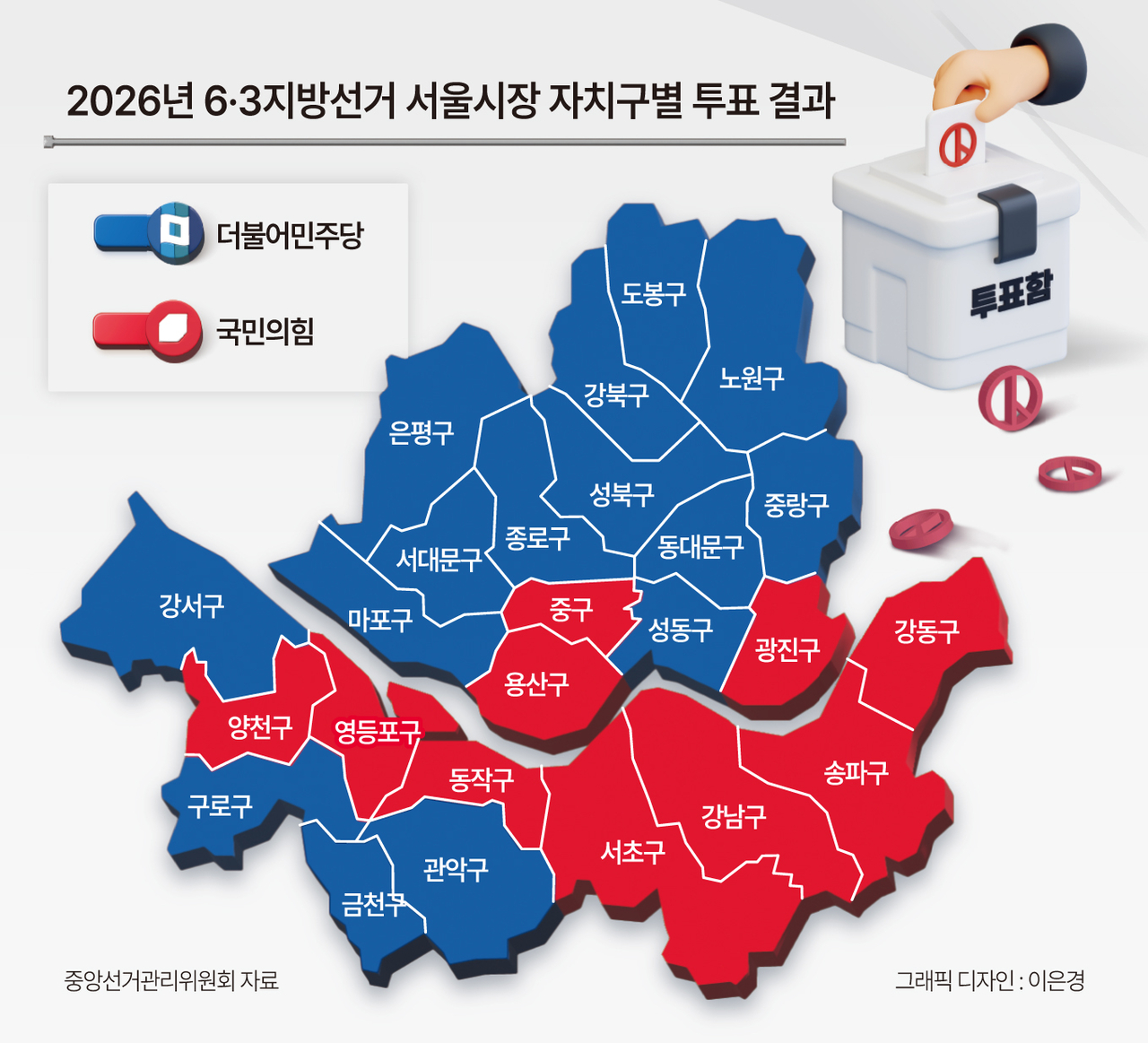
Final vote tallies from the 9th National Simultaneous Local Elections showed Oh leading in 10 of Seoul's 25 autonomous districts: Gangnam, Gangdong, Gwangjin, Dongjak, Seocho, Songpa, Yangcheon, Yeongdeungpo, Yongsan and Jung-gu. The results swept in the three Gangnam districts and key Han River belt areas.
The clearest trend emerged in Yangcheon-gu, where 14 complexes in the Mok-dong Sinsigage development are slated for reconstruction. According to precinct-level results from the National Election Commission, Oh led in 6 of Yangcheon-gu's 18 administrative dong — Mok 1-dong, Mok 3-dong, Mok 5-dong, Sinjeong 1-dong, Sinjeong 6-dong and Sinjeong 7-dong. Those neighborhoods overlap geographically with the cluster of Mok-dong Sinsigage reconstruction complexes.
The People Power Party also won the Yangcheon-gu district mayoral race, making it one of eight districts — alongside Gangnam, Gangdong, Gwangjin, Songpa, Seocho, Yongsan and Jung-gu — where the party took the district mayor's seat.
Of the 14 Mok-dong Sinsigage complexes, 12 have received association establishment approval, with only Complexes 3 and 7 still pending. All 14 are pursuing reconstruction through the Seoul Metropolitan Government's fast-track integrated planning program.
Adding urgency, the International Civil Aviation Organization is set to tighten altitude restrictions in 2030, meaning the Mok-dong complexes must secure project implementation approval before that deadline to proceed without disruption from future regulatory changes. Experts say concern that a change in Seoul mayor could slow reconstruction in the area was a key factor rallying voters in the affected zones.
Seoul has been actively supporting the Mok-dong reconstruction push. The fastest-moving of the 14 complexes, Complex 6, cleared the city's integrated review last month. According to the Seoul Metropolitan Government, the project set an all-time record — just 30 months from selection under the fast-track integrated planning program to association establishment — and also completed the integrated review process in five months from submission to approval, another record.
In Seongdong-gu, the vote split along redevelopment lines. Oh Se-hoon outpolled Jeong Won-o in Seongsu 1-ga 1-dong and Seongsu 2-ga 1-dong — home to Districts 1 through 4 of the Seongsu Strategic Redevelopment Zone, long considered a stronghold of the former Seongdong-gu district mayor. The Seongsu Strategic Redevelopment Zone is a major urban renewal site with an estimated project value of around 8 trillion won (approximately $5.23 billion).
The long-stalled project gained momentum after Seoul unveiled a plan in 2023 to create a waterfront residential complex with direct access to the Han River. Across all four districts, more than 9,000 apartment units and a landmark tower reaching up to 250 meters are planned. The fastest-moving of the four, District 1, confirmed GS Construction as its contractor in April, with construction costs of 2.154 trillion won — making it the largest single project within the Seongsu Strategic Redevelopment Zone.
In Yeongdeungpo-gu, where support was relatively evenly spread, Yeouido-dong — facing large-scale reconstruction — gave Oh an overwhelming 71.8 percent of the vote. Yeouido has 15 complexes, including Daegyo and Sibeom apartments, with roughly 15,000 units slated for reconstruction.
The fastest-moving project there is Daegyo Apartment, which received management and disposal plan approval from the Yeongdeungpo-gu office last month. The milestone came two years and four months after the association was established in January 2024, and nine months after project implementation approval in August last year — a pace that has drawn wide attention.
In Apgujeong-dong, Gangnam-gu, where contractor selection for Apgujeong Districts 2, 3, 4 and 5 recently wrapped up, Oh's vote share reached 84.5 percent — the highest of any administrative dong across Seoul. Districts 2 through 5 together form the country's largest Han River-front reconstruction belt, encompassing more than 10,000 units with construction costs approaching 12 trillion won.
All four districts, also proceeding through Seoul's fast-track integrated planning program, have completed the redevelopment zone designation process. Going forward, District 2 is planned for approximately 2,700 units, District 3 for approximately 5,800 units, District 4 for approximately 1,790 units and District 5 for approximately 1,540 units.
Ham Young-jin, head of Woori Bank's Real Estate Research Lab, said Oh's election win "may be read by the market as a signal of heightened expectations for privately led urban renewal projects," adding that it was notable his strength was concentrated in areas with a high density of reconstruction and redevelopment activity, such as the Han River belt and the Gangnam zone.
Ham added that many redevelopment sites in Seoul have already reached the association establishment approval stage, and that as they move sequentially through project implementation approval and management and disposal plan approval toward the relocation phase, relocation financing could become a sensitive issue. "Even if the city cannot support every project, it would be prudent for local governments to prepare funding and systems in advance to handle relocation demand," he said.
A related report examines whether the government may slow the pace of the reconstruction excess profit recapture regime and other regulations following its failure to retake Seoul.
![‘서울 탈환 실패’ 정부, 재초환 등 규제 속도 늦추나 [부동산360]](https://wimg.heraldcorp.com/news/cms/2026/06/05/rcv.YNA.20251229.PYH2025122911780001300_T1.jpg)
quq@heraldcorp.com
lucky@heraldcorp.com