City to conduct emergency safety inspections through July
C rating means 'average' condition — no bar to use
Expert: 'Fix defects immediately after inspection'
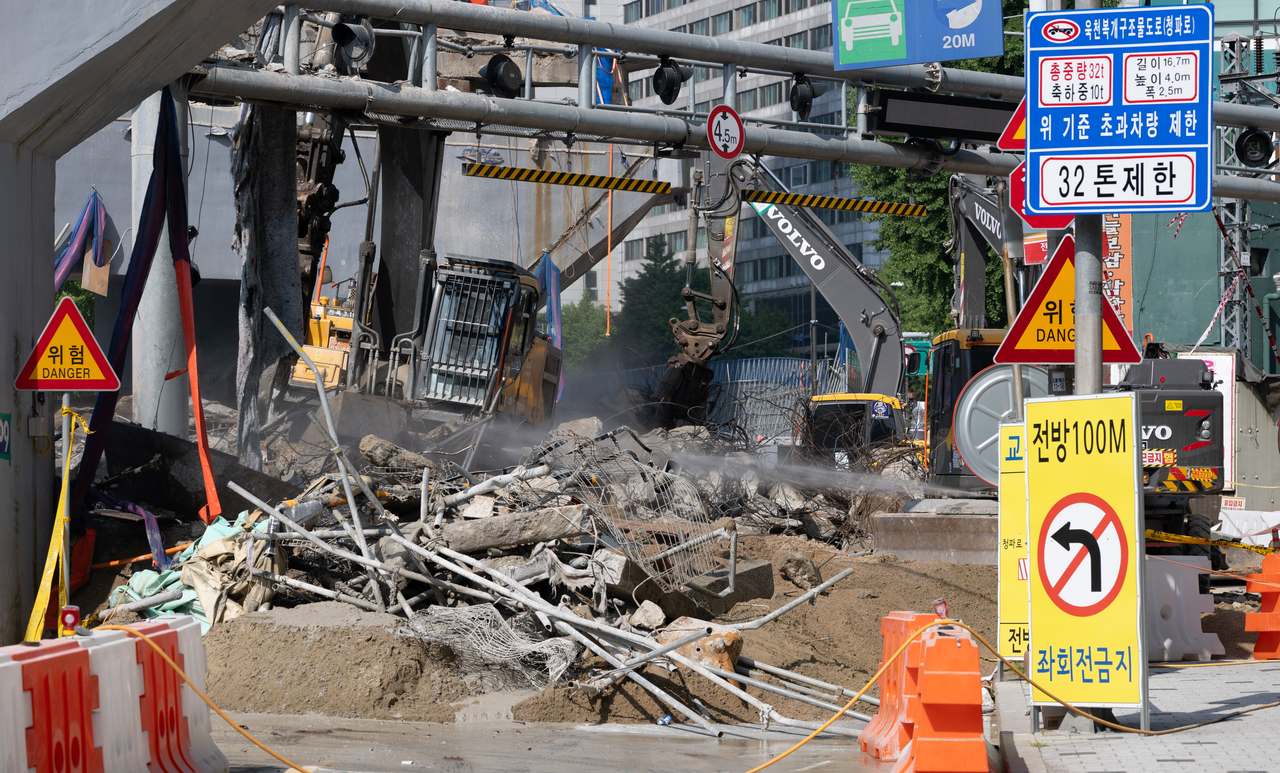
The Seoul Metropolitan Government will conduct emergency safety inspections over the next two months, through July, of 27 elevated roads and bridges rated C — the third tier on the national safety scale — in the wake of the structural collapse at the Seosomun Overpass demolition site. The city said the inspections are intended to ease public anxiety.
The Jeongja Bridge in Seongnam, Gyeonggi Province, which collapsed in April 2023, killing one person and injuring another, had also received a C rating in a detailed safety inspection two years earlier, in 2021.
Experts said C-rated elevated roads and bridges are in "average" condition requiring some repairs but pose no obstacle to use. The Jeongja Bridge was an exceptional case: after the accident, it was ultimately downgraded to D — the same rating as the Seosomun Overpass — in December 2023.
Ahn Hyung-jun, a professor in the Department of Architecture at Konkuk University and a leading authority on construction safety in South Korea, said facilities are graded on a five-tier scale: A (very good), B (good), C (average), D (inadequate or requiring repair and reinforcement), and E (immediate demolition required). The Seosomun Overpass, which collapsed in the recent accident, was rated D, he said.
"The C-rated facilities subject to this emergency inspection are in a condition that needs minor repairs but presents no safety problem," Ahn added.
If physical or functional defects are found during the inspections, the Seoul Metropolitan Government plans to conduct additional detailed safety inspections and draw up repair and reinforcement measures.
Ahn drew a distinction between the two types of remediation. "Repair means simple work such as filling holes or applying waterproofing, whereas reinforcement is a more fundamental intervention — replacing rebar or addressing the basic structure," he said.
Kong Ha-seong, a professor of fire and disaster prevention at Woosuk University, also said a C rating indicates "minor defects in members and components" that do not prevent use but require appropriate repairs. On the Jeongja Bridge, which held a C rating at the time of its collapse, Kong said the failure occurred on the pedestrian walkway side rather than the bridge deck itself, and cautioned that "a C rating should not be seen as cause for alarm."
The Seoul Metropolitan Government began its first round of joint inspections of the 27 C-rated facilities on May 27, together with specialized safety diagnosis agencies and outside experts.
A city official said the first round of emergency and detailed safety inspections was launched May 27 — the day after the accident — on the orders of the acting Seoul mayor, to ease public concern. "If repairs or reinforcement are found to be necessary, we will take immediate action," the official said.
Ahn noted that South Korea conducts regular safety inspections of all facilities under a special law enacted after the collapse of the Seongsu Bridge and Sampoong Department Store. "However, the number of aging facilities requiring repair and reinforcement keeps growing," he said, adding that while inspections are carried out on schedule, they are often perfunctory.
Alongside the bridge inspections, the Seoul Metropolitan Government will also conduct special inspections of 984 public construction sites commissioned by the city over the same two-month period through July. The inspections will focus on whether safety plans for managing hazards and preventing accidents are actually being followed on site; privately commissioned construction sites where demolition or excavation work is under way will receive concentrated scrutiny.
The inspection targets are: 114 public construction sites commissioned by the city; 338 private construction sites where hazardous processes such as demolition or excavation are ongoing; 32 excavation sites at risk of ground subsidence during the rainy season; and 500 small-scale construction sites with budgets under 5 billion won ($3.6 million) that have not designated a safety manager.
The inspections will be conducted as joint operations involving civil servants from relevant city departments — including the Urban Infrastructure Headquarters, the Construction Technology Policy Office and the Disaster Safety Office — as well as outside experts. Before entering any site, inspectors will confirm the status of ongoing construction and whether any high-risk work is in progress, and all inspections will be carried out in the presence of the site's safety manager and other responsible personnel.
The city plans to notify the relevant autonomous districts and commissioning departments of any violations found during inspections and demand corrective action. Matters related to industrial safety and health will be shared with relevant agencies to ensure prompt follow-up.
Ahn said the latest accident also appeared preventable. "Warning signs were detected 12 hours before the collapse, so it looks like an accident that could have been avoided had road controls and other safety measures been put in place in advance," he said. "Along with this special safety inspection, we need more thorough safety measures to prevent such accidents from recurring."
Kong said routine inspections must not be treated as a formality. "Whether it is the semi-annual regular safety inspection or the emergency inspection conducted every five years, defects found must be repaired immediately," he said.
ikson@heraldcorp.com