The brutal profit reality behind the glittering scoreboard
'A sure thing' — until it wasn't: production house IPOs keep falling through
Movie theater deals stall as exit routes dry up

By Ahn Hyo-jung, The Herald Business
From "K-Pop Demon Hunters," the animated film that swept the globe last year, to the wildly popular cooking competition "Black and White Chef," which recently wrapped its run, to "Squid Game" — whose second and third seasons the world has been holding its breath for — Korean content has become a brand audiences trust everywhere.
That is precisely why the Korea Creative Content Agency named "global" one of its top keywords when it reviewed the content industry last year. The Korea Development Institute reached a similar conclusion in its report "The Rise of K-Content: Industry Characteristics and Growth Factors," noting that K-content "is cementing a firm foothold in the global market on the strength of its high quality and artistic merit." The report cited data from 2023 and 2024: during that period, K-content accounted for 7 percent of all films and TV shows on Netflix and claimed 30 percent of the top 100 non-English titles globally — a commanding presence by any measure.
Yet for all the dazzling numbers, investment bankers who cover the sector are decidedly unimpressed. In capital markets, the refrain is that K-content is a blockbuster at the box office and a disaster on the balance sheet. The question is why — and the answer lies in a profit model that consistently punishes the people who actually make the content.
Box office hits, but studios are crying

Most people assume that high ratings and buzz translate directly into big profits for the production house behind a hit. That assumption ignores the peculiarities of the content industry — and it is wrong. Call it the "ratings trap." Production companies today operate under two broad business models — <style ref="s0">contract production</style> and <style ref="s1">IP ownership</style> — and each carries structural constraints that keep investors at arm's length.
Under the <style ref="s2">contract production</style> model, a studio receives full production costs plus a fixed fee from a global OTT platform such as Netflix. The upside is that the platform absorbs all the downside risk. The catch is that even a historic hit like "Squid Game" generates no additional revenue for the studio once it delivers the finished product — because the platform owns the IP outright.
"No matter how well a show performs, the studio walks away with nothing but its fixed margin," one industry insider said. "There's a reason people say the studio does all the work and the platform takes all the money." It is a stable model, but one with a hard ceiling on growth.
The <style ref="s3">IP ownership</style> model, by contrast, leaves the door open to much higher returns — but in today's market, the cost of failure has become prohibitive. Production budgets have ballooned, driven in large part by the fees commanded by lead actors, pushing the break-even threshold ever higher.
"If a title underperforms, the studio absorbs losses that can run into the tens of billions of won, and that loss flows straight through to investors' principal," said another industry insider who asked not to be named.
SLL Joongang in last-minute standoff with financial investors over IPO deadline

The uncertainty baked into this profit structure is now spilling over into capital markets as a full-blown exit-delay crisis. SLL Joongang is the clearest example.
In its 2021 pre-IPO funding round, SLL Joongang was valued at roughly 1.2 trillion won ($820 million) and raised approximately 400 billion won ($273 million) from domestic private equity fund operator Praxis Capital and China's Tencent, among others. At the time, riding the wave of K-content's global prestige, a listing looked like a foregone conclusion.
That optimism proved unfounded. SLL Joongang and its investors had signed a shareholder agreement requiring a listing within three years — by March 2024 — with two one-year extension options available. The company has now burned through both extensions. The final IPO deadline is next month, and there is still no listing in sight.
The financial investors who had counted on a public offering to recoup their money are growing increasingly anxious. SLL Joongang and its investors are reportedly in talks to extend the IPO deadline by another year. "A March listing is realistically off the table," one industry insider said. "With a delay now unavoidable, investors and the company are working through multiple contingency options." The insider added that sensitive terms — including adjustments to the guaranteed return rate tied to any extension — mean the two sides face a difficult road to a final agreement.
Contentre Joongang misses yet another deadline
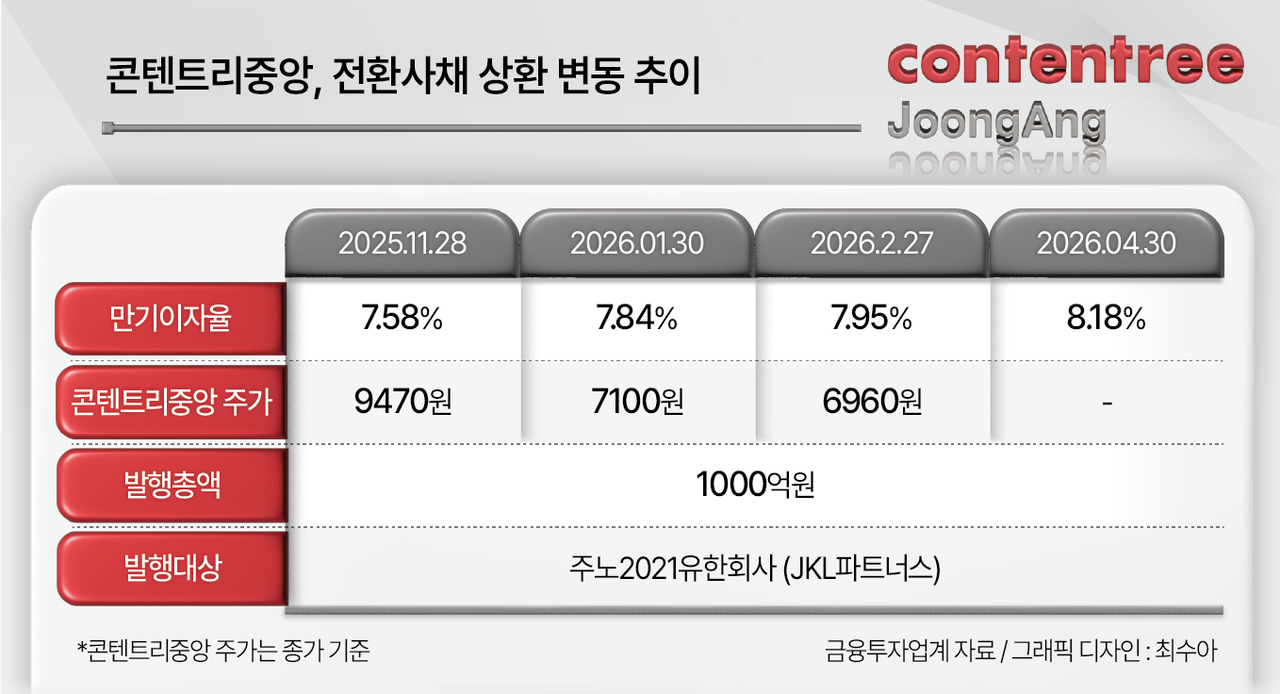
Parent company Contentre Joongang faces a similar predicament with its own financial investor, JKL Partners.
JKL Partners invested 100 billion won ($68.3 million) in Contentre Joongang in 2021 through convertible bonds, backing the company's growth. A sharp drop in the share price as industry conditions deteriorated threw JKL's exit strategy into disarray.
Contentre Joongang pushed the original November repayment deadline to January this year, then braced for a hard stop on March 27 — a deadline it has now also missed. Each extension has compounded the company's interest burden. The initial coupon rate of 7.58 percent rose to 7.84 percent at the first extension and climbed further to 7.95 percent when the deadline was pushed to February.
The two sides are now moving toward yet another extension — the third. "Without a clear roadmap, both the investor and the issuer are stuck in a prolonged deadlock with no obvious way out," one industry insider said.
Market attention has now shifted to Ares Management, the global alternative asset manager, which is reportedly pursuing an investment of around 300 billion won ($205 million) in Contentre Joongang. Industry observers expect the outcome of that deal to be a pivotal variable in determining whether existing financial investors can finally begin to exit.
The repeated deadline extensions underscore how deeply the content industry's structural profit problems have undermined investor confidence, leaving both companies and their backers searching for a way forward.
Lotte-Megabox 'mega-deal' meets a cold reception

The crisis is not confined to content production. The <style ref="s4">movie theater industry</style> — the offline anchor of the entertainment ecosystem — is mired just as deeply.
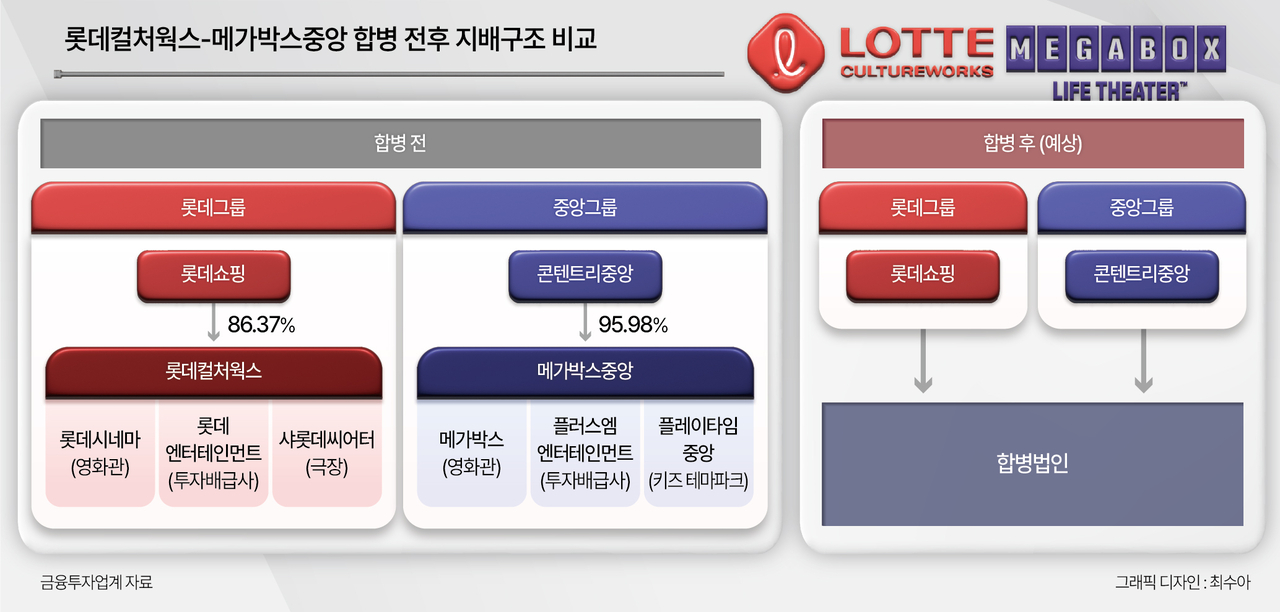
In a bid to survive, major conglomerates have turned to consolidation. In May last year, Lotte Group and Joongang Group signed a memorandum of understanding to merge Lotte Cultureworks and Megabox Joongang, combining their theater and film operations in hopes of generating synergies.
The logic of the merger is to unite the two groups' sprawling content value chains under a single roof. Lotte Cultureworks — which operates Lotte Cinema, distributor Lotte Entertainment and the Charlotte Theater — would combine with Megabox Joongang, which runs Megabox cinemas, distributor Plus M Entertainment and children's theme park operator Playtime Joongang. The result would be a single entertainment giant.
Industry estimates put the combined entity's value at close to 1 trillion won ($683 million). The Korea Fair Trade Commission is currently reviewing the merger, signaling that a major new force in the media market may be on the way. Investment, however, has been slow to materialize. The prevailing view is that simply getting bigger will not be enough to arrest the structural decline of the theater industry.
A clearer picture of how the merged company plans to raise large-scale capital has only recently begun to emerge. IMM Credit & Solution, a domestic credit private equity fund manager, is reportedly considering an investment of up to 400 billion won ($273 million) in the combined entity.
Analysts note that a credit fund — rather than a traditional equity private equity fund — is taking the lead role in this deal. As uncertainty over the content industry's prospects has grown, credit investment, which prioritizes principal protection and stable interest income over equity upside, has become the pragmatic choice for both issuers and investors alike.
The shift toward credit-style financing reflects a broader recalibration of risk appetite across the entertainment sector, as investors seek downside protection over the prospect of outsized equity gains.
How movie theaters became a graveyard for capital
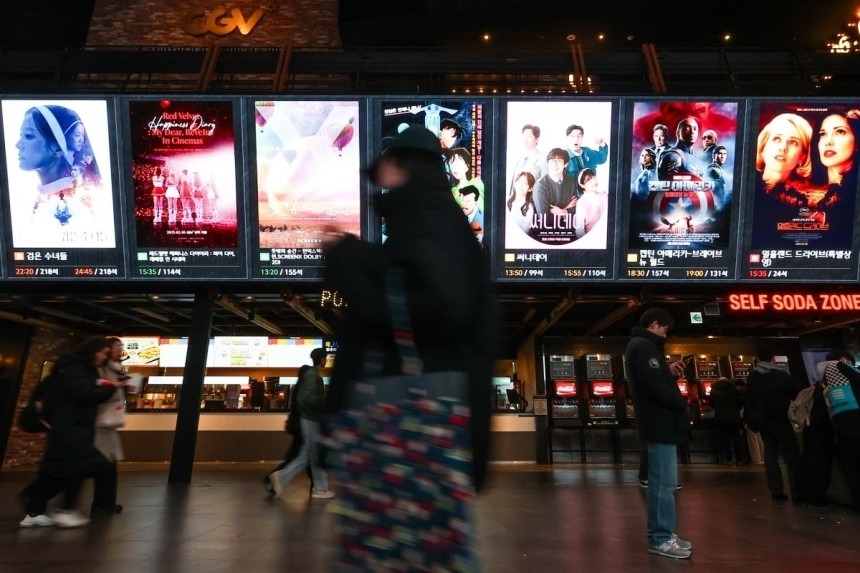
The movie theater industry is a classic cyclical business: revenue swings with the performance of individual titles, and consumers cut discretionary spending quickly when the economy sours.
But the more fundamental problem is a <style ref="s5">paradigm shift</style>. The COVID-19 pandemic accelerated a wholesale migration of media consumption to OTT platforms, and audiences have never fully returned to theaters. "The rise of OTT has eroded the sense of occasion that only a cinema could provide," one industry insider said. "The current crisis is not just a cyclical downturn — it is a signal that the theater industry has entered a structural decline."
Even as demand has fallen, the fixed costs of running large multiplexes — facility maintenance, rent and staffing — have not. Revenue shrinks, but the bills stay the same: a structural trap. "Cost-cutting and the occasional blockbuster are no longer enough to turn theater profitability around," a private equity fund industry insider said. "The limits of that approach are plain to see."
That is precisely why private equity funds that bet on the theater boom years ago have spent years unable to find a way out.
CGI Holdings, the Asian arm of CJ CGV, raised pre-IPO investment in 2019, only to see its listing plans collapse when the pandemic hit. Unable to bear the mounting pressure to return capital, financial investors including MBK Partners and Mirae Asset Securities PE exercised their drag-along rights against CJ CGV in July last year.
The trigger for that forced-sale process was CJ CGV's decision to walk away from its call option. The company had originally agreed to buy back the financial investors' stakes at a guaranteed return if the IPO failed, but deteriorating finances led it to abandon that commitment.
The financial investors have since appointed Morgan Stanley to lead the sale of CGI Holdings and are pushing hard to close a deal — but the process has stalled. With the industry recovery sluggish and no credible buyer emerging, even the drag-along mechanism has proven toothless, and the sale continues to spin its wheels.
The Turkish subsidiary, MARS Entertainment, tells a similar story. Financial investors including IMM Private Equity poured roughly 800 billion won ($546 million) into the company alongside CJ CGV, only to have their capital locked up for nearly a decade as the Turkish lira collapsed and the pandemic struck.
IMM PE and its co-investors have held drag-along rights covering even the controlling shareholder's stake since 2021 — but five years on, they have yet to pull the trigger. "On paper the right is clear, but a drag-along only has value if there is a buyer willing to take the asset," one industry insider said. "Given where the theater industry stands and the situation on the ground in Turkey, finding a credible buyer is extremely difficult. The right exists, but it has lost its practical utility."
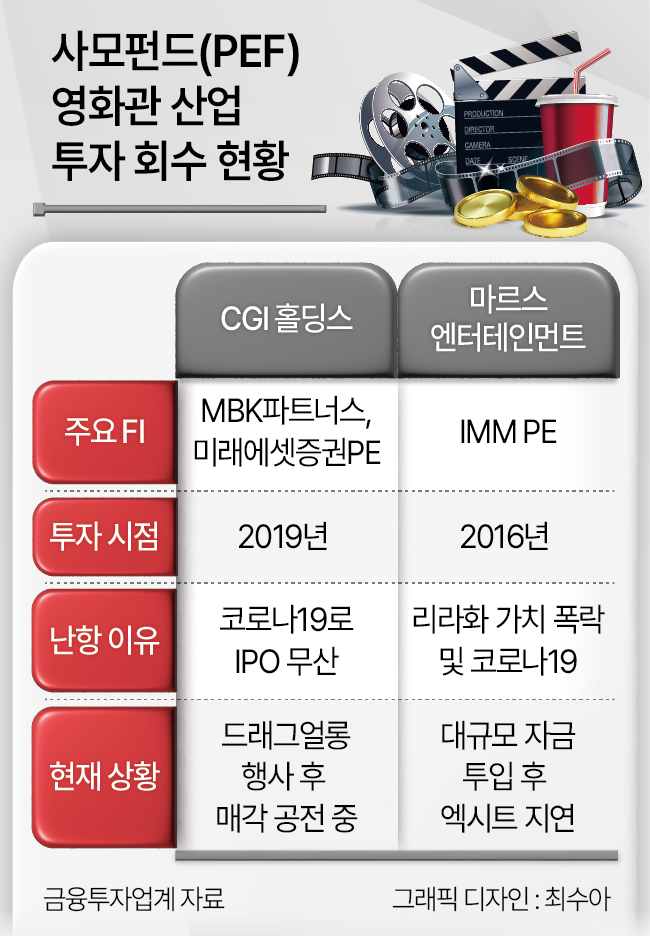
The experiences of CGI Holdings and MARS Entertainment illustrate how thoroughly the theater sector's structural headwinds have neutralized even the most aggressive contractual protections available to investors.
Surviving the deep freeze: the path back runs through IP
Not every door is shut. Even in the current chill, companies that have successfully restructured their operations are finding new opportunities.
The industry's cold-eyed consensus is that only studios capable of building proprietary IP and exercising tight control over production costs will ultimately survive. Because that goal is difficult to achieve quickly, however, there are growing concerns that the content industry's winter could last longer than anyone expected.
"This year will be the point at which financial investors in K-content-related businesses hit the limits of their patience and exit pressure reaches its peak," one market insider said. "Once fund maturities start forcing investors to rush for the exits, sweeping industry restructuring and market consolidation will be unavoidable."
an@heraldcorp.com