
Pilot to launch at Daesin Parcel's Incheon terminal
Chaevi to handle design, operation and maintenance of chargers
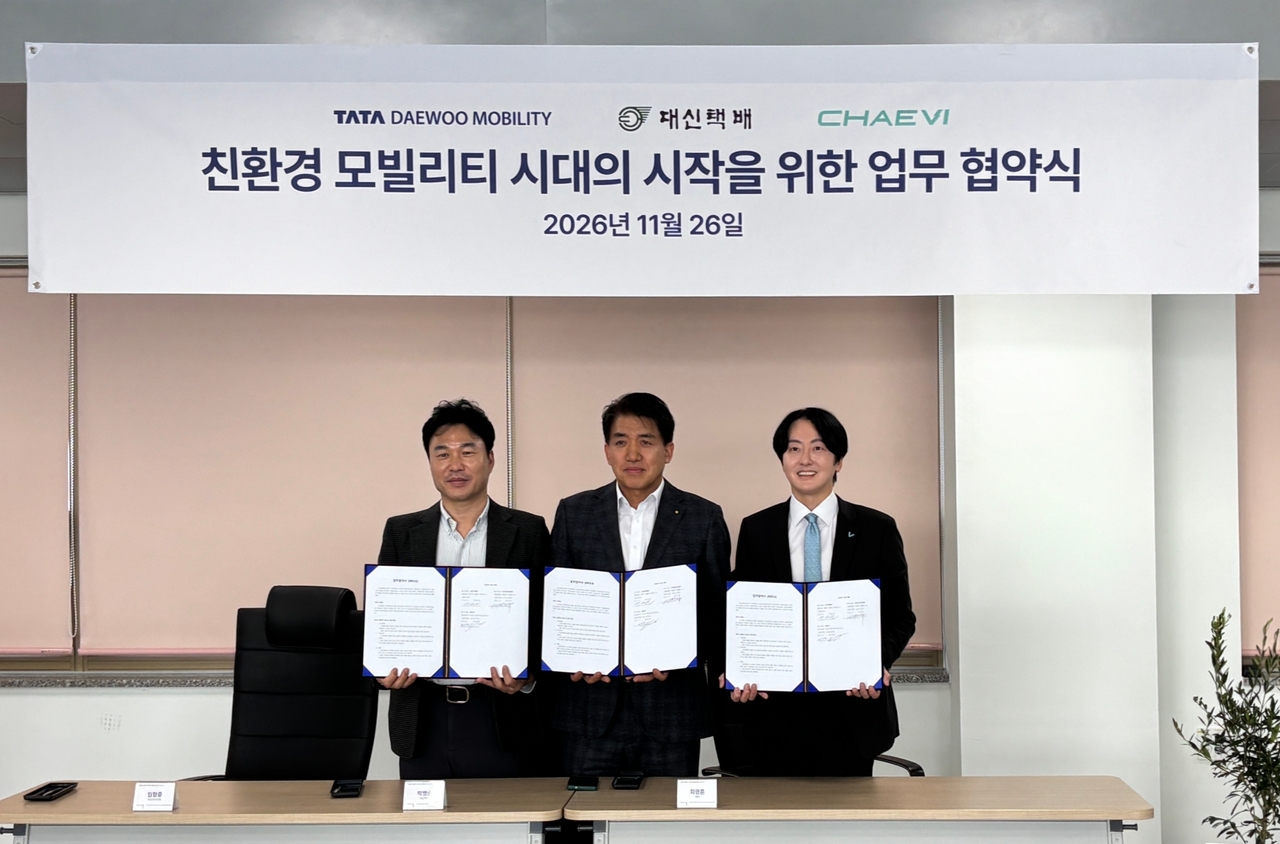
Chaevi, an electric vehicle fast-charging infrastructure operator, announced Friday that it has signed a memorandum of understanding with Tata Daewoo Mobility and Daesin Jeonggi Hwamul Jadongcha — known as Daesin Parcel — to expand commercial electric truck adoption and build out charging infrastructure.
The signing ceremony was held Thursday at Daesin Parcel's Incheon terminal and was attended by Chaevi Chief Executive Choi Young-hoon, Tata Daewoo Sales Chief Executive Im Hyung-joong, Daesin Parcel President Park Byung-kwon and other representatives from all three companies. The three parties will jointly pursue a shift to an eco-friendly logistics system built on electric vehicle charging infrastructure and solutions, beginning with a pilot operation of the first unit of the electric truck "Gissen" at the Incheon terminal.
Under the agreement, Chaevi will build customized charging infrastructure at logistics hubs and manage charging service operations. Tata Daewoo Mobility will supply its 2.5-ton Gissen electric truck and provide maintenance and parts support. Daesin Parcel will take the lead on introducing electric trucks and establishing the necessary charging environment.
During the pilot, Chaevi will analyze data on mileage, charging volume and charger usage to assess charging demand at each logistics hub. The company will also conduct a comprehensive review of vehicle routes and power supply conditions to determine optimal charger placement and output capacity. Chaevi will handle the entire process, from charger supply and installation through operation and maintenance.
Once the pilot is complete, the three companies plan to prioritize building charging infrastructure across 250 Greater Seoul locations. Over the long term, they aim to expand the project to 840 logistics hubs nationwide.
Chaevi said it expects the transition to electric freight vehicles at logistics sites to accelerate as revisions to the 2026 electric vehicle purchase subsidy program expand support for electric cargo trucks. Charging demand grows with longer routes, and available charging time varies depending on when vehicles return to base and when their next departure is scheduled, making hub-based charging infrastructure increasingly important, the company said. The partnership is expected to ease the charging burden for logistics firms adopting electric freight vehicles and speed up the transition.
On Nov. 9, Chaevi installed a 1.2 MW charging system at the Ansan branch of the Korea Electrotechnology Research Institute and began a pilot of ultra-fast charging aimed at cutting charge times for large electric trucks and electric buses. The company is also developing autonomous charging infrastructure based on a megawatt charging system as part of a government-funded project to automate Busan Port.
"This agreement is significant in that we are jointly building the charging environment at logistics hubs in step with the broader rollout of electric trucks," Choi said. "Chaevi will accelerate the logistics industry's transition to eco-friendly operations, expand our customer base, and develop large commercial electric vehicle charging as a new growth pillar."
Im said the delivery of the first Gissen unit and the three-way MOU represented "an important milestone that goes beyond simply introducing electric trucks to actual logistics sites — it establishes a cooperative framework linking vehicle supply, charging infrastructure and operational support." He added that Tata Daewoo Mobility and Tata Daewoo Sales would continue to supply eco-friendly commercial vehicles suited to customers' transport needs and expand the collaborative foundation to ensure stable operations.
eyre@heraldcorp.com




