PPP cites fiscal health concerns; Democratic Party calls for investment in future growth
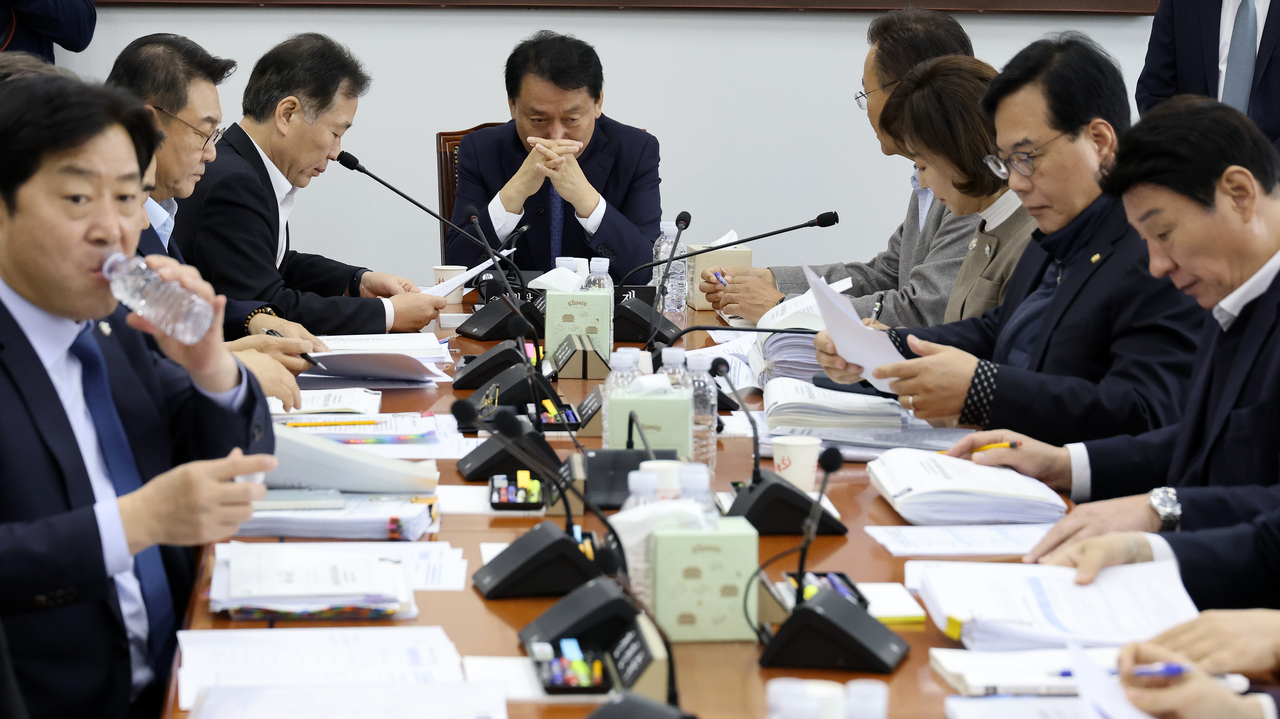
With less than a week before the Dec. 2 legal deadline to pass next year's budget, the ruling and opposition parties began reviewing the most contentious item — the proposed Future Response Fund — but only reaffirmed the depth of their differences. Clashes over everything from the fund's rationale to its financing mechanism and the appropriateness of individual projects left a string of related reviews in limbo.
The National Assembly's Budget and Accounts Committee convened its budget adjustment subcommittee Thursday to take up the Future Response Fund, a review that had been repeatedly deferred due to the wide gap between the two sides. The parties sparred over how to use surplus tax revenue, how to distribute funds to local governments, and the ceiling on self-directed changes to the fund's operating plan.
The People Power Party said the fund's reliance on surplus tax revenue could worsen fiscal health. It also opposed creating the fund on the grounds that allowing the government to unilaterally revise up to 30 percent of major fund expenditures without National Assembly approval would infringe on the legislature's budget oversight authority.
PPP lawmaker Na Kyung-won said there were concerns that the fund could become a "future-destruction fund" — one that creates new national debt and burdens future generations rather than paying down existing obligations when revenues are strong.
PPP lawmaker Song Eon-seog raised concerns about the fund's dependence on surplus tax revenue driven by a boom in the semiconductor industry. "According to data from the National Assembly Budget Office, there will be no surplus tax revenue from 2029," Song said. "Entrusting the entire fiscal program of the Republic of Korea to a single industry is as reckless as putting all your eggs in one basket."
PPP lawmaker Lee Jong-wook said the Future Response Fund was "a mechanism created by the Lee Jae Myung administration to spend money freely," adding that the 30 percent self-directed reallocation ceiling "makes no sense at all." "Can the National Assembly really not stop the government from doing whatever it wants with 13 trillion won?" Lee said.
The Democratic Party of Korea, by contrast, said surplus tax revenue should be used not only to pay down national debt but also to invest in future growth engines, and stressed the need to establish the fund.
Democratic Party lawmaker Lee Yeon-hee said it was "very important to repay debt while also investing some in future growth engines," arguing the fund could serve as a kind of "dam" for fiscal stabilization. Fellow Democratic Party lawmaker Kim Seong-hoe said "a budget is needed to spend on nurturing future industries, including AI."
Democratic Party lawmaker Park Ji-won said that if the opposition's proposed 50 percent of surplus tax revenue were used to retire government bonds on the open market, it could shock the bond market. "The consolidated fiscal balance is in surplus to a degree rarely seen, yet this is not widely known," Park said. "Full repayment or 50 percent repayment is excessive."
The gap between the two sides did not narrow during the review of individual projects. The PPP called for cuts across all projects, citing concerns about the sustainability of funding and potential overlap with existing programs. The Democratic Party emphasized the necessity of each project, and reviews were deferred one after another.
Particularly contentious was the budget for the Gwangju-South Jeolla Province integration initiative, including 3.5 trillion won ($2.6 billion) in regional future growth grants.
PPP lawmaker Yoo Sang-bum, who leads his party's side on the budget committee, said the regional future growth grants would amount to double support for Gwangju and South Jeolla Province, which are already set to receive 3.5 trillion won in special grants. "If Gwangju and South Jeolla are included again, other local governments — already frustrated by smaller local fiscal allocations — will not accept another round of distributions to the same region," Yoo said.
In response, Democratic Party lawmaker Jeon Jin-suk said the Gwangju-South Jeolla integration involved many difficulties but was a decision made in the broader national interest, and that the 5 trillion won incentive was a commitment. "To say that because 5 trillion won is going in, it is wrong to provide funding for other matters — that really does not hold up. If anything, the amount should be increased," Jeon said.
Na rebuffed that argument, saying the concern was not about withholding funds from the Honam region but about the support being excessive and duplicative.
Debate also continued over projects under the Ministry of Science and ICT's purview, including support for AI-focused universities. The PPP said it was inappropriate to place projects requiring sustained fiscal input into the Future Response Fund — which depends on surplus tax revenue — and called for them to be moved to the general account.
Na said that while one-time projects could be placed in the Future Response Fund, there was no reason to include ongoing programs, and called for them to be returned to the general accounts of the relevant ministries.
Lee pushed back, saying the absence of additional tax revenue and the depletion of the Future Response Fund were separate issues, and urged the government to manage the fund in a stable manner.
mp1256@heraldcorp.com