Gifting shares in a downturn: a strategy worth considering
For listed shares, the assessed value is the average closing price over two months before and after the gift date
Watch out for 'immediate sale after receiving a gift' — it can cost you on capital gains
Sell within a year and the parent's original purchase price applies to the gain calculation
Housing, food, transportation — money seems to drain away just by breathing. But there is one more expense quietly embedded in everyday life: taxes. Owning even a single apartment now means thinking about inheritance and gift taxes. There is no need to panic, though. Reading through neighbors' real-life cases — even ones that seem to have nothing to do with you — will naturally reveal tax-saving hints you can apply to your own situation. Drawing on consultations with tax experts, this column, "Your Tax Questions Answered," breaks down the tax dilemmas of daily life in plain language.
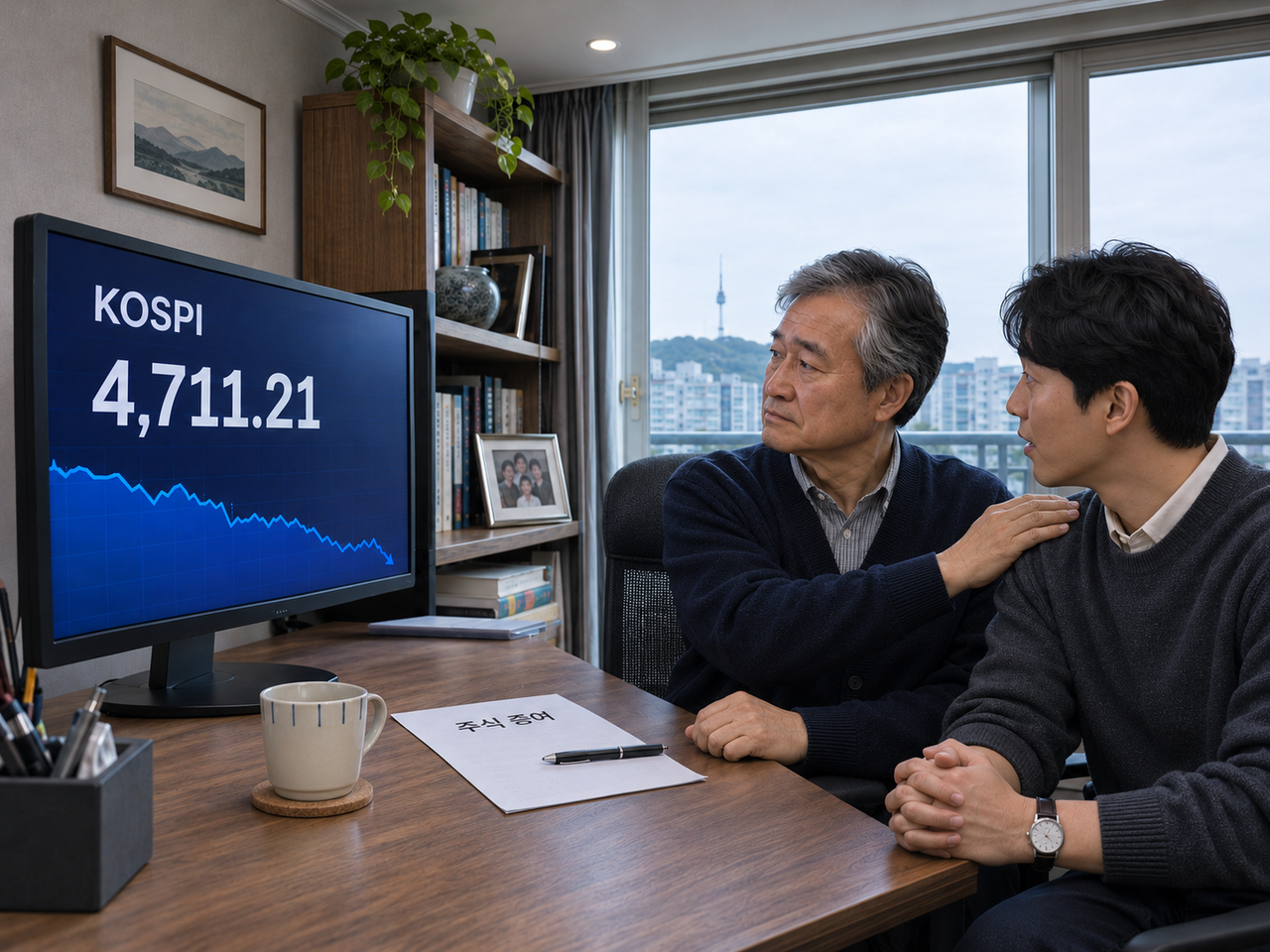
I've heard it's better to gift shares when the price is down — how much could I actually save in my situation?
The Kospi has slipped below the 5,000 mark. Na Se-sang (a pseudonym), a 61-year-old manufacturer preparing for retirement, opened a brokerage account and reached for a calculator. A portfolio of listed shares that had once been worth 1 billion won ($744,000) had shrunk to 600 million won. The loss stung, but it also sparked a thought: these were shares to be passed on to a daughter anyway. If the transfer was going to happen eventually, why not do it now — while prices were down — and save on gift tax in the process.
That raised another question about a separate holding: shares in Company B, an unlisted manufacturer the family runs. Those shares were valued at around 1 billion won. Na wondered whether arranging an over-the-counter transaction at 300 million won would allow that lower price to serve as the basis for gift tax when the shares were eventually transferred to a son.
Tax accountant Kim Hye-ri, a former National Tax Service official known as "National Tax Sister," walked through the tax issues to watch when gifting both listed and unlisted shares.
Q. People around me say to gift shares to children when prices are down. Why is a market downturn seen as a gifting opportunity?
A. When share prices fall, the tax-assessed value of the shares decreases, which can reduce the gift tax burden.
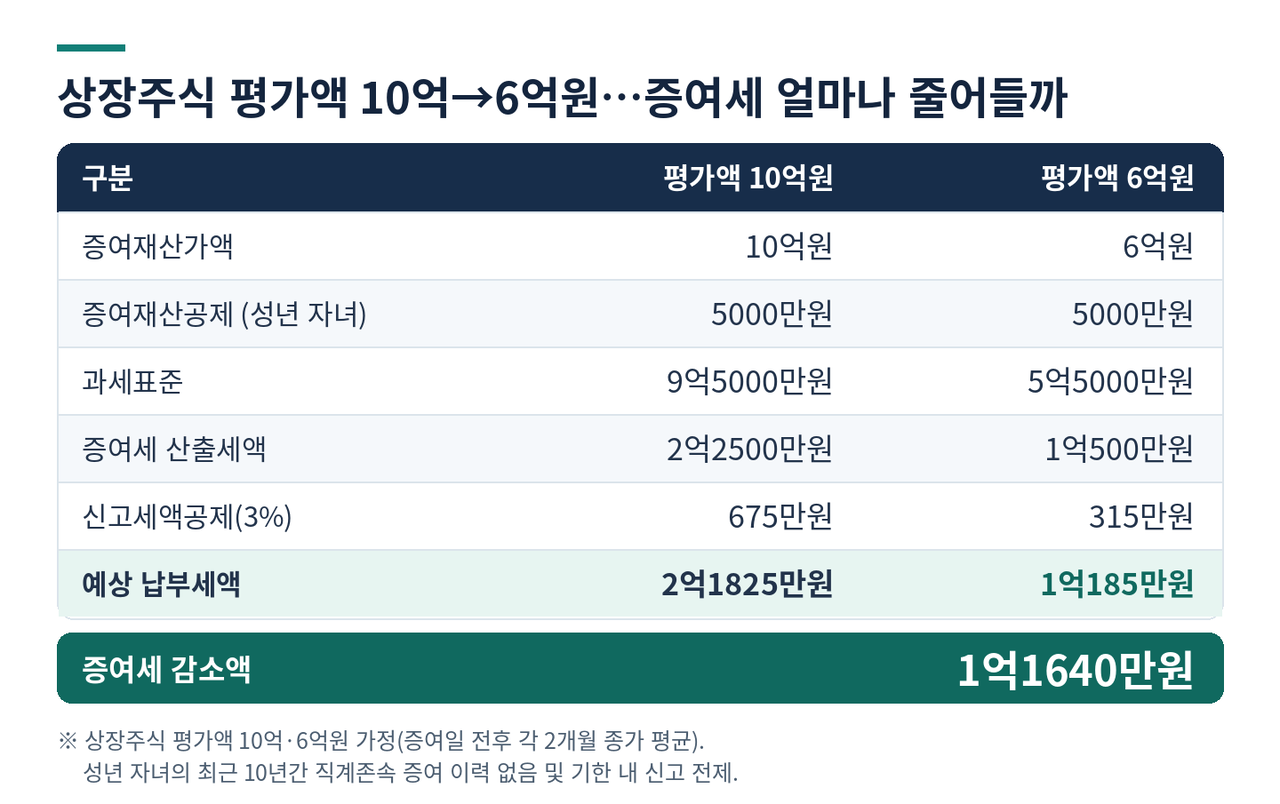
Suppose the tax-assessed value of the shares Na plans to give a daughter drops from 1 billion won to 600 million won. Assume the daughter is an adult and has received no other gifts from parents or other direct lineal ascendants in the past 10 years, so she qualifies for the full 50 million won deduction.
At an assessed value of 1 billion won, the calculated gift tax is 225 million won. Filing on time and claiming the 3 percent filing deduction brings the amount payable down to 218.25 million won. At 600 million won, the calculated tax falls to 105 million won, and the amount payable after the filing deduction is 101.85 million won. The difference between the two scenarios is a striking 116.4 million won.
Q. So if I gift shares on the day prices crash, is the gift tax calculated using that day's closing price?
A. No, it is not.
For domestically listed shares, the standard valuation method averages the closing prices over the two months before and after the gift date. Even if shares are transferred on a day when prices have plunged, if prices were high during the two months prior, the tax-assessed value may still exceed what the closing price alone would suggest. Any rebound within two months after the gift date also feeds into that average.
Even if Na transfers shares on Thursday after seeing a 600 million won balance in the account, the assessed value used to calculate gift tax will not be known until two months later. Gift tax must be reported and paid within three months of the last day of the month in which the gift was received.
Q. In that case, couldn't you achieve the same effect with unlisted shares simply by arranging transactions among executives and employees at a low price?
A. The two situations are entirely different.
A market decline in listed shares reflects price movements formed through transactions among a large number of investors. By contrast, if a specific party deliberately drives down the transaction price of unlisted shares and then uses that price as the basis for a gift to a child, the tax authorities may refuse to recognize it as a legitimate market price.
If shares with a genuine value of 1 billion won are reported at an artificially created price of 300 million won, the National Tax Service can reassess the gift using 1 billion won as the market price and recalculate the gift tax accordingly.
Q. Company B's shares are listed on an over-the-counter platform with asking prices posted. Even if an actual transaction takes place at that price, could it still fail to qualify as a recognized market price for tax purposes?
A. Yes. Even when a transaction actually occurs on an over-the-counter platform, tax authorities examine how that price was formed. They look at whether the parties traded freely of their own accord, whether the transaction volume was sufficient, and whether any specific party steered the price. This is precisely why a nominal par value or an arbitrary over-the-counter asking price alone is not enough to determine the value of unlisted shares.
Particularly if the counterparty acted on instructions from one side, or if repeated transactions were used to artificially suppress the price, the National Tax Service can disregard those transaction prices and reassess the gift property value. For unlisted shares, authorities first examine whether there are arm's-length transaction prices that can serve as market value; if no qualifying transactions exist, they apply the supplementary valuation method under the Inheritance Tax and Gift Tax Act.
Consider a case where unlisted shares with a genuine market value of 1 billion won are gifted to a child using an artificially created transaction price of 300 million won. If the National Tax Service recognizes the market value as 1 billion won, the assessed gift property value rises by 700 million won. Applying the same assumptions as before — an adult child claiming the full 50 million won deduction — the calculated gift tax could jump from 40 million won to 225 million won.
There have in fact been cases this year where taxpayers who artificially lowered over-the-counter transaction prices before making a gift were later hit with back taxes.
In one case, the child of a listed-company owner arranged for executives and employees holding shares in unlisted Company B to repeatedly trade those shares on an over-the-counter platform at below-market prices, pushing the share price down to roughly one-third of its actual value. The owner and spouse then used that suppressed price to value Company B shares for gifts to the child and others.
After the ownership transfer, it also emerged that the listed company controlled by the owner had lent funds to Company B at a below-market interest rate. The National Tax Service levied gift tax on the recipients and assessed corporate tax and other charges against Company B.
Q. If a low valuation is reported and the tax is later recalculated, are penalties also added? What should you do if you discover an error after filing?
A. If capital gains tax or gift tax is underreported as a result of improperly understating the market value, penalties beyond the principal tax can apply — including an underreporting penalty and a late-payment penalty at an annual rate of 8.03 percent.
The standard underreporting penalty of 10 percent and the fraudulent-act underreporting penalty of 40 percent — or 60 percent for fraud involving offshore transactions — differ in their rates and the criteria for applying them. Not every below-market transaction is automatically treated as fraud, but the risk rises sharply if the transaction price was deliberately manipulated.
If an error is discovered, the taxpayer should gather the transaction contract, share valuation materials, shareholder register and share transfer records, and payment documentation, then assess the feasibility of filing an amended return and the resulting tax liability. Because the availability of penalty reductions depends on the timing of the amended filing and whether a tax audit has already begun, acting quickly is essential.
Q. If shares in listed Company A and unlisted Company B are each sold separately, how does the capital gains tax treatment differ?
A. Capital gains tax on shares is levied on the profit earned from selling them.
Not all share transactions are taxed the same way, however. Ordinary minority shareholders trading domestically listed shares on a regulated exchange are generally not subject to capital gains tax. By contrast, a major shareholder of a listed company who sells shares — or any shareholder, even a minority holder, who sells outside the exchange — may be subject to tax.
Unlisted shares are generally subject to capital gains tax. There is an exception, however, for shares in small and medium-sized enterprises traded on the K-OTC market where the seller meets the minority shareholder criteria. The tax treatment of unlisted shares therefore cannot be assumed to be uniform. The trading venue, company size, ownership stake, and the status of the parties involved all need to be verified.
Q. If a child sells gifted shares immediately, can the gift-date assessed value be used as the acquisition price?
I ask because it seems like gifting shares that a parent bought cheaply long ago — and having the child sell right away — would also help reduce the capital gain.
A. This is an area where a recently amended rule requires particular caution. For shares and similar assets gifted by a spouse or direct lineal relative on or after Jan. 1, 2025, if the recipient sells within one year, a carryover taxation rule applies under certain conditions — meaning the donor's original acquisition price is used to calculate the gain.
Suppose a parent purchased shares for 100 million won, and those shares are gifted to a child when their tax-assessed value is 600 million won.
If the child sells the shares six months later for 650 million won, using the gift-date assessed value as the acquisition price produces a gain of 50 million won. But if the carryover rule applies and the parent's acquisition price of 100 million won is used instead, the gain rises to 550 million won. Before deducting necessary expenses, the 500 million won appreciation that accrued while the parent held the shares is folded into the child's gain calculation.
In practice, the gift tax paid on those shares is factored in as a necessary expense when filing. If the carryover rule applies but the child still reports the gift-date assessed value as the acquisition price, the capital gains tax will be understated. The National Tax Service added a carryover taxation notice to the Hometax filing screen this year to help reduce such errors.
Q. What should be checked first, and what documents should be prepared, when transferring an unlisted company's shares to a child?
A. The first step is to objectively confirm the true market value of the shares and the purpose of the transaction. This means compiling a valuation report for the unlisted shares, records of recent arm's-length transactions, the shareholder register and share transfer history, contracts, and documentation of payment and the source of funds. In transactions between family members, evidence that substantiates the economic reality of the deal matters far more than a contract alone.
Second, the tax implications for the transferor, the recipient, and the company itself should each be examined separately — not treated as a single transaction. Third, succession of management control and tax reduction must be kept distinct. Legitimate advance gifting and business succession support programs are worth exploring, but manipulating prices is not tax planning — it is an act that increases the risk of back-tax assessments.
By Yu Hye-rim and tax accountant Kim Hye-ri, deputy head of HKL Tax Corporation

forest@heraldcorp.com