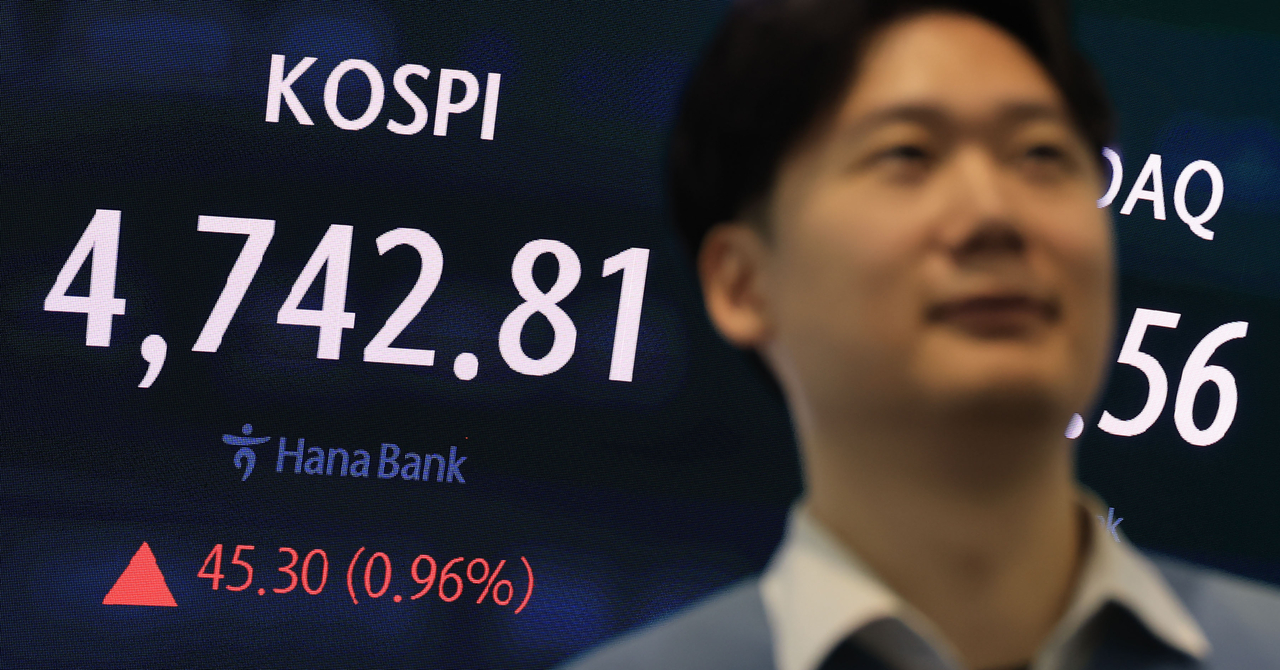
As discussions over forming a 10 trillion won ($7.44 billion) market stabilization fund gain momentum, attention is turning to the potential synergy with share buybacks by companies such as Samsung Electronics and SK hynix. Analysts say the fund's size alone may not be enough to offset the broad downward pressure on the market — including sustained foreign selling — and that corporate buyback capacity must also be mobilized for stabilization measures to take effect. Focus is also on how the relaxed daily buyback limit will affect SK hynix's remaining purchase plan, and on the additional shareholder return program Samsung Electronics is expected to detail by late January next year.
According to the financial investment industry on Thursday, SK hynix is pursuing a 20 trillion won share buyback, and Samsung Electronics is set to follow with a concrete additional shareholder return plan by late January next year. Samsung's remaining shareholder return resources are estimated at 55 trillion to 75 trillion won, with securities analysts projecting actual share buyback and cancellation at between 10 trillion and 20 trillion won.
Share buybacks by Samsung Electronics, SK hynix and other companies are drawing renewed attention alongside the financial authorities' decision to ease daily buyback limits as part of market stabilization measures. The expectation is that if the stabilization fund's direct market purchases and corporate buybacks proceed at the same time, they can reinforce overall supply and demand while also easing downward pressure on large-cap semiconductor stocks, which account for a significant share of the domestic market's total capitalization.
The Financial Services Commission held its regular meeting Monday and decided to relax the daily buyback order limit for listed companies from Tuesday through Feb. 23 next year. Under the measure, companies may now purchase in a single day the full number of shares they have reported acquiring. Previously, the daily order limit was capped at the higher of 10 percent of the reported acquisition volume or 25 percent of the average daily trading volume in the month before the board resolution, and single-day purchases could not exceed 1 percent of total shares outstanding.
The measure allows companies to accelerate the execution of existing buyback plans or adjust the timing of purchases depending on market conditions. Companies already conducting buybacks — such as SK hynix — can speed up the execution of their remaining allotments, and Samsung Electronics' additional shareholder return program next year also falls within the relaxed limit period.
A similar easing in March 2020 also raises expectations for the current measure's impact. In the three months immediately following that earlier relaxation, the number of Kospi- and Kosdaq-listed companies disclosing share buybacks jumped roughly 1.9 times compared with the preceding three months.
However, given that companies have finite buyback resources, boosting corporate participation is essential. From a company's perspective, placing large bulk orders at once raises the average acquisition price, increasing the cost burden. The time required for board resolutions and disclosure procedures must also be factored in.
Among the incentives being discussed to encourage corporate participation is a plan to use policy funds to concentrate purchases in companies with strong shareholder return track records. One proposal calls for investing in value-up related indexes that reflect shareholder return capacity. Rather than spreading limited policy funds evenly across a broad market index, concentrating them in companies with strong records of dividends or share cancellations would support those companies' supply-demand dynamics while also giving other companies an additional reason to expand shareholder returns.
Park Se-yeon, a researcher at Hanwha Investment & Securities, said the key issues are balancing investment with highly liquid benchmark indexes and ensuring fairness in stock selection, but added that "if policy funds buy companies that pay dividends or cancel shares, we believe that gives companies one more reason to increase shareholder returns."
The Korea Value-up Index, developed domestically to encourage corporate value enhancement, is a leading example. Korea Exchange launched it in September 2024. It selects 100 stocks based on a comprehensive assessment of market capitalization, profitability, whether a company has paid dividends or canceled shares for two consecutive years, and capital efficiency.
Japan offers a nearby precedent for concentrating policy funds in companies with high capital efficiency. When the Bank of Japan expanded monetary easing in October 2014, it raised its annual exchange-traded fund purchases from 1 trillion yen ($6.28 billion) to 3 trillion yen and added ETFs tracking the JPX-Nikkei 400 — an index that incorporates corporate capital efficiency metrics such as return on equity — to its list of eligible assets.
Analysts also say that if Samsung Electronics and SK hynix continue to expand shareholder returns, it could ultimately help resolve the Kospi's chronic undervaluation. Improved capital efficiency relative to corporate profitability would give the market room to assign higher price-to-book ratios. Ha Jang-kwon, a researcher at Hanwha Investment & Securities, said the forward return on equity currently priced into the Kospi stands at about 9 percent — roughly one-third of the market consensus estimate of around 27 percent — and that "if the shareholder return effect from Samsung Electronics and SK hynix is properly reflected, the Kospi's forward ROE should rise by 1.8 to 2.8 percentage points."
kacew@heraldcorp.com