South Gyeongsang Province held a completion ceremony Thursday; total project cost 1.4 billion won
Solar panels covering 6,024 square meters on an expressway slope generate 997 kilowatts
Revenue to fund welfare programs, with a portion returned to residents as dividends
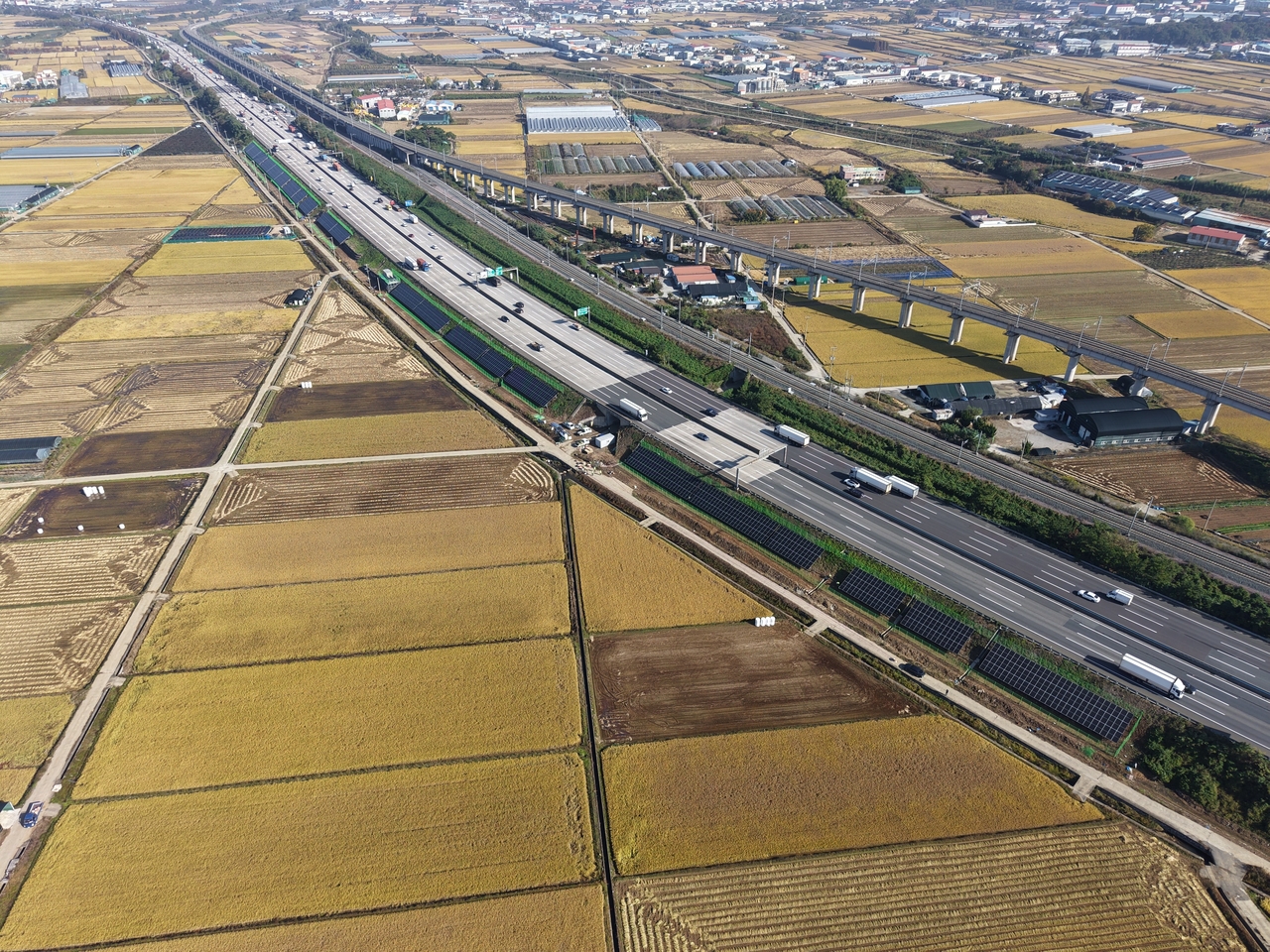
Chojeon village in Jillye-myeon, Gimhae, South Gyeongsang Province, has been completed as the nation's first "sunshine income village" — a rural renewable energy model in which residents form a cooperative, build a power plant on idle land and channel electricity sales revenue back into community welfare and household income.
South Gyeongsang Province held the completion ceremony in Chojeon village on Thursday. About 100 people attended, including Ministry of Interior and Safety Minister Yun Ho-jung, South Gyeongsang Province Innovation and Growth Vice Governor Choe Man-rim, Gimhae Mayor Jeong Yeong-du, provincial assembly member Ha Seon-yeong, and officials from the Korea Expressway Corporation and Korea Electric Power Corp., along with village residents.
The sunshine income village program installs solar power facilities of 300 to 1,000 kilowatts on idle village land and distributes the proceeds among the community. The Chojeon Sunshine Income Village Cooperative leased 6,024 square meters of expressway slope owned by the Korea Expressway Corporation and completed a 997-kilowatt power plant on the site.
The total project cost was 1.4 billion won ($1.04 million). Financing covered 85 percent of installation costs, or 1.19 billion won, while the remaining 15 percent — 210 million won — came from village funds and other resources. Provincial officials said more than 70 percent of the village's roughly 270 residents consented to the project.
Under the cooperative's bylaws, electricity sales revenue will first go toward statutory reserves, loan principal and interest repayments, maintenance costs and ancillary energy project expenses. The remainder will fund welfare programs — including communal meals, care services, a community taxi service, support for residents seeking caregiver and care worker certifications, and cultural classes — with any surplus distributed as resident dividends or held in discretionary reserves. The cooperative will also hire full-time staff to handle operations, accounting and management.
Chojeon village secured the national first-place distinction through swift action by its residents. After learning about advanced cases from other local governments at a training session in March, the village developed a concrete plan to use the expressway slope. Residents passed a resolution at a special village assembly on May 9 and established the cooperative, then filed a conditional application with the Korea Expressway Corporation before a formal lease contract was signed on May 29. A lease agreement was concluded with the corporation on July 28, and the village was selected for immediate implementation just two days later. Construction began Sept. 28, and the project cleared a pre-use inspection Nov. 9 and completed a power supply contract with Korea Electric Power Corp. on Nov. 19.
Park Ju-byeong, the village chief and cooperative chairman, said the project gained momentum thanks to the residents' decision to commit village funds and the swift land lease process. "We will operate the cooperative so that the revenue flows back into resident care and community vitality," Park said.
South Gyeongsang Province secured immediate implementation approval for nine villages in the first and second rounds of applications — the most of any province nationwide — through on-site consulting support, and plans to provide phased support to 32 conditionally approved villages and newly interested communities. Vice Governor Choe said the project marks "a turning point in returning energy created by residents as income and welfare," adding that the province would expand support to help it take root as a stable income base for rural communities.
ook967@heraldcorp.com