- Kim Hwi-dong of KITECH publishes findings in Nature as lead author
- Manganese overcomes hot-electron energy loss, enabling long-range travel
- Findings open path to solar hydrogen, ultrafast photodetectors and quantum sensors
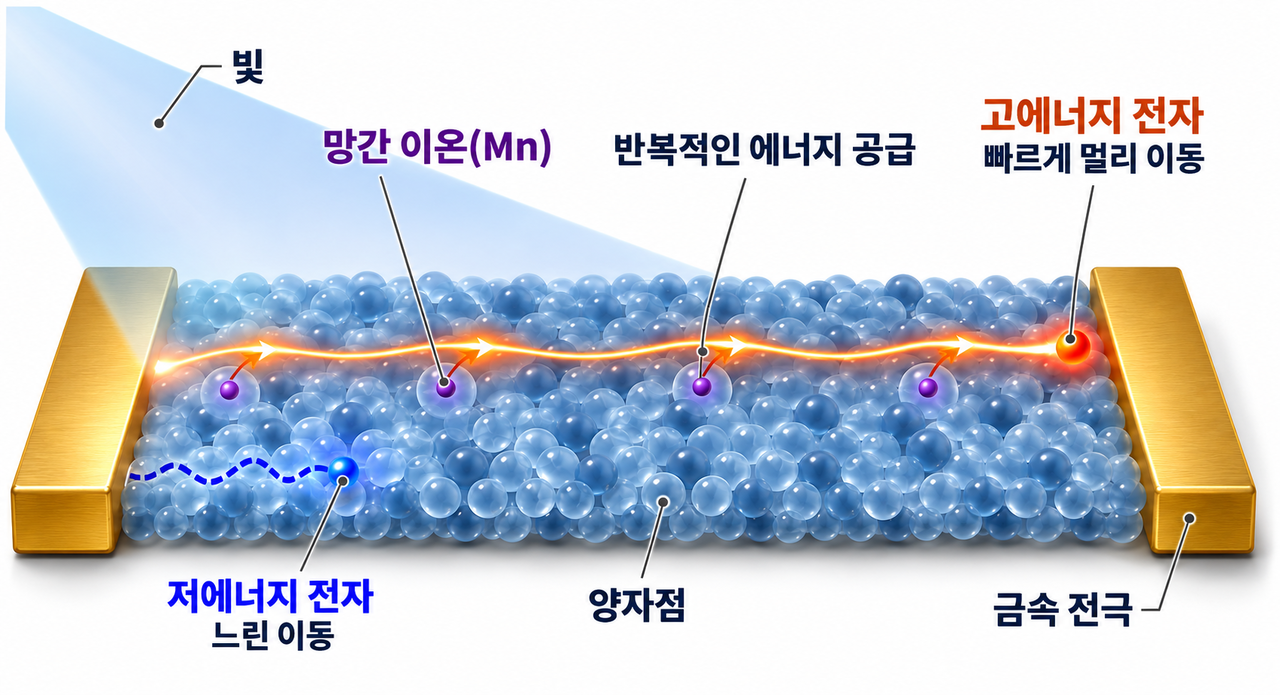
Researchers have developed a technique that continuously replenishes the energy of high-energy electrons inside semiconductors — particles that normally shed their energy almost instantly — allowing them to travel far greater distances. Much like an aircraft extending its range through aerial refueling, the method repeatedly recharges electrons with energy, boosting their mobility roughly 10-fold compared with conventional approaches.
The Korea Institute of Industrial Technology said the findings, led by Senior Researcher Kim Hwi-dong as first author, were published Wednesday (local time) in Nature, the world's most prestigious scientific journal.
Quantum dots are ultrafine semiconductor particles just a few nanometers — billionths of a meter — in size. As a nanomaterial, they allow precise control over how light is absorbed and emitted depending on their size and structure.
When a semiconductor absorbs light carrying more than a threshold level of energy, it generates so-called hot electrons — high-energy electrons carrying surplus energy. Harnessing that energy could dramatically improve the efficiency with which light is converted into electricity or chemical energy.
The problem is that hot electrons shed their surplus energy as heat within just a few picoseconds — trillionths of a second. Moving them to a desired location before that energy is lost has long been one of the most stubborn unsolved challenges in the field of photoelectric materials and devices.
The research team found a solution by doping quantum dots with manganese. Manganese ions absorb light and store energy, then repeatedly transfer that energy back to hot electrons, keeping them in a high-energy state.
The team confirmed that this recharging process occurs continuously as electrons move through a quantum dot thin film. They also identified the underlying mechanism as the spin-exchange Auger effect.
In experiments, hot electrons in manganese-doped quantum dot thin films showed a mobility of about 150 square centimeters per volt-second at room temperature — roughly 10 times higher than the 10 to 20 square centimeters per volt-second recorded in conventional high-performance quantum dot thin films.
The elevated mobility was sustained for about seven nanoseconds, and the estimated travel distance reached approximately 0.15 millimeters — far enough for electrons to pass through more than 10,000 quantum dots in succession.
The study is significant because it proposes a new materials-design principle that makes it possible to harness high-energy electrons previously lost as heat in conventional quantum dot devices.

Kim conducted the research with the team of Dr. Victor Klimov at Los Alamos National Laboratory in the United States, where Kim was previously based. Since joining the Korea Institute of Industrial Technology in 2021, Kim has been pursuing follow-up research to apply the core technology to industrial settings.
Current work includes applying hot electrons generated in manganese-doped quantum dots to water-splitting reactions to improve the efficiency of solar-based hydrogen production through photocatalysis. The team is also developing highly sensitive quantum sensors capable of detecting individual photons, the smallest unit of light.
"If previous research was about paving better roads so cars could go faster, this research is about getting electrons — which used to cool down almost immediately — airborne like a plane, with manganese acting as the aerial refueler to keep them flying far," Kim said. "Building on this new materials-design concept that achieves both high energy and high mobility at the same time, we will focus on commercializing next-generation devices and energy technologies, including photocatalysts for solar hydrogen production, ultrafast photodetectors and high-sensitivity quantum sensors."
nbgkoo@heraldcorp.com