
Korea Labor Foundation holds 2026 Labor Rights Conference
Forum addresses protections for special-type, platform and freelance workers
Calls grow for worker presumption regime to fix misclassification
Public-private network 'Nodong Gwonrie-eum' set to launch
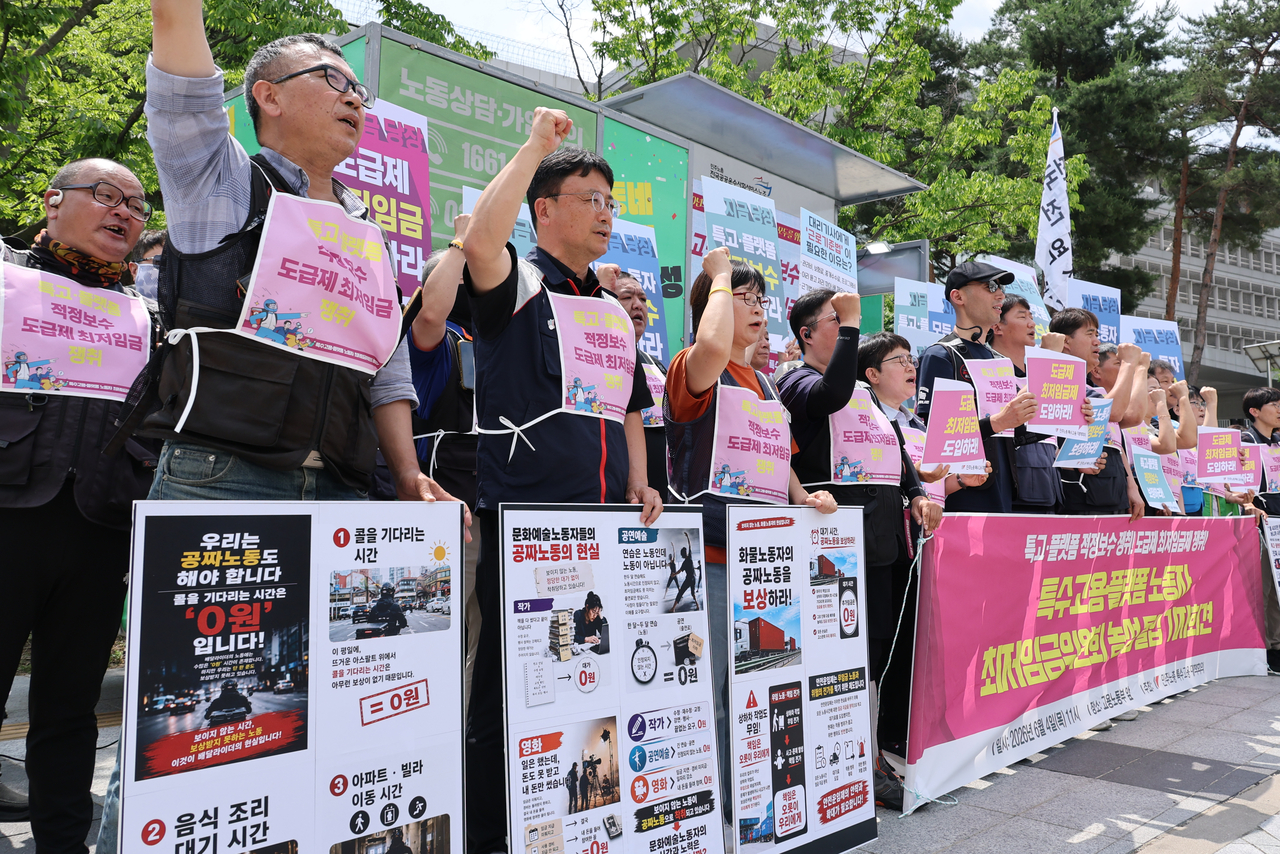
The government is moving to accelerate legislation that would guarantee basic labor rights for all working people — including delivery riders, broadcast writers and translators — regardless of their employment type.
Plans include enacting a "Basic Law for Working People," establishing a K-Labor Welfare Council to support vulnerable workers, and introducing an income-based employment insurance system.
The Korea Labor Foundation held the 2026 Labor Rights Conference "Work Next" on Thursday at Peace & Park Convention in Yongsan-gu, Seoul. Hosted by the Ministry of Employment and Labor and co-organized by the Korea Labor Foundation and the Hankyoreh Economy & Society Research Institute, the event centered on the theme "The Basic Law for Working People: How Will Our Work Change?"
Employment and Labor Minister Kim Young-hoon said the government would "actively support National Assembly discussions toward the swift enactment of the basic law, so that all working people can be guaranteed minimum labor rights without discrimination, regardless of how they work." Kim added that the government would "push ahead without delay" on related tasks, including establishing the K-Labor Welfare Council and introducing income-based employment insurance.
Jung Heung-jun, a professor at Seoul National University of Science and Technology who delivered the keynote address, said that while the forms of work are diversifying — beyond traditional wage employees to include special-type workers, platform workers and freelancers — the legal framework to protect them remains inadequate.
Jung said enacting a basic law to protect the fundamental rights of all working people was necessary, and called for the introduction of a worker presumption regime to correct the "misclassification" problem, in which people working in genuinely subordinate relationships are denied protection under labor law because of the form of their contracts.
A panel discussion that followed brought together Kim Jong-jin, director of the Working Citizens Research Institute; Lee Nam-shin, co-representative of the Korea Non-Standard Workers Center; and Lee Joo-hee, a professor at Ewha Womans University. They discussed ways to build social consensus for guaranteeing the rights of all working people as universal rights, and how to strengthen regional labor rights protection delivery systems.
The conference also gave vulnerable workers a chance to share the difficulties they face on the job. Delivery riders, broadcast writers, translators, video-content freelancers and youth activists raised issues including unfair contract arrangements, unclear safety responsibilities, uncertainty in securing work, and workplace harassment and violations of personal dignity. A common thread was the lack of legal and institutional protections to fall back on when working people find themselves in hardship.
The Korea Labor Foundation also unveiled Thursday the new name for its public-private cooperation network for labor rights protection: "Nodong Gwonrie-eum." A public naming contest held Oct. 19 drew 2,170 participants who submitted a total of 3,385 name suggestions. The chosen name carries the meaning of connecting workers' rights and the support they need, and linking cooperation between the public and private sectors.
Park Jong-pil, secretary-general of the Korea Labor Foundation, said that while the ways people work and the forms of employment are changing rapidly, "the fundamental value that anyone who works should receive fair compensation for their work and be able to work safely and with dignity does not change." Park said the foundation would strengthen programs closely tied to the field "so that no working person is left in a blind spot when it comes to their rights."
fact0514@heraldcorp.com




