
First press conference since 'Tank Day' controversy
Operating losses narrowing after first-ever quarterly deficit in Q2
Holiday season seen as turning point; marketing and product teams merged
'Coffee house' concept to anchor push for quality growth next year
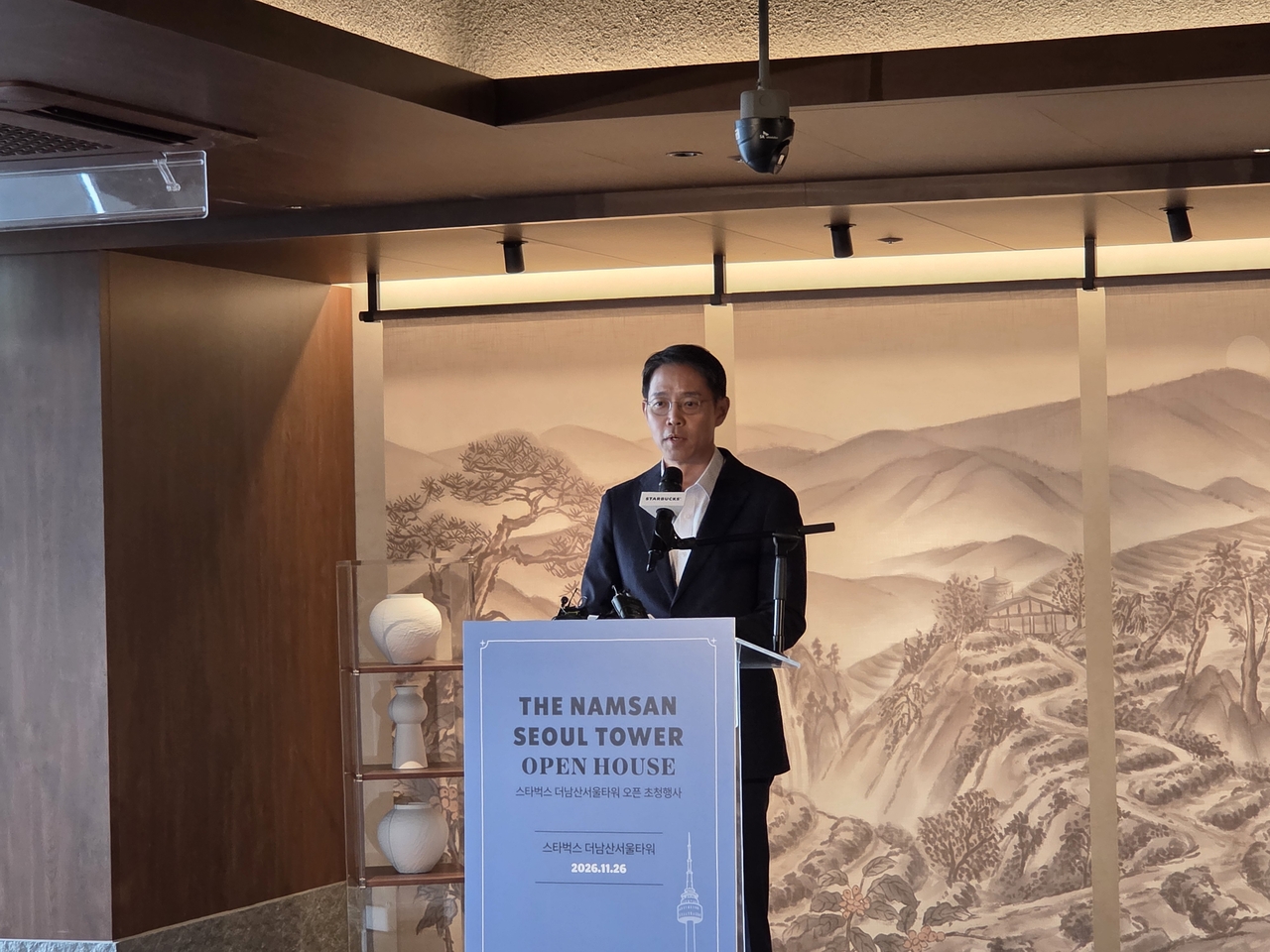
Starbucks Korea CEO Shin Dong-woo said Thursday that key earnings indicators have been improving in the second half of the year and vowed to return the company to profitability in the fourth quarter.
Shin made the remarks at a press conference held at N Seoul Tower in Yongsan-gu, Seoul, to mark the opening of the Namsan Seoul Tower store — the chain's 15th special store in South Korea. Spread across the fourth and fifth floors of N Seoul Tower and spanning about 990 square meters with more than 200 seats, the store reinterprets the spatial layout of a traditional Korean home — including the main gate, courtyard and sarangchae (outer quarters) of a hanok — in a contemporary style. The store officially opens Friday.
The press conference was the first Starbucks Korea had held in about nine months, since a February briefing on its new "Aeroccano" product. It was also the first such event attended by the company's CEO in about 12 years, since 2014. The gathering came after Starbucks Korea drew fierce public backlash in May over a marketing campaign run on the anniversary of the May 18 pro-democracy movement — an event critics dubbed "Tank Day."
In the aftermath, Shinsegae Group moved in June to stabilize management by appointing Shin — then an executive vice president overseeing support and finance at Shinsegae Property — as the new CEO.
"As the new CEO, I sincerely apologize to everyone who was troubled by the marketing issue that arose in May," Shin said at the press conference. "Starbucks Korea's employees have been working to immediately implement measures to prevent a recurrence of similar mistakes, while making the recovery of customer trust our top priority."
The fallout from the Tank Day controversy was severe. SCK Company, the operator of Starbucks Korea, posted an operating loss of 18.4 billion won ($13.7 million) in the second quarter of this year — its first quarterly deficit since entering the Korean market in 1999. Third-quarter sales fell 16.2 percent year-on-year to 679 billion won, while the operating loss widened to 45.3 billion won.
Performance has been gradually recovering in the second half, however. According to Starbucks, the year-on-year sales decline narrowed from 28 percent in June to 21 percent in July, 15 percent in August and 8 percent in September. Monthly operating losses also fell 46.2 percent, from 25.1 billion won in June to 13.5 billion won in September. Average daily sales and average daily customer visits in September were up 17 percent and 11 percent, respectively, compared with June.
Starbucks is looking to capitalize on the year-end holiday season to reverse its fortunes. In October, it launched its winter e-Frequency promotion a week earlier than last year. The company also restructured its organization to help rebuild trust, merging its marketing and product development functions to streamline communications, while strengthening teams responsible for digital customer experience and information security.
Starbucks Korea has set next year as the "inaugural year of quality growth." The company plans to shift away from an expansion-driven strategy centered on opening new stores, focusing instead on improving the competitiveness and operational efficiency of existing locations. It intends to roll out more store renewals under a "coffee house" concept emphasizing comfort, creating spaces where customers will want to linger.
"We know well that regaining customer trust is not something that can be achieved quickly or by simply repeating the old ways," Shin said. "But I believe that if we build on the potential Starbucks Korea has accumulated over the past 27 years, and continue our efforts to change alongside our roughly 24,000 partners, we will be able to earn the understanding of more customers."
korean@heraldcorp.com




