
Online delivery halted Thursday; all stores to close Friday
Management says letter of intent received; union disputes claim
E-mart, Lotte Mart set for fiercer two-way battle
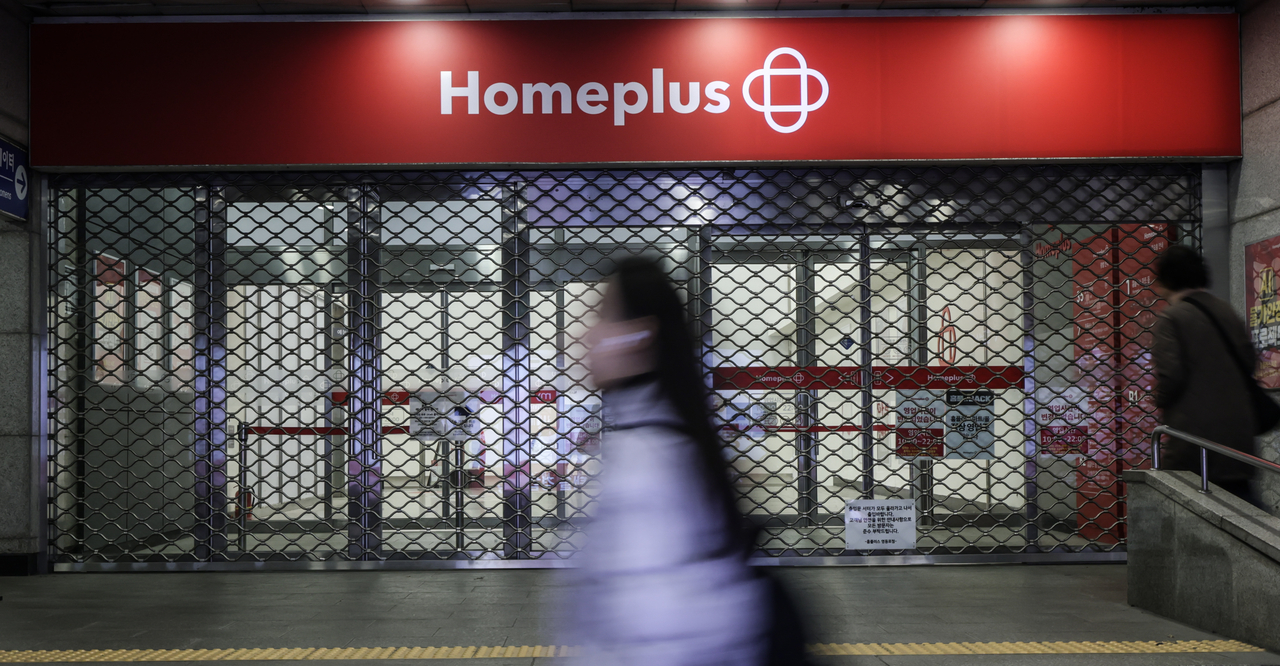
Homeplus, struggling with a severe cash crunch while under court receivership, has once again resorted to shutting its doors. Additional funding is seen as virtually impossible until a new buyer emerges, and the company has said it will suspend operations until a merger and acquisition deal is finalized, leaving the timeline for any resumption of business deeply uncertain.
Homeplus halts online and in-store operations as emergency loan runs dry
Homeplus suspended its online delivery service Thursday and will halt operations at its headquarters and all retail stores starting Friday. All 67 currently operating stores are affected. The closures come just 106 days after the retailer reopened following a 200 billion won ($149 million) emergency debtor-in-possession loan in August.
In an internal notice issued Wednesday, Homeplus said a prolonged drop in sales triggered by product supply problems had left it without sufficient funds to purchase inventory for store operations. It said it would temporarily suspend its retail business starting Friday, pending the completion of an M&A deal.
The Homeplus app, its online delivery platform, is already effectively dormant. The app's layout and product listings remain intact, but purchases are no longer possible. Clicking on an item no longer shows a "Buy" button — only a "Sale ended" notice appears in its place.
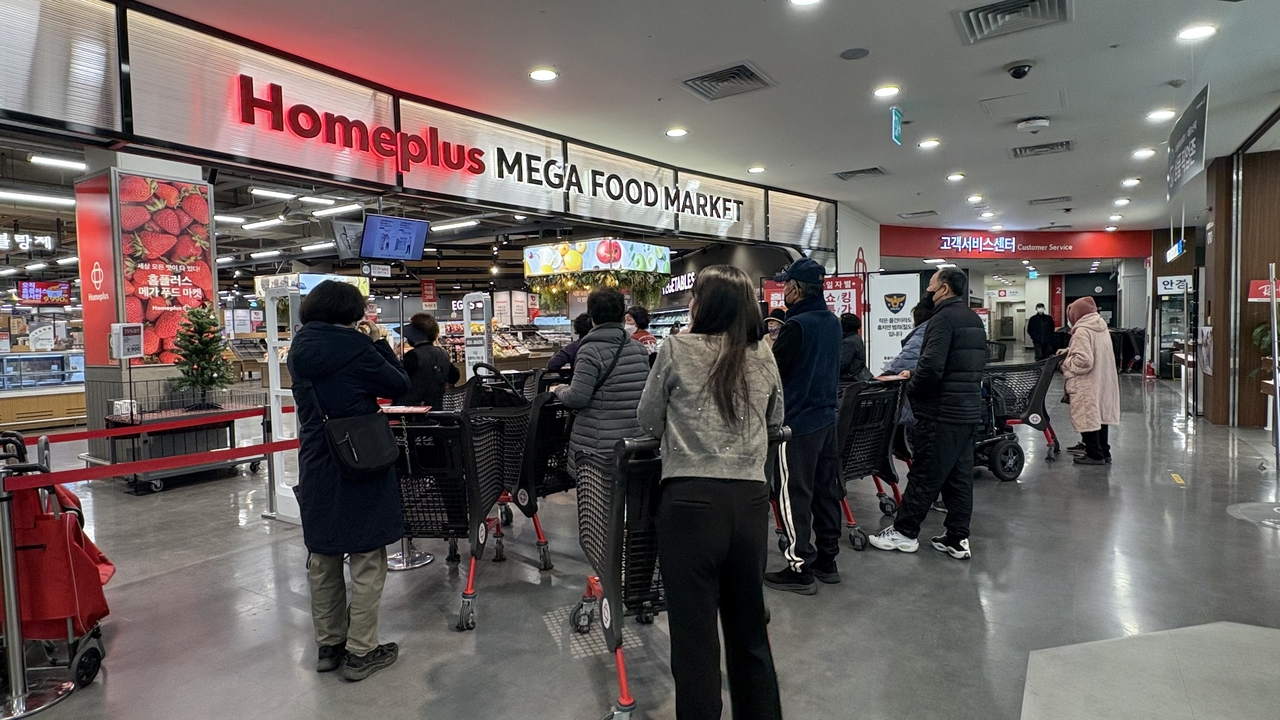
Conditions at physical stores are similarly bleak. At the Gangseo branch — one of the last stores open before the temporary closure — shelves near the checkout counters were the only areas with any stock on the final trading day Thursday. Fresh produce was nearly impossible to find, with displays limited mostly to everyday essentials such as disposable chopsticks, face masks and frying pans. About 20 customers who arrived before the 10 a.m. opening said they hoped the store would not disappear for good.
The latest shutdown had been widely anticipated. Homeplus had already been struggling to pay utility bills, including electricity, due to liquidity pressure, while dwindling product supplies made normal store operations increasingly difficult. Wage arrears have also mounted. Employees received only 25 percent of their September pay and have yet to receive their October and November salaries.
A significant number of stores are now at risk of having their electricity cut off after repeatedly failing to pay power bills. At 37 already-closed locations, power has been disconnected in stages. Suppliers who have gone unpaid for extended periods have also stopped making deliveries, with the fresh food supply rate reportedly falling below 10 percent.
Revival hinges on finding a buyer; dispute over letter of intent heats up
With former majority shareholder MBK Partners having stepped away, Homeplus's revival now depends entirely on finding a new owner. In September, MBK canceled all of the Homeplus common shares it held through a special purpose company — valued at 2.5 trillion won — effectively relinquishing control. Kim Kwang-il, an MBK vice chairman who had served as co-administrator of Homeplus, also stepped down from management last month.
Meritz Financial Group, Homeplus's largest creditor, extended the 200 billion won DIP loan in July backed by MBK's guarantee, but further financial support without such a guarantee is unlikely unless a new owner comes forward. Meritz holds major Homeplus real estate assets as collateral and is in a position to recover its full 1 trillion won in bonds even in a liquidation scenario.
Homeplus says it will continue pursuing M&A and real estate sales during the suspension, and has said it recently received a letter of intent from a potential acquirer. Whether that interest will survive the full process — creditor consultations, due diligence and the rest — remains to be seen.
The company's union has cast doubt on the claim. In a letter sent to management Wednesday, the Homeplus general union said it had checked with the court, Samil PwC and the creditor group, and that none of them could confirm the existence of a letter of intent matching the company's announcement. The union asked management to clarify what it could verify.
Homeplus's fall reflects broader hypermarket decline; two-way rivalry to intensify
While Homeplus's collapse stems from years of management failures compounded by a cash crisis, analysts say it also reflects a broader erosion of competitiveness in the brick-and-mortar hypermarket sector.
Data from the Ministry of Trade, Industry and Resources show that offline hypermarket sales in October plunged 14.1 percent from a year earlier — the steepest decline of any retail channel. That contrasts sharply with a 10.9 percent increase in online channel sales over the same period. Hypermarkets' share of total retail sales has also tumbled to 7.7 percent, falling below the 8 percent threshold for the second time since June, when it hit 7.5 percent. Online sales now account for 60.3 percent of the total.
Industry observers say Homeplus cannot realistically stage a comeback without breaking free from the structural disadvantage it faces against online rivals. They argue that without easing regulations that fall disproportionately on large-format stores — including restrictions on operating hours, bans on early-morning delivery and mandatory biweekly Sunday closures — the hypermarket sector as a whole will continue to lose momentum.
Competition between the two remaining major players, E-mart and Lotte Mart, is expected to intensify. "Given the state of the hypermarket industry, it will be hard for Homeplus to find a buyer with a genuine commitment to the retail business," one industry official said. "The market will likely solidify into a two-player structure dominated by E-mart and Lotte Mart."
spa@heraldcorp.com
soho0902@heraldcorp.com
siuu@heraldcorp.com




