
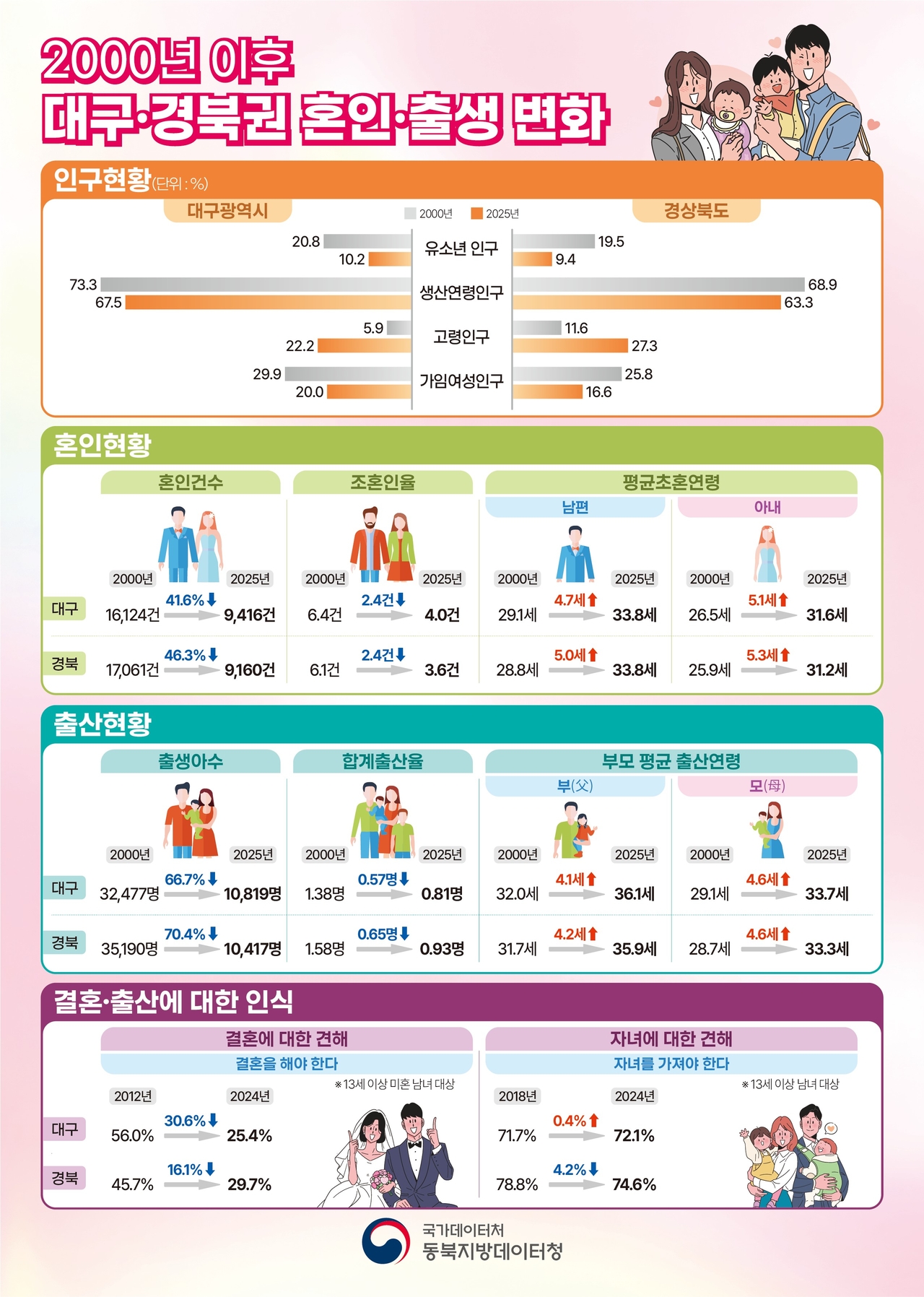
The number of births in Daegu and North Gyeongsang Province rose for two consecutive years after hitting a record low in 2023, but the total fertility rate in both areas remains below 1, data showed Thursday.
According to a report on changes in marriages and births since 2000, released Thursday by the Northeast Regional Data Agency, the proportion of women of childbearing age in Daegu and North Gyeongsang fell by about 10 percentage points from 2000 levels, amid deepening population decline and aging.
The number of marriages in Daegu declined through 2021 before rebounding from 2022, while North Gyeongsang also saw a renewed uptick from 2024.
The crude marriage rate in 2025 stood at 4.0 per 1,000 people in Daegu and 3.6 in North Gyeongsang.
The average age at first marriage was 33.8 for men and 31.6 for women in Daegu, and 33.8 for men and 31.2 for women in North Gyeongsang.
Births increased for two consecutive years in both regions after bottoming out in 2023, with Daegu recording a larger gain. The total fertility rate in 2025 was 0.81 in Daegu and 0.93 in North Gyeongsang — down 0.57 and 0.65, respectively, from 2000 levels.
The average age of parents at childbirth also rose, reaching 36.1 for fathers and 33.7 for mothers in Daegu, and 35.9 for fathers and 33.3 for mothers in North Gyeongsang.
By birth order, the share of first children increased while the proportions of second children and third or higher-order births declined.
Attitudes toward marriage and childbearing also shifted. The share of unmarried adults who said marriage was necessary in 2024 fell in both Daegu and North Gyeongsang compared with 2012.
The share of respondents who said having children was necessary rose by 0.4 percentage points in Daegu compared with 2018, but fell by 4.2 percentage points in North Gyeongsang.
The ideal average number of children in 2024 was 1.78 in Daegu and 1.97 in North Gyeongsang.
kbj7653@heraldcorp.com




