
Online portal lets anyone instantly check whether a person claiming to be a city employee is real
Paju Mayor Son Bae-chan calls impersonation crimes 'a serious problem that undermines public trust in government'
Report suspicious contacts or unauthorized transfers immediately to police or the Financial Supervisory Service
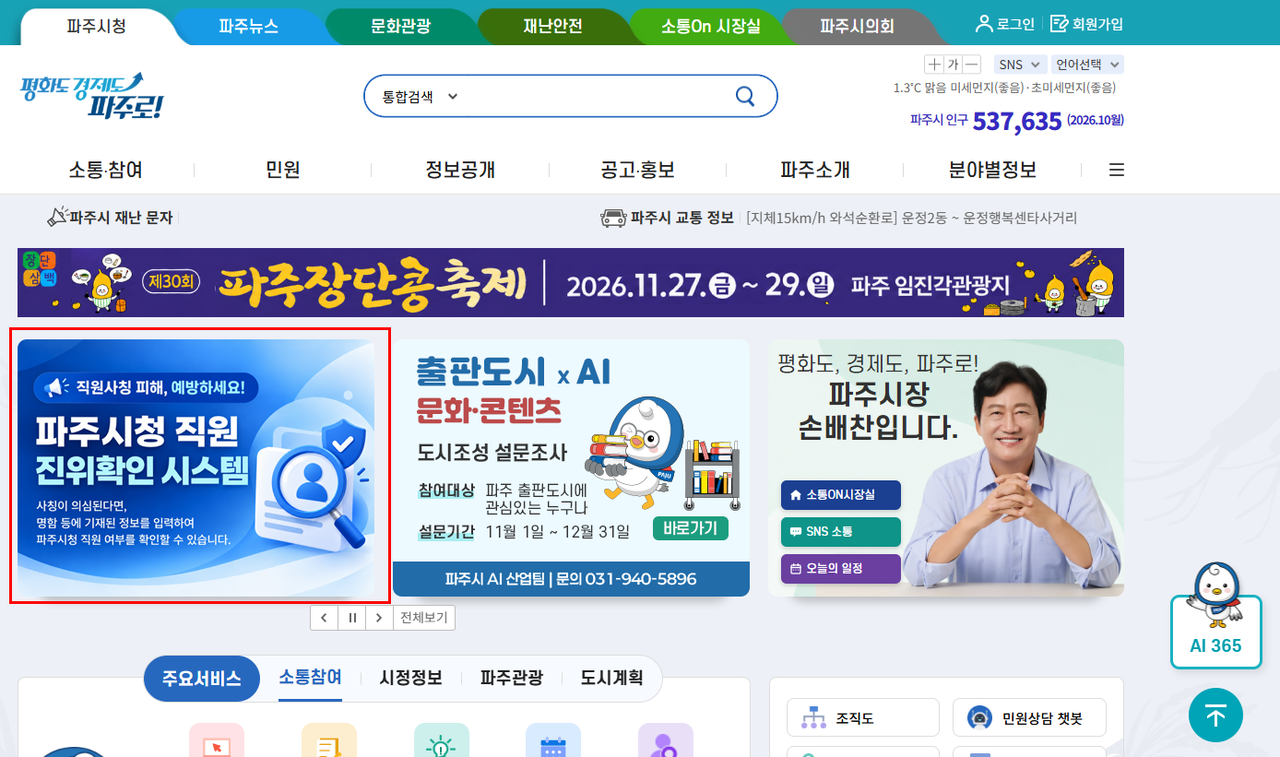
"If you suspect impersonation, you can enter the information on the business card to verify whether the person is a Paju City Hall employee."
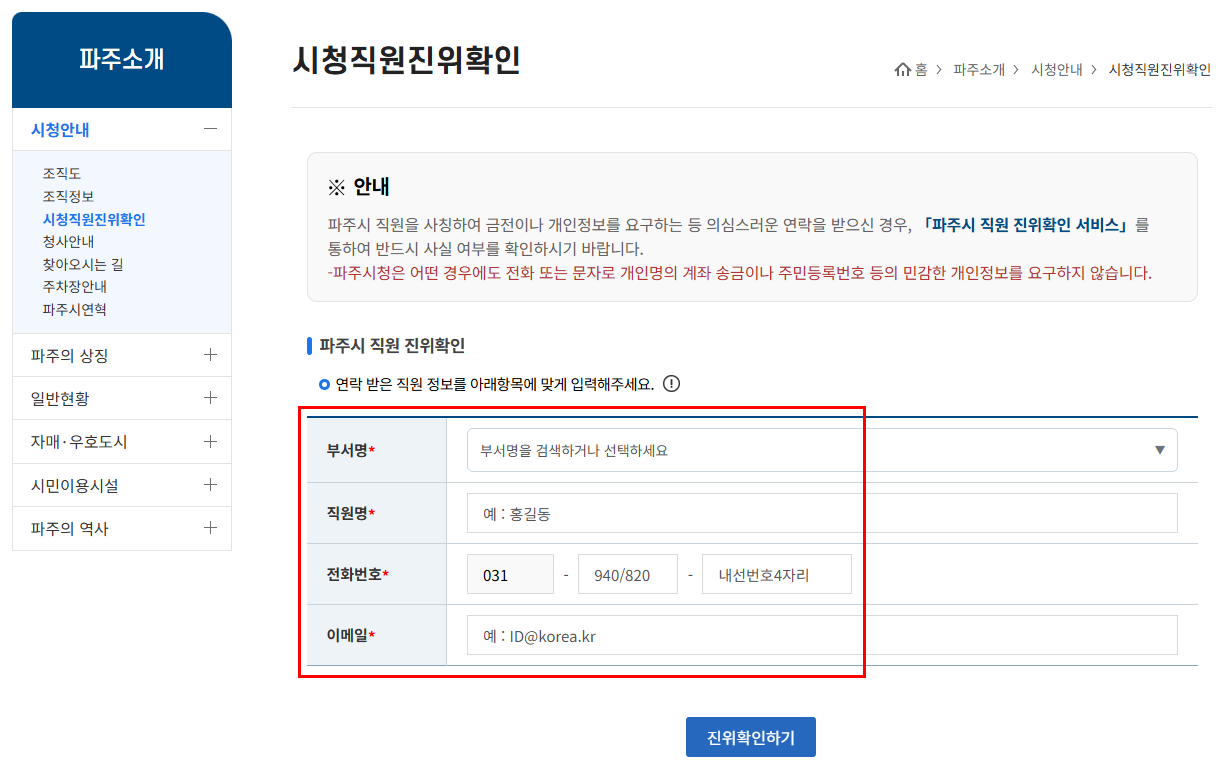
Paju has launched an online verification portal called the "Paju City Hall Employee Authentication System" to help residents and businesses confirm whether someone claiming to be a city official is genuine, in a bid to prevent fraud involving impersonation of civil servants.
According to Paju on the 26th, the system is hosted on the city's official website and replaces the previous method of calling the city to check, allowing anyone to quickly and easily verify a suspected impersonator directly through the portal.
The system carries a notice stating that Paju City Hall will never ask for transfers to personal bank accounts or sensitive personal information such as resident registration numbers by phone or text message under any circumstances. If a resident receives a suspicious contact, they can enter four pieces of information about the person claiming to be a city employee — department name, name, phone number and email address — and click "Verify" to immediately check whether that person is actually on staff.
The portal eliminates the need to separately look up a department's contact information, allowing anyone to check employee details instantly, at any time and from anywhere.
Fraud involving impersonation of civil servants has been occurring with increasing frequency, driven in part by advances in AI that make it easier to forge business cards and official documents. Scammers have used these tactics to pressure victims into making advance purchases on their behalf or to set up no-show schemes. The methods have grown more sophisticated and brazen — exploiting real bid announcements and contract information, or even designating city hall as a meeting location — raising growing concern about harm to residents.
Among officially reported cases in Paju, several involved impersonators posing as city officials — one pretending to be an official surnamed Yoo to request the purchase of fire extinguishers while soliciting quotes for two workshop tour buses, another posing as an official surnamed Park to request proxy purchases of fire-safety equipment, and a third posing as another official surnamed Park to ask a furniture company to buy gloves and other items unrelated to its business. In each case, the fraud was caught during fact-checking before any financial loss occurred.
In 2025, however, a case did result in actual financial loss. A scammer posing as a department head at Paju City Hall sent a business card and arranged a meeting at the city hall accounting office at 5 p.m., ostensibly to discuss replacing table glass and bathroom mirrors inside the building. Around 2 p.m. that same day, the scammer called again, claiming that procurement through official channels was not possible, and asked the victim to purchase 10 sets of self-contained breathing apparatus, sending a vendor name and account number. The victim transferred 12 million won ($8,930), resulting in a confirmed financial loss.
According to data compiled by Gyeonggi Province, there were 60 attempted proxy-purchase scams involving impersonation of provincial or municipal civil servants in 2025 alone. Four of those attempts resulted in actual losses totaling 120 million won.
The Korean National Police Agency began separately tracking such crimes in its official statistics from the second half of 2024, after a sharp rise in cases involving forged city and district office employee business cards and proxy purchase fraud. The agency created a dedicated category called "no-show fraud (proxy purchase)" in its national crime statistics system.
According to data the Korean National Police Agency submitted to the National Assembly's Public Administration and Security Committee at the request of lawmaker Park Jeong-hyeon, no-show fraud caused 6,515 cases and 125.9 billion won in losses in 2025. In 2026, from January through June alone, there were 3,936 cases with losses reaching 115.5 billion won.
This type of fraud targeting small business owners typically works by impersonating city or district office employees, military officers or prison guards to build trust, then inducing victims to make third-party purchases on the scammer's behalf.
The schemes have grown increasingly organized and sophisticated, with overseas-based phishing operations — including those based in Cambodia — forging the business cards and official documents of local government employees to trick small business owners into making proxy purchases.
Systems like Paju's Employee Authentication System can serve as a safeguard against such fraud, allowing residents and small business owners to verify a person's identity before acting on any request, while also bolstering public confidence in local government.
"Crimes involving impersonation of civil servants are a serious problem that damages not only residents' property but also public trust in government institutions," Paju Mayor Son Bae-chan said. "We will continue to practice proactive administration — carefully examining even minor inconveniences and risks, and improving our services — so that residents can use government services with confidence."
As a general rule, government agencies and local authorities never ask private businesses to make proxy purchases on behalf of other companies or to make advance transfers to personal accounts.
Official procurement contracts with public institutions go through formal systems such as the Korea On-line E-Procurement System. Any case in which someone sends only a scanned image of an official document — as a JPG or PDF — to a personal mobile phone and demands a bank transfer is, without exception, a scam.
Anyone who receives a suspicious contact or has already made a transfer should report it immediately to police or the Financial Supervisory Service. Proxy-purchase fraud is now subject to account freezes and victim relief procedures equivalent to those for voice phishing, following a 2026 amendment to the Act on Prevention of Damage from Telecommunications-Based Financial Fraud — making it essential to contact both the bank and police as quickly as possible after a transfer to request a payment suspension.
pjh@heraldcorp.com




