
President chairs public housing forum at Eunpyeong-gu office
Calls for public rental units that middle class would choose
Orders legislation to ban conversion of universal public rentals to private sales
Also conducts unannounced site visit to public housing complex
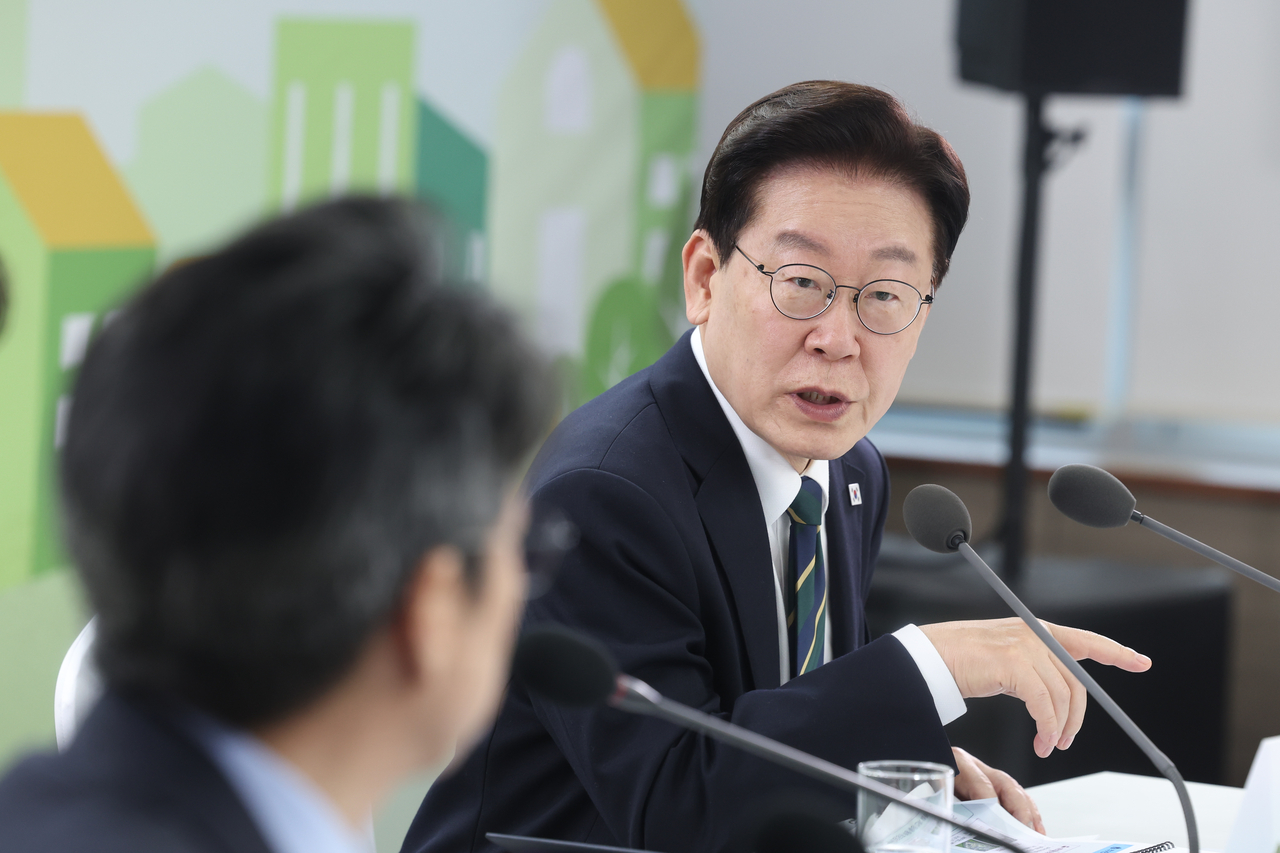
President Lee Jae Myung said Wednesday that public rental housing must go beyond serving as welfare for low-income households and become a residential option that the middle class would actively choose.
The goal, Lee said, is to close the gap with private housing in terms of location, unit size and quality, making public rentals a mainstream choice for ordinary Koreans.
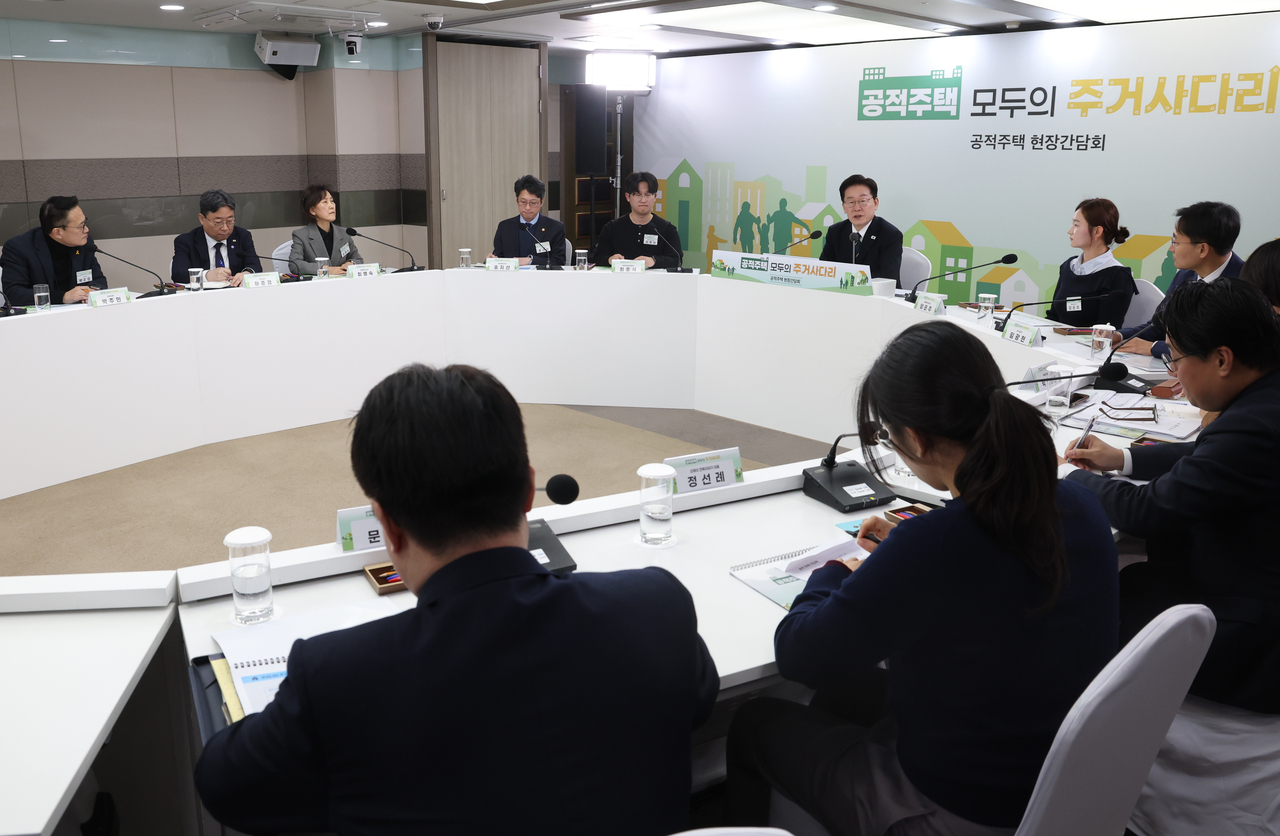
"Public rental housing needs to be able to serve as one genuine option," Lee said at a public housing forum held at the Eunpyeong-gu district office in Seoul.
Lee said the longstanding image of public rental housing — remote locations, cramped units, housing of last resort for the very poor — had to change. "I think this policy needs to be overhauled on a sweeping scale," he said.
He added that it was important for public housing to serve as "a rung on the housing ladder" by offering locations, sizes and quality that middle-class households could also consider.
Lee also called for accelerating the supply of public housing. The government plans to deliver an average of 240,000 public housing units per year from this year through 2030 — a 50 percent increase over the average of the past decade and the largest supply drive on record.
"From 2022 through last year, both permits and ground-breakings fell sharply. The housing market has become somewhat unstable," Lee said. "It seems truly important to push as fast as possible and expand supply."
However, Lee also stressed the need for safeguards to ensure that the supply push does not fuel a new round of real estate speculation.
"There are cases where new housing supply has itself become a hotbed of new housing speculation," he said. "Preparing against that outcome will also be important."
"Public housing as a safety net, public housing as a housing ladder — we will do our utmost to expand government responsibility to the fullest and stabilize the housing market," Lee said.
Land ministry to supply 1.19 million public housing units; LH to break ground on 497,000 units in greater Seoul over 5 years
At the forum, the Ministry of Land, Infrastructure and Transport reported plans to supply a total of 1.19 million public housing units by 2030, comprising 350,000 construction-rental units, 313,000 purchase-rental units, 230,000 jeonse-rental units, 52,000 privately built publicly supported rental units and 243,000 publicly sold units.
The ministry plans to supply 190,000 units of a new "universal" public rental category by 2030, with relaxed income and asset eligibility thresholds to accommodate the middle class and other diverse groups. The key feature is offering larger units in preferred locations — transit-oriented areas and city centers — at below-market rents.
The share of mid-sized units in public rental housing will also be raised from less than 20 percent to as much as 40 percent, with interior upgrades and expanded balcony floor plans introduced to improve living quality.
To fund the drive, the government plans to increase public housing investment by more than 40 percent, from 21 trillion won ($15.6 billion) this year to 30 trillion won next year, and to develop a pan-government fiscal support plan for large-scale investment from 2028 onward.
Korea Land and Housing Corporation also reported at the forum that it plans to break ground on 497,000 units of public housing in the greater Seoul area over the next five years — roughly five times the 103,000 units it started in the previous five years from 2021 to 2025, equivalent to building a new Bundang new town every year.
Of those, 377,000 units will be built on public land and 120,000 in urban areas. The annual breakdown calls for 46,000 units this year, 69,000 next year, and an average of 127,000 per year from 2028 through 2030.
During the briefing, Lee asked why construction was so heavily concentrated after 2028. LH President Lee Seong-hun explained that a strengthening of financial performance metrics in public enterprise evaluations in October 2022 had created pressure over rising debt ratios, causing delays in land acquisition and housing construction.
Lee responded: "So you created a situation where it was actually in the interest of public enterprises to delay." He then directed officials to explore adding bonus points in public enterprise performance evaluations for how quickly and faithfully housing supply targets are met.
To fund the construction, LH plans to award apartment construction contracts worth 182 trillion won through 2030 — about six times the 31 trillion won it contracted in the previous five years. Apartment construction alone accounts for 170 trillion won of that total.
LH projected that the effort would generate an average of 157,000 jobs per year in the construction sector over the next five years and increase annual orders for specialty contractors by 19 trillion won.
To raise the quality of public housing, the government will also significantly expand a program that allows private construction companies to lead design and construction under their own brands.
According to materials submitted by LH, the volume of such private-participation projects will grow more than eightfold, from 36,000 units over the previous five years to a provisional 300,000 units over the next five.
Listening to LH's supply plan, Lee urged officials to press ahead without hesitation. "Advance unconditionally, like German tanks charging forward," he said. "What was announced today must be carried out in full — no slipping behind."
Lee also stressed that expanding housing supply could stimulate the construction sector, create jobs and revive domestic demand, and directed officials to proactively prepare measures to address potential labor shortages and manage the supply and prices of construction materials as demand surges.
Lee orders ban on converting universal public rentals to private sales, calling them 'public assets'
Lee also directed officials to make it unambiguously clear that universal public rental housing — units never intended for private sale — cannot be converted to private ownership.
Lee noted that tenants of long-term public rental housing sometimes demand conversion to private ownership once the rental period ends. "These are provided as a housing ladder for all our people, built with national assets," he said.
"The person who wins a sale allocation may shed tears of joy, but if it ultimately ends up as a source of speculative profit, what is the point?" he said. "Wouldn't it be more important to keep it as a housing ladder so that many more people can use it?"
"If someone gets to convert to private ownership simply because they were selected first and have been living there, it is the same as pulling up the ladder so no one else can use it," Lee said. "I would like it made absolutely clear that conversion is not possible."
The remarks reflected concern that even if new public rental units are continuously added, converting existing ones to private ownership would make it difficult to grow the total stock of publicly held rental housing.
Lee said he would like the prohibition on converting universal public rental housing to private sales to be written explicitly into law. "Public rental housing shall not be sold off — it would be good to make that absolutely clear in legislation," he said.
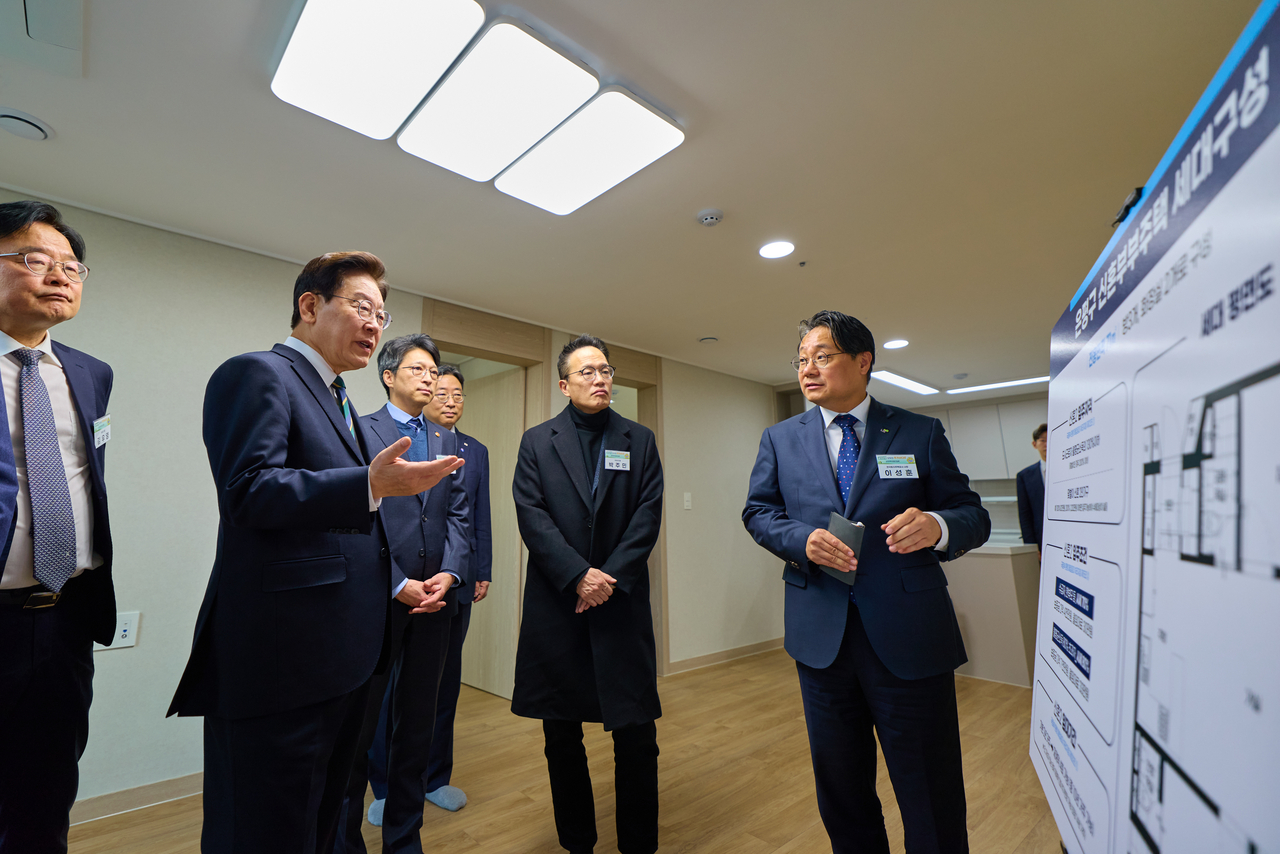
Before the forum, Lee toured a public housing complex in Eungam-dong, Eunpyeong-gu, and received a briefing from LH President Lee Seong-hun on supply results and future plans. The complex, located near Saejol Station on the Seoul subway, consists of 72 units of three-bedroom, two-bathroom housing with a pantry, each about 76 square meters, designed for newlywed couples.
sang@heraldcorp.com




