
Exercise tests coordinated response to large-scale, complex road disasters inside tunnels ahead of winter
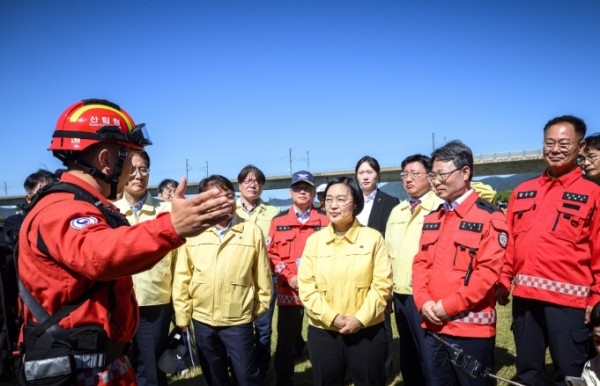
The Ministry of Interior and Safety conducted the fourth Ready Korea drill of the year Wednesday at the Saepasan Tunnel in Gyeonggi Province, in a joint exercise with the Ministry of Land, Infrastructure and Transport, the Ministry of Health and Welfare, Gyeonggi Province, Goyang city, the National Fire Agency, the Korean National Police Agency and Seoul Expressway Co.
The Ready Korea drill is a public-private exercise designed to test coordinated response systems against large-scale, complex disasters arising from potential risks such as the climate crisis and aging urban infrastructure.
This round simulated a scenario ahead of winter in which black ice near a tunnel entrance causes 40 vehicles to collide in a chain reaction, with fire breaking out from the crashed vehicles and spreading to nearby cars and cargo, resulting in mass casualties.
The exercise assessed the integrated response capabilities of participating agencies — including evacuation of tunnel users, firefighting and rescue operations — under harsh conditions: heat and smoke spreading rapidly through an enclosed space while wrecked vehicles blocked rescue teams from entering.
The drill began with a vehicle skidding on an icy road surface near the entrance of the Saepasan Tunnel on the Seoul Metropolitan Ring Expressway, triggering a series of rear-end collisions by following vehicles.
A driver involved in the crash called 119, and the tunnel management office detected the situation and alerted relevant agencies. An initial response team from the road management authority and first-arriving fire and police units immediately moved to the scene.
Seoul Expressway Co. blocked vehicles from entering the tunnel, activated electronic signboards and emergency broadcasts to prevent further vehicles from entering, and guided drivers and passengers to evacuate. The company also operated the tunnel's ventilation system to help clear smoke. Police controlled access at both ends of the tunnel, directed traffic to alternate routes and secured lanes for emergency vehicles.
The Ministry of Interior and Safety convened a situation assessment meeting with relevant agencies after receiving word of the accident and determined a response course of action. Gyeonggi Province and Goyang city each activated their local disaster safety response headquarters and sent emergency alert messages informing the public of road closures and detour information. Goyang city also set up an on-site integrated disaster support headquarters to coordinate field operations.
As the fire spread to surrounding vehicles and deeper into the tunnel and casualties mounted, the Ministry of Land, Infrastructure and Transport activated a central accident response headquarters while the Ministry of Interior and Safety stood up a central disaster safety countermeasures headquarters for an all-out pan-government response, overseeing and coordinating damage assessment, rescue operations, emergency medical support and recovery measures.
The National Fire Agency raised its response level and activated an emergency rescue control unit, throwing full resources into firefighting and rescue. The exercise confirmed the procedures and equipment needed for tunnel emergencies, including rapid searches for trapped individuals and extraction of passengers from wrecked vehicles.
The Deokyang-gu public health center in Goyang city set up a field emergency medical station and, together with the disaster medical assistance team from Myongji Hospital, carried out triage and emergency treatment of patients. The Ministry of Health and Welfare checked available beds at nearby medical facilities, arranged the dispersed transfer of seriously injured patients and activated a medical support system to ensure specialized treatment for burn and smoke-inhalation victims.
The Ministry of Land, Infrastructure and Transport and the Korea Infrastructure Safety and Technology Institute inspected the tunnel structure for damage and collapse risk to support safe rescue operations. After firefighting and rescue were completed, the Goyang city on-site integrated disaster support headquarters led efforts to tow away damaged vehicles, clear debris, apply anti-icing measures and restore facilities. A detailed safety inspection was also conducted, and options for reopening the tunnel to traffic were reviewed after safety was confirmed.
Alongside these efforts, a temporary shelter and a disaster victim support center were operated to assist victims and bereaved families. Volunteers were mobilized to distribute relief supplies and provide interpretation for foreign nationals among the victims. Post-disaster recovery steps — including an investigation into the cause of the accident and psychological support for victims — were also reviewed.
"In a tunnel accident, fire and smoke spread rapidly in an enclosed space, making swift access control, evacuation guidance and inter-agency cooperation paramount," Interior Minister Yun Ho-jung said. "The government will thoroughly prepare for winter tunnel accidents through realistic drills and continue to strengthen our response capabilities to protect the lives and safety of the public."
thlee@heraldcorp.com




