
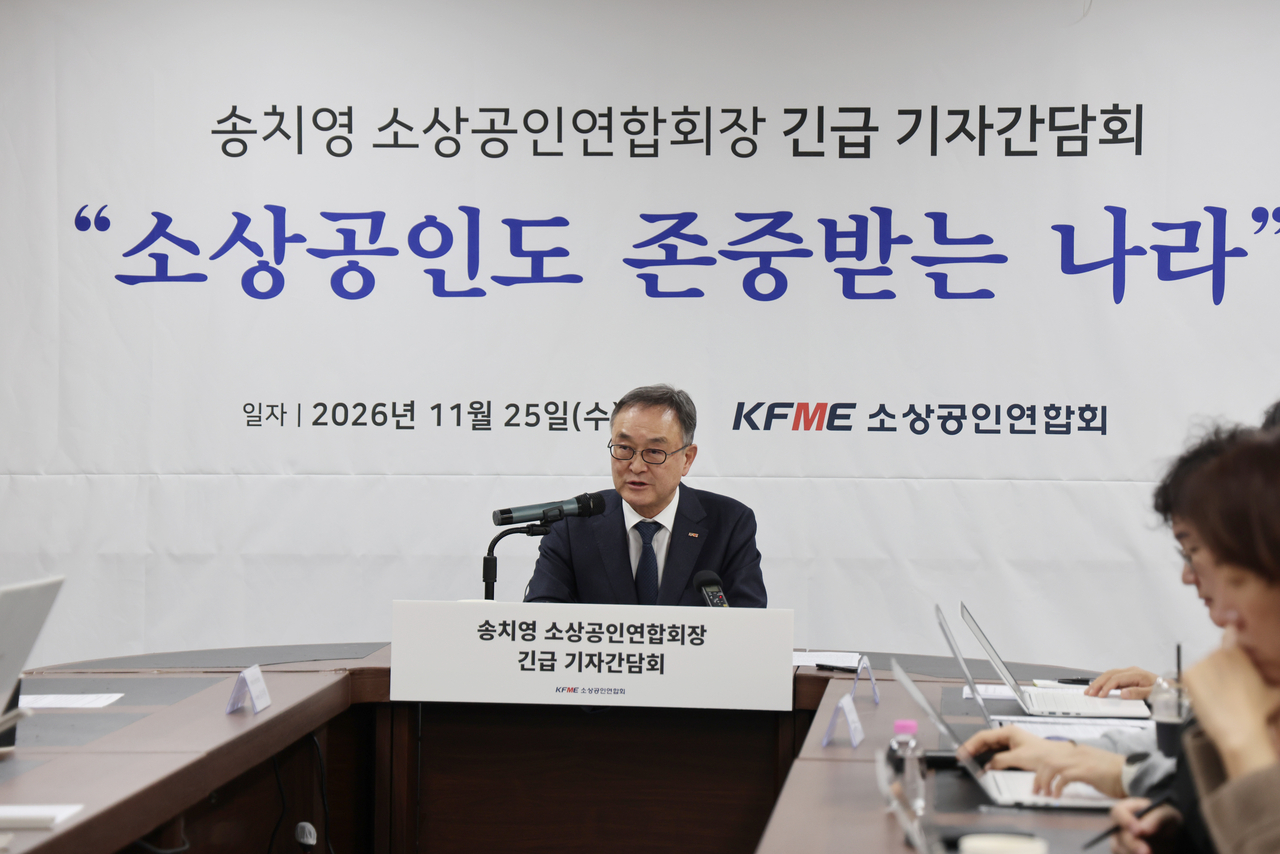
KFME chairman holds emergency briefing Wednesday
Group urges halt to 'workers' rights package' legislation
Calls for presidential advisory committee on small businesses
The Korea Federation of Micro Enterprise has officially raised the possibility of a campaign to oust Employment and Labor Minister Kim Young-hoon, escalating its opposition to the government's push to revise labor relations laws. The move comes eight days after the group held a press conference on Nov. 17 demanding a halt to the related legislation.
KFME Chairman Song Chi-young convened an emergency press briefing at the federation's main conference room Wednesday, warning that the group would "immediately launch a nationwide campaign to oust Minister Kim Young-hoon, rallying the will of 8.11 million small business owners, if the government ultimately ignores the voice of small businesses and forces through what we consider harmful employment legislation."
Song questioned whether the ministry had lost sight of its employment mandate. "One cannot help but ask whether the Employment and Labor Ministry has any 'employment' left in it, or only 'labor,'" Song said, criticizing the ministry for what he described as a one-sided approach. "If it looks after only labor interests with biased thinking, it cannot be said to be fulfilling its proper role."
South Korea's Ministry of Employment and Labor is pushing to enact a Basic Act on the Rights of Working People and introduce a worker-presumption regime to protect the rights of those in legal blind spots — including special-employment workers, platform workers and freelancers. Under the worker-presumption regime, when a dispute arises over whether someone qualifies as an employee, the burden of proof falls on the business owner to demonstrate that the person is not an employee.
The KFME estimated that if all freelancers, special-employment workers and platform workers — a group estimated at up to 8.7 million people — were treated as employees for cost purposes, the additional annual burden on small businesses would reach 44 trillion won ($32.7 billion), covering the four major social insurance programs and retirement reserves.
Song argued the legislation would shift the burden of proof onto small operators with no capacity to mount a legal defense. "It transfers the burden of rebuttal onto small business owners who have no resources to fight legal battles," Song said. "Small businesses will be left with no choice but to give up on hiring and become one-person operations, or simply shut down."
Song also took issue with the gap in representation between labor and small business groups on government committees. According to the KFME, the Korean Confederation of Trade Unions participates in 78 government committees and affiliated bodies, while the KFME sits on only two — the Minimum Wage Council and the Economic, Social and Labor Council.
"The figure of KCTU 78 versus KFME 2 starkly illustrates an uneven playing field," Song said, urging public debate on applying differentiated minimum wage rates by industry, introducing a biennial minimum wage review cycle and abolishing the weekly holiday allowance.
Song also called on President Lee Jae-myung to establish a presidential advisory committee dedicated to small businesses and to activate a pan-government emergency economic response system focused on small businesses and livelihoods.
"Last March, you chaired a one-on-one meeting with the Federation of Korean Trade Unions, and in April with the Korean Confederation of Trade Unions, and in October you held a dialogue with farmers and fishermen — yet there has not been a single official meeting with small business owners to this day," Song said, urging the president to "promptly create a forum for listening to voices from the field."
hong@heraldcorp.com




