
Gap between two indexes widens to 16.17 percentage points since 2020
Consumer price linkage fails to capture true construction cost increases
Repeated renegotiations risk delays and added burdens for association members
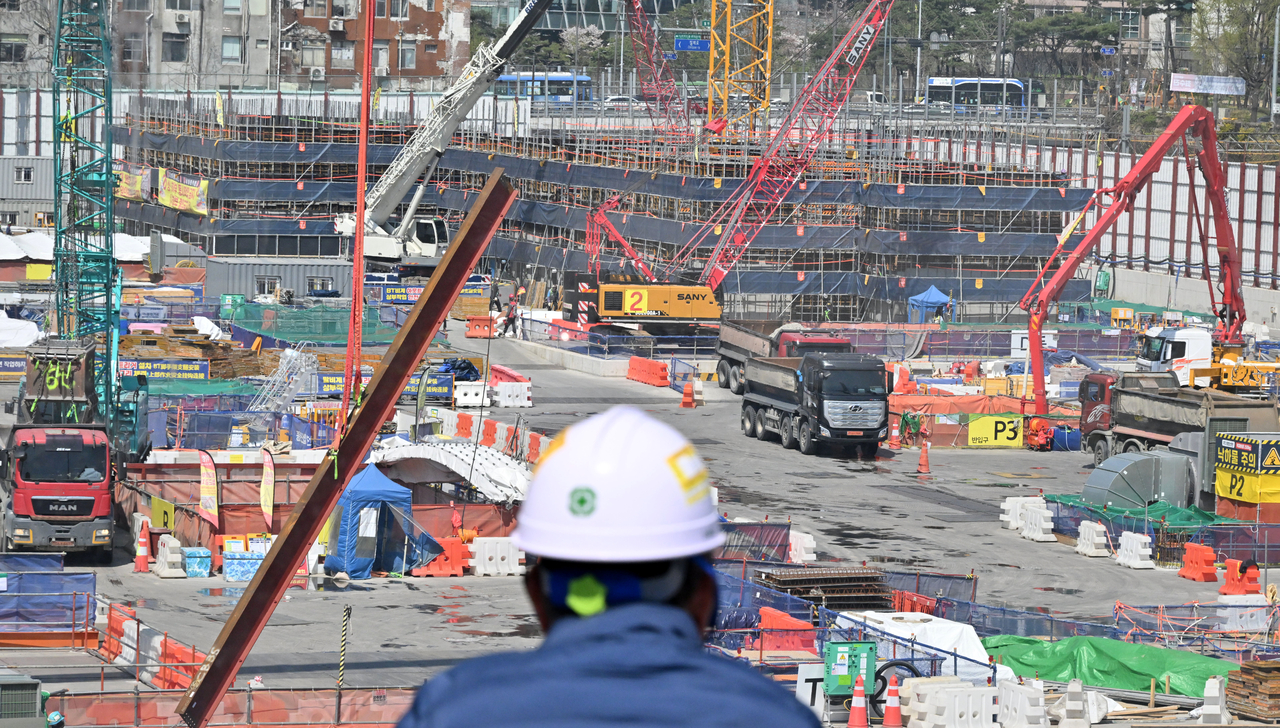
Construction cost disputes are spreading across major redevelopment and reconstruction sites in South Korea, deepening concerns about housing supply. Industry voices are calling for price-adjustment standards based on the construction cost index to ease supply bottlenecks, as the gap between construction cost inflation and consumer price inflation continues to widen. Given that urban renewal projects typically require lengthy permitting, relocation and demolition processes between contractor selection and ground-breaking, failing to reflect price changes accurately could raise financing costs from project delays and erode construction quality, observers warn.
According to industry sources, the Korea Institute of Civil Engineering and Building Technology's construction cost index for residential buildings reached 136.60 in September, a 36.60 percent increase from 2020. Over the same period, the consumer price index rose only 20.43 percent to 120.43, leaving a cumulative gap of 16.17 percentage points between the two indexes.
The divergence was also evident over the past year: the residential building construction cost index rose about 6.78 percent, while the consumer price index climbed just 3.41 percent.
The gap stems from differences in purpose and composition. The consumer price index tracks price changes affecting ordinary household spending, while the construction cost index reflects actual project input costs such as materials and labor. Using the consumer price index as the basis for adjusting construction costs makes it structurally difficult to capture the full extent of cost increases.
The domestic posted price of electrolytic copper — the primary raw material for electric wires and cables — rose about 15.3 percent from 17.73 million won ($13,200) per ton in January to 20.45 million won per ton in October. With price volatility rising for key materials, contractors say it is increasingly difficult to deliver the residential product and construction quality they have promised without adequate cost recovery.
Rising costs also have a direct bearing on apartment quality. Finishing materials, equipment performance, landscaping and community facilities all shape a unit's marketability, and a prolonged construction cost dispute can strain materials procurement, project scheduling and quality control.
South Korea's Ministry of Land, Infrastructure and Transport acknowledged the limitation in January 2024, when it distributed a standard construction contract for urban renewal projects, noting that the consumer price index falls short of capturing construction cost movements. The ministry proposed an index-adjustment method that accounts for price changes in individual cost components and allowed parties to use the construction cost index by mutual agreement.
Article 24 of the standard contract restricts general inflation-linked cost adjustments after ground-breaking, but allows associations and contractors to revise contract amounts by agreement when the price of a specific grade of material changes beyond a set threshold — a mechanism known as "single-item sliding."
Applying the provision in practice, however, requires each contract to spell out the eligible materials and the conditions for triggering a price change, and observers say more effective contract terms are needed to make the mechanism work.
Some in the industry argue it is also worth examining whether broader post-ground-breaking construction cost inflation should be reflected in contracts. Korea Land and Housing Corporation included such a provision in the project guidelines it published in June for a public housing complex near Seoul's Yongma Tunnel: if the construction cost index rises above its 10-year average annual rate after ground-breaking, the excess can be passed through to the contract price up to a set ceiling.
Industry participants say urban renewal projects should adopt a similar framework, allowing exceptional post-ground-breaking cost increases to be reflected within defined limits.
One proposed approach would have associations and contractors agree at the contract stage on the conditions and scope for adjustments, then verify the appropriateness of any actual cost-increase request against objective data.
When price-indexing standards fail to reflect real costs, repeated renegotiations generate additional expenses — outside advisory fees, cost re-verification and financing costs from project delays. A single round of construction cost re-verification alone is known to run around 200 million to 300 million won.
"Price-indexing standards that do not reflect actual construction costs fuel disputes and impose unnecessary burdens on association members," a redevelopment industry official said. "From the outset, we need standards that can capture appropriate costs, and we must be able to respond rationally to exceptional post-ground-breaking price increases — only then can we secure the quality of the residential product and construction, and keep projects on track."
lucky@heraldcorp.com




