
Russian military aircraft entered KADIZ three times in one week; Russian defense attaché summoned
Experts: flights appear to be training runs premised on supporting North Korea in a contingency
Russian military aircraft entered South Korea's Korea Air Defense Identification Zone (KADIZ) and came close enough to breach the airspace over Ulleungdo within seconds before turning away, sources said. Russia maintained the flights were planned and did not violate international law, while experts said the maneuvers appeared to be training runs premised on supporting North Korea in a contingency.
According to the TASS news agency, Russia's Defense Ministry said its Tu-160 strategic bomber conducted a planned flight over international waters in the East Sea on Tuesday, with the mission lasting about 10 hours. Su-35S and Su-30SM fighter jets from the Russian Aerospace Forces provided escort. The Tu-160 is the world's largest supersonic strategic bomber and has been used in the war in Ukraine to carry out long-range strikes with conventional cruise missiles.
Russia's Defense Ministry said foreign fighter jets shadowed the strategic missile-carrying bombers during certain segments of the flight, and added that Russian Aerospace Forces aircraft "strictly comply with international regulations governing the use of airspace on all flights."
The Russian Embassy in Seoul confirmed it had been in contact with South Korea's Ministry of Foreign Affairs, saying it had explained that "Russia is acting in accordance with international legal norms, as in previous similar cases."
The embassy also said it had emphasized that South Korea's KADIZ was established unilaterally by the South Korean government and "imposes no legal obligations on aircraft of other states."
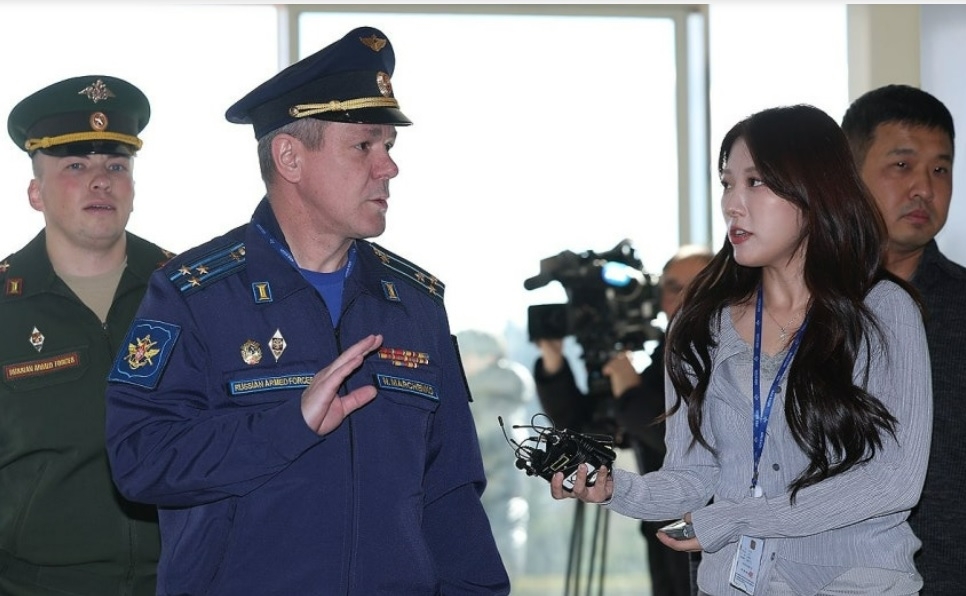
Kim Hak-jo, director general for international policy at South Korea's Ministry of National Defense, summoned Russian Defense Attaché Col. Nikolai Marchenko to the Defense Ministry compound in Yongsan-gu, Seoul, on Tuesday to lodge a formal protest and urge Russia to prevent a recurrence. Russia's Foreign Ministry said on social media that South Korean Ambassador to Russia Lee Seok-bae had requested a meeting with Russian Deputy Foreign Minister Andrei Rudenko to discuss the matter.
Russian military aircraft had previously flown through KADIZ and Japan's Air Defense Identification Zone (JADIZ) all the way to Vietnam and back on Nov. 17, ahead of the Asia-Pacific Economic Cooperation summit, breaching Japanese airspace in the process. The aircraft also entered KADIZ over the East Sea on Thursday, marking three KADIZ incursions within a single week through Tuesday.
Kim Min-gyu, a research fellow at the Korean Association for Intelligence Studies, said the flights clearly presuppose supporting North Korea in a contingency. "There is a need to verify, even in peacetime training, which flight routes would be most effective," Kim said.
Kim added that while North Korea and China, and North Korea and Russia, have never conducted joint military exercises, China and Russia have continued to hold combined drills. "Russia may be making a first attempt to vary the format of combined exercises, so this needs to be viewed in a complex light," Kim said.
On whether such flights would be repeated, Kim said the purpose was likely to familiarize Russian forces with the flight route, making it unlikely they would fly the same path again. "But every time Russian military aircraft come in, our air force needs to collect data and conduct research on what flight patterns they use and where they turn to find the optimal route," Kim said.
Du Jin-ho, a visiting research fellow at Kyungnam University's Institute for Far Eastern Studies, said South Korean and Russian military authorities had agreed in 2021 to establish a hotline as a confidence-building measure, but its activation was delayed after Russia's invasion of Ukraine. "Paradoxically, this incident has provided a justification for resuming working-level talks between the two countries' military authorities to prevent accidental military clashes at sea and in the air," Du said.
Du added that as a follow-up to a brief summit between the two countries' leaders, dialogue channels between the diplomatic and defense authorities of both sides should be gradually restored "to drive a virtuous cycle in the situation on the Korean Peninsula and inter-Korean relations."
youknow@heraldcorp.com
rimsclub@heraldcorp.com




