
Five major banks' savings-backed loan balance hits 7.07 trillion won, up 12.7% this year
84% of increase at some banks driven by housing subscription account loans
Borrowers seeking quick cash for living expenses, not stock investment
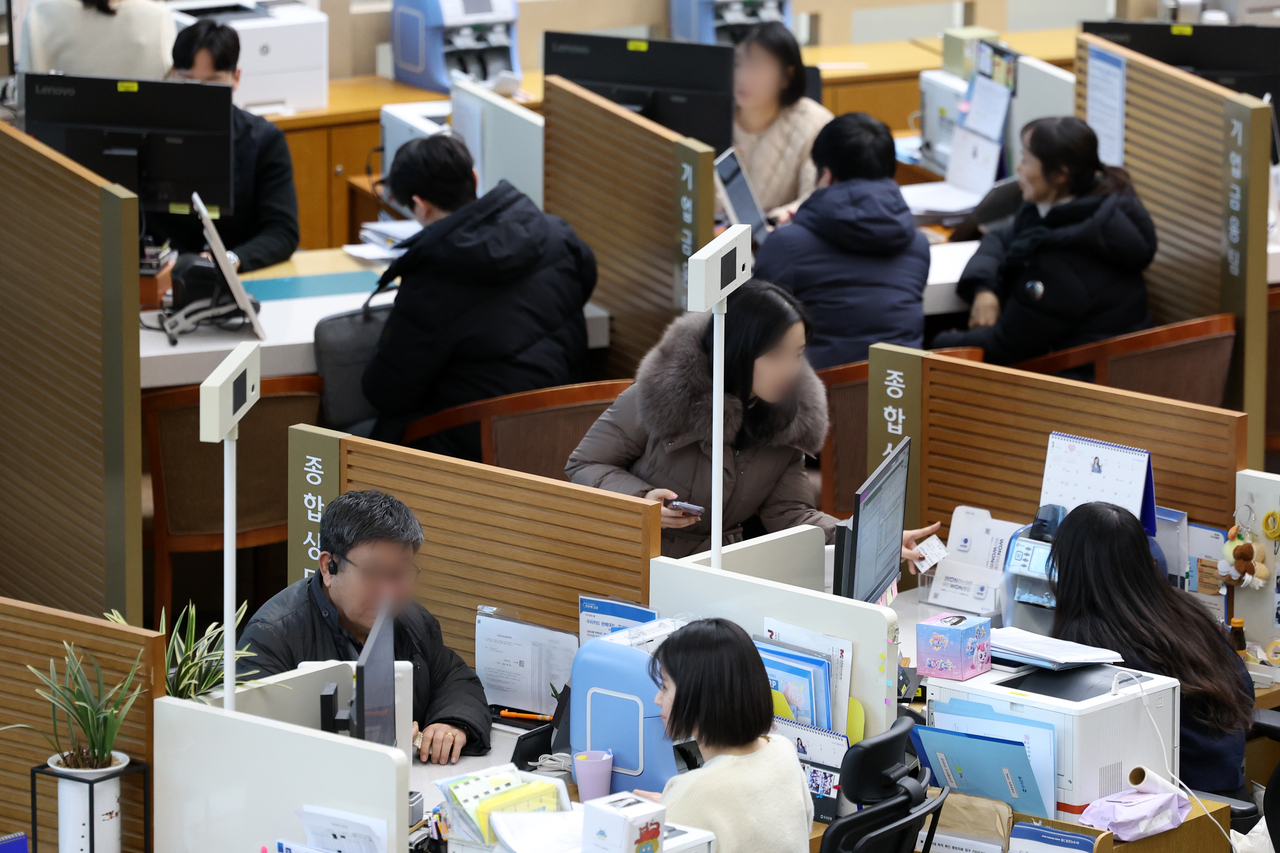
A growing number of households are borrowing against their housing subscription accounts — savings set aside to eventually buy a home — to cover immediate cash needs. While the rise in savings-backed loans at banks had previously been attributed to debt-fueled investment, the recent surge is driven increasingly by housing subscription account loans, which borrowers tend to use for living expenses and other urgent costs. Analysts say tighter finances amid rising interest rates and stricter lending conditions are behind the trend.
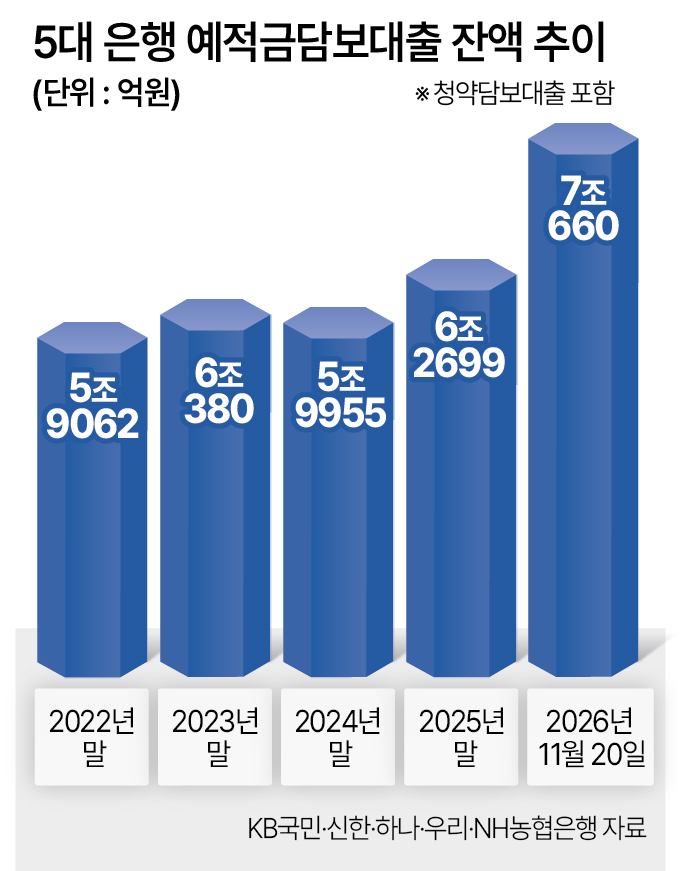
The combined balance of savings-backed loans — including housing subscription account loans — at KB Kookmin, Shinhan, Hana, Woori and NH NongHyup banks stood at 7.07 trillion won ($5.25 billion) as of Friday, according to financial industry data released Wednesday. That marks an increase of 796.1 billion won, or 12.7 percent, from the end of last year, when the balance was 6.27 trillion won.
After hovering around 6 trillion won for years, the savings-backed loan balance has climbed sharply this year. The combined figure at the five banks was 5.91 trillion won at the end of 2022, rose to 6.04 trillion won by end-2023, then edged down to around 6 trillion won at end-2024. Last year it rose again to 6.27 trillion won, but the annual growth rate was just 4.6 percent.
This year, with more than a month still remaining before year-end, the increase in loans has already reached 2.9 times last year's full-year gain of 274.3 billion won. It is also more than double the 363.7 billion won added over the three years from 2023 through last year.
The rise in housing subscription account loans stands out in particular. The combined balance of such loans at two major commercial banks — identified only as Bank A and Bank B — climbed 17.1 percent, from 2.03 trillion won at the end of last year to 2.38 trillion won as of Friday. That is 2.8 times the 6.1 percent growth rate recorded for general savings-backed loans over the same period. Housing subscription account loans accounted for 83.7 percent of the two banks' total savings-backed loan increase of 415.8 billion won this year, with the subscription loan portion alone rising 348.2 billion won.
The number of housing subscription account loan accounts also increased. The two banks' combined account count rose 8.4 percent, from 757,611 at the end of last year to 820,994 as of Friday. The average loan balance per account also grew, from about 2.68 million won to 2.9 million won.
Banks say the growth in housing subscription account loans cannot be explained by demand for stock investment alone. Unlike regular savings accounts, housing subscription accounts have no maturity date, and closing one means losing years of accumulated membership and payment history. As a result, many borrowers prefer to take out a loan to cover a temporary cash shortfall rather than cancel the account.
"Housing subscription account loans allow borrowers to receive 90 to 100 percent of their deposited amount, but the loan sizes themselves are not large," a financial industry official said. "It seems people are using them mainly to cover immediate needs like living expenses while keeping their subscription accounts intact, rather than for stock investment."
Tighter lending conditions have also fueled demand for savings-backed loans. Such loans, including those backed by housing subscription accounts, are exempt from the debt service ratio regulation. Even borrowers who have maxed out their mortgage or personal credit loan limits can still raise funds by pledging their savings deposits as collateral.
Some in the banking industry see the recent rise in savings-backed loans as a signal that household finances are deteriorating. "As interest rates have risen, some borrowers may be taking out savings-backed loans just to pay the interest on their existing debt," another commercial bank official said. "It appears household finances are becoming increasingly strained."
Financial industry officials advise borrowers to carefully assess their repayment capacity before using savings-backed loans. While the approach allows them to raise funds without canceling their deposits, it adds an extra layer of interest costs. In the case of housing subscription account loans in particular, failure to repay could trigger enforcement of the collateral, resulting in the account being closed — and the loss of all accumulated membership standing and payment history.
rim@heraldcorp.com




