
Government launches 8th seasonal management program; coal plant output capped at 80% for up to 46 units
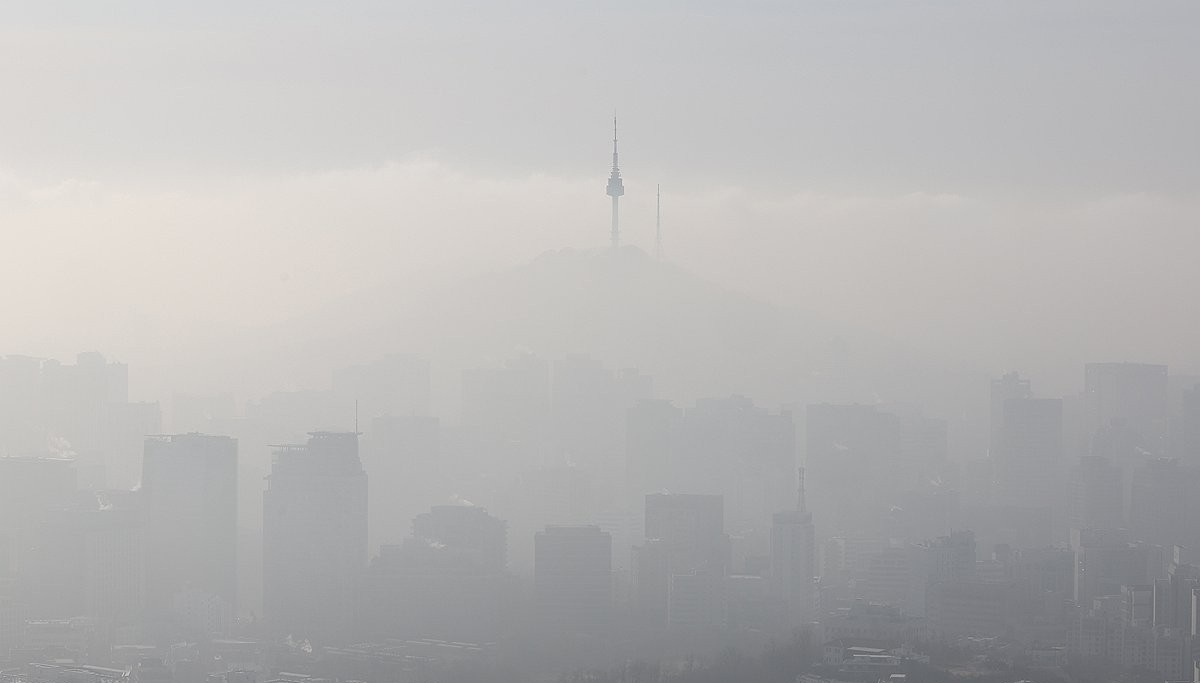
Fine dust concentrations this winter are likely to be worse than last year's, the government warned Tuesday, as El Niño-driven atmospheric stagnation is expected to trap both domestically generated and foreign-origin particulate matter over the Korean Peninsula. In response, the government said it will restrict coal-fired power plant output and roll out a seasonal management program.
The government convened the 20th Special Committee on Fine Dust on Tuesday and announced it will implement the 8th Seasonal Fine Dust Management Program from December through March next year.
According to the National Institute of Environmental Research, there is a 50 percent probability that average PM2.5 concentrations this winter — December through February — will be higher than last winter's, a 40 percent probability they will be similar, and a 10 percent probability they will be lower.
The probability that the number of days with a national daily average PM2.5 concentration of 36 micrograms per cubic meter or above — classified as "bad" air quality — will be higher than last winter stands at 50 percent, with a 30 percent chance of a similar number and a 20 percent chance of fewer such days.
El Niño is the main reason fine dust is expected to be worse this winter than last.
When El Niño raises sea surface temperatures in the tropical eastern Pacific above normal levels, high-pressure circulation systems tend to develop more frequently over the Philippine Sea and to the east of the Korean Peninsula. Such systems stall the atmosphere, preventing fine dust — whether blown in from abroad or generated domestically — from dispersing, causing concentrations to rise.
The National Institute of Environmental Research said the combined effect of atmospheric stagnation from high-pressure circulation and elevated humidity from moist air inflows — which causes airborne pollutants to absorb moisture and form "secondary fine dust" — is expected to be more pronounced this winter.
In response, the government said the 8th seasonal management program will cut emissions of fine dust and fine dust precursors by about 137,000 tons, aiming to keep average PM2.5 concentrations at 19 micrograms per cubic meter during the program period. The comparable figure during the 7th program was 21.5 micrograms per cubic meter.
The number of coal-fired power generators taken offline will be adjusted based on electricity supply conditions, with between 15 and 18 public coal plants shut down and the output of up to 46 units capped at 80 percent.
During the 7th seasonal management program, output restrictions on coal-fired generators were lifted early after LNG prices surged amid the war in the Middle East.
As in previous years, vehicles with the lowest emissions rating — Grade 5 — will be barred from operating in Greater Seoul and six other major metropolitan cities during the program period.
A measure expanding dedicated parking zones for electric and hydrogen vehicles — introduced during the previous seasonal management program for the Ministry of Climate, Environment and Energy and its affiliated agencies — will be extended to four local governments: Seoul, Gyeonggi Province, Sejong and Gwangju in South Jeolla Province.
Seven cities and provinces also agreed to implement Level 2 emergency fine dust reduction measures even in situations that would normally trigger only Level 1 responses.
The government also plans to establish an "integrated air quality control center" at the Korea Environment Corporation to comprehensively analyze fine dust forecasts and air quality monitoring data, identify areas of pollution concern and facilities with abnormally high emissions, and enable regional environmental agencies and local governments to respond swiftly.
In addition, the government said it will pilot monthly fine dust outlooks on top of the existing winter and spring seasonal forecasts.
"A pan-government implementation monitoring team, led by the Office for Government Policy Coordination, will regularly check the progress of related ministries and local governments," the government said, adding that it plans to continue protective measures for the public after the seasonal management period ends, depending on fine dust conditions, and to analyze implementation results and their effectiveness.
thlee@heraldcorp.com




