
FSC calls specialized sales firm 'medium- to long-term' review; FSS urges caution
29.3% of large GAs rated 'weak' or 'dangerous' on internal controls
Industry: expanding authority and strengthening accountability are separate issues
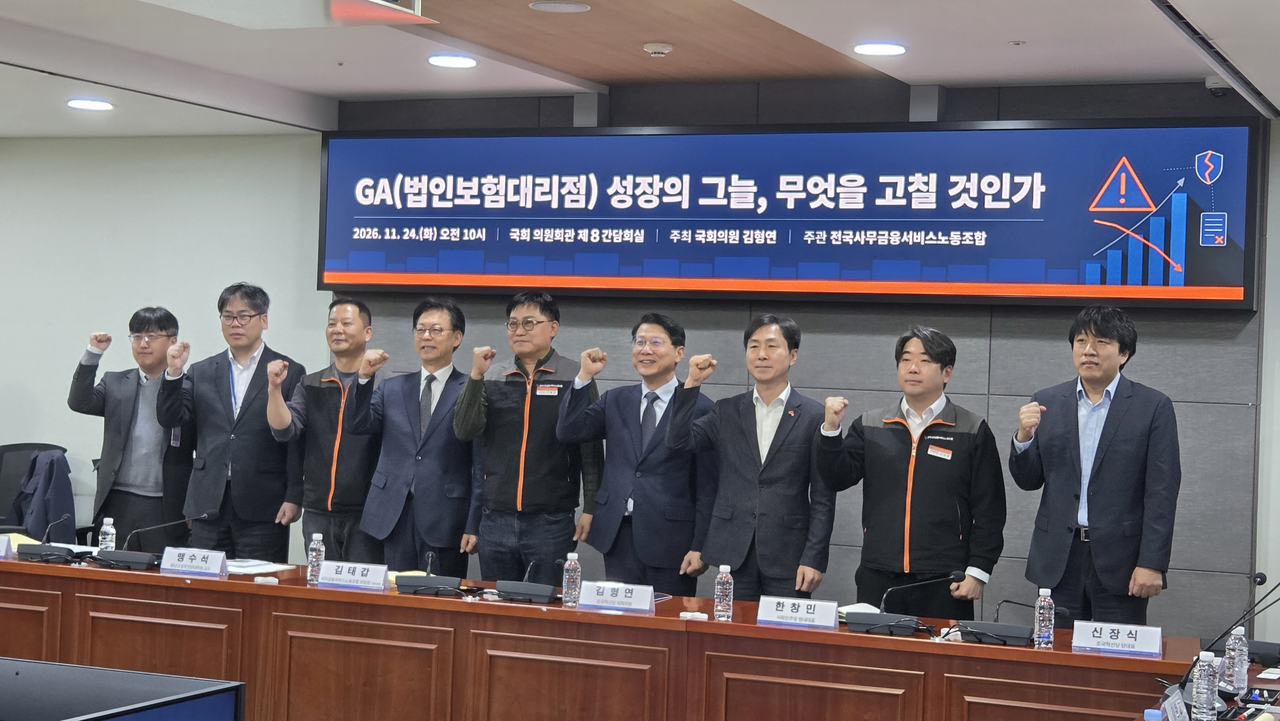
Financial regulators have signaled caution over a proposal to grant large general insurance agencies, known as GAs, a distinct legal status and commission-negotiating rights as specialized insurance sales firms, saying accountability frameworks must be put in place before any expansion of authority, given persistent gaps in internal controls and repeated cases of mis-selling.
The forum, titled "The Shadow Side of GA Growth: What Needs to Change?", was held at the National Assembly on Tuesday, hosted by Rebuilding Korea Party lawmaker Kim Hyeong-yeon and organized by the Korean Financial Services and Commerce Workers' Union. It was the first forum Kim has hosted at the National Assembly.
Im Hyeong-jun, head of the insurance division at the Financial Services Commission, said the specialized sales firm model "could be considered over the medium to long term, on the premise that GAs fulfill responsibilities and obligations commensurate with their growth," but stressed that "establishing accountability and control mechanisms before expanding authority is more important for consumer protection." Im added that reforms to sales commissions and stronger internal controls "can be pursued sufficiently within the existing legal framework without creating a separate sales channel," and said the FSC would focus on embedding those measures in practice.
The FSC has placed greater weight on strengthening GA accountability than on expanding their authority. It introduced a comparative disclosure system for sales commissions in March, extended the "1,200 percent rule" to GA-affiliated agents in July, and tightened comparison and explanation obligations for large GAs. A phased installment system for agent sales commissions is set to take effect from January 2027.
Im said the FSC would review whether Article 85-3 of the Insurance Business Act and the model consignment contract are functioning properly in practice, in relation to agent welfare issues such as excess commission clawbacks and deductions from settlement support payments.
Lee Gwon-hong, head of the insurance supervision bureau at the Financial Supervisory Service, also said that moving toward a specialized sales firm model "is the right direction to go eventually," but that "careful review is needed under current circumstances." Citing discussions at the International Association of Insurance Supervisors, Lee said reducing improper solicitation requires three conditions: strengthened individual accountability, a sound performance-compensation structure, and risk governance with checks and balances.
"I question whether the largest GAs are meeting these three basic requirements," Lee said, adding that a review could proceed "once the balance between authority and accountability is achieved and social consensus is reached."
Bills introduced separately by the ruling and opposition parties to establish the specialized insurance sales firm regime are currently pending in the National Assembly. The proposed legislation would designate large GAs meeting certain criteria as specialized sales firms, expanding their scope to include contract maintenance and management, insurance claim intake, and small-claim payment processing, while granting them the right to negotiate solicitation commissions and operating expenses with insurers. In return, the bills would require mandatory liability insurance or performance bond deposits, with specialized sales firms bearing primary liability for consumer damages.
Eom Min-sik, head of the non-life insurance sector at the Korean Financial Services and Commerce Workers' Union and the forum's lead presenter, said strengthening GA accountability and expanding GA authority "are entirely separate issues."
Eom cited FSS data showing that an internal control assessment of 75 large GAs for 2024 found 22 firms, or 29.3 percent, rated at the fourth tier (weak) or fifth tier (dangerous). He also presented figures showing that 54 of the 74 GA sanctions issued between January and November this year — 73 percent — involved large GAs with 500 or more agents, and that six of the top 10 firms in the industry had received sanctions. At one GA, 1,890 fraudulent contracts written under other people's names were uncovered, with commissions paid on those contracts exceeding 2 billion won ($1.49 million).
Eom identified eight problems with the specialized sales firm regime: premium pass-through costs from enhanced GA bargaining power, market concentration among large GAs, sensitive personal data protection, conflicts of interest, expanded insurance fraud, limits of after-the-fact liability, declining claims-handling expertise, and job insecurity for workers. "Pursuing a policy to curb excessive commission competition while simultaneously strengthening large GAs' commission-negotiating power is a policy contradiction," he said.
In opening remarks, lawmaker Kim said 32 large GAs had received 42 sanctions from 2024 through August this year. A national audit also revealed that Incar Financial Service, which has some 25,000 agents, had no separate audit organization beyond a single auditor. "Before expanding GAs' duties and authority, we must first confirm that the internal control and supervisory frameworks needed to prevent consumer harm are actually working," Kim said.
Kim Dong-gyeom, head of the financial market analysis division at the Korea Insurance Research Institute, said "the practical power to compare and recommend has shifted to large sales organizations, while liability and supervisory discipline remain anchored in an exclusive-agency structure — creating a structural mismatch between authority and accountability." However, Kim added that "the standard for reforming the regime should be consumer rights, not the expansion of sales channels' business scope," and that "only when the expansion of authority and the associated cost and risk controls are verified together will the system function in a consumer-centered way."
Jo Ji-seong, head of the life insurance branch of the Korean Financial Services and Commerce Workers' Union, compared GAs to a "massive carnivorous dinosaur" that needs to be fenced in, saying that "introducing a specialized sales firm model without proper training would simply create a better environment for the prey to grow."
Concerns also emerged from the floor. A union official from one life insurer said the share of sales-related complaints at their company originating from GAs had risen from 66 percent three years ago to 84 percent. The GA share of complaints related to small-claim filings and payments jumped from 17 percent in 2023 to 67 percent in the first half of this year, the official added.
won@heraldcorp.com




