
NYT: Move shows how far Trump will go to keep AI boom alive
Tech stocks surged 31% on Nvidia CEO's return announcement
National security concerns draw pushback from within GOP
White House faces political liability as probes continue
A single word from Donald Trump can shake global markets. If keeping up with the daily flood of Trump news feels overwhelming, this column cuts through it fast — delivering the key stories moving US markets and global assets in about one minute.
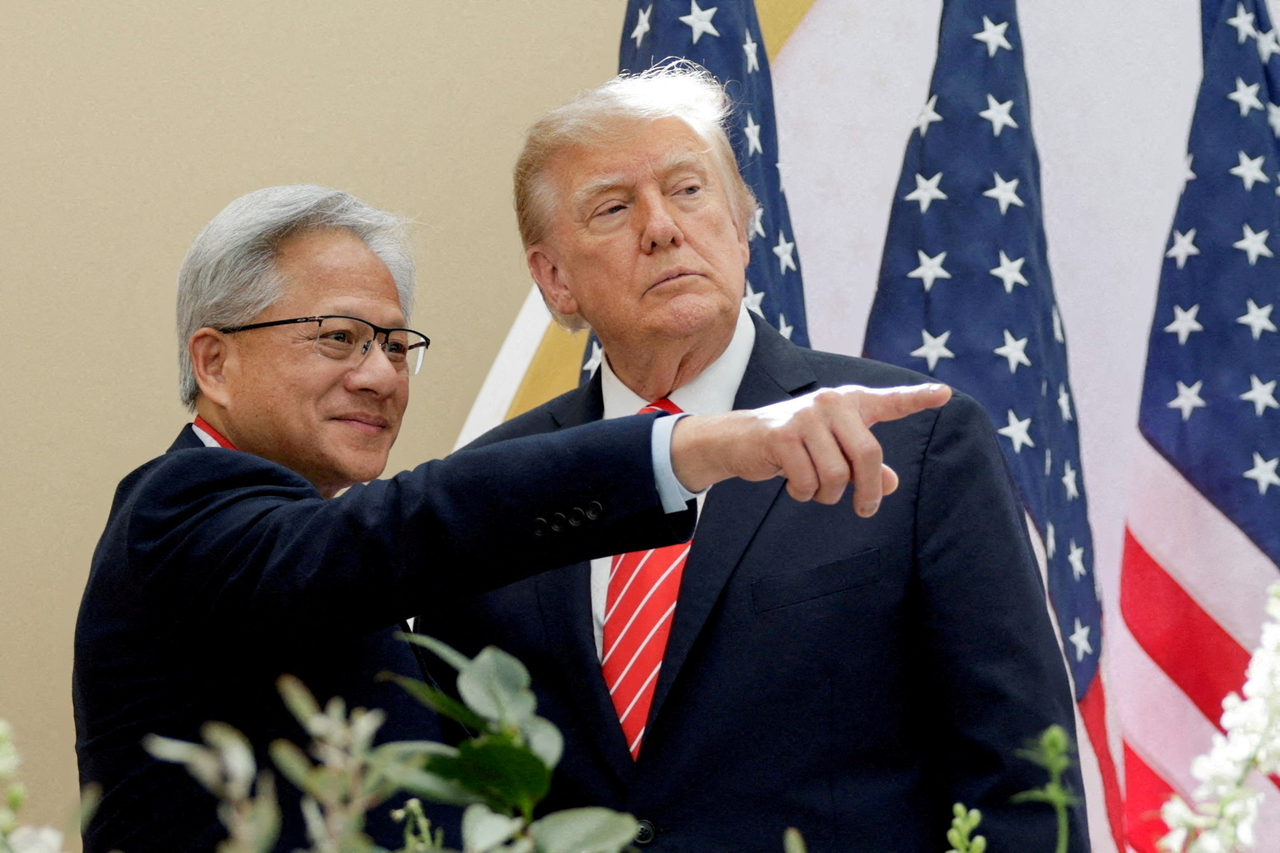
Analysts say Donald Trump's decision to personally intervene to bring Nvidia CEO Jensen Huang back was driven by a calculated political bet — one that has staked the administration's credibility on AI dominance and a strong stock market. When Huang's departure sent investor sentiment in the AI sector into a sharp decline, the White House chose to wade into the management of a private company rather than stand aside. Wall Street cheered, at least initially, but a widening national security controversy is adding to Trump's political burden.
The New York Times, in an analysis published Monday (local time), said Huang's return "shows how far President Trump is willing to go to keep the AI boom alive."
"For President Trump, the economic damage that seemed likely if Nvidia fell into crisis appeared to matter more than the misdeeds of a troubled executive," the Times said.
Trump has long treated the growth of the AI industry as a cornerstone of both US economic competitiveness and the broader technology rivalry with China — framing the race to develop AI not merely as a question of innovation but as a great-power struggle over economic and military supremacy.
The Times noted that while many Americans remain uneasy about AI, Trump has remained one of its most ardent champions.
Trump said on his Truth Social account Tuesday that "America needs Jensen Huang's leadership at Nvidia to ensure not only the success and prosperity of Nvidia, but the success and prosperity of the American economy."
The accelerating slide in US stocks following Huang's resignation is also widely cited as a key reason Trump moved directly.
The tech-heavy NASDAQ composite had been falling steadily since Huang stepped down. On Friday — the last trading session before the return announcement — it fell more than 5%, bringing it to the edge of bear-market territory.
For a president who has consistently pointed to rising share prices as proof of his economic stewardship, analysts say allowing a sharp selloff in AI-related shares to continue unchecked was simply not an option.
The Times said Trump has long used the stock market as a scorecard for his economic policies, and that whenever he has highlighted the AI boom under his presidency, a surging market has been central to his argument.
The Washington Post similarly noted that Trump had been closely watching how AI-driven growth was powering the broader US economy, and that many White House aides viewed Huang's return as the most direct lever available to reverse the market's decline.
Trump himself did not deny that the market selloff had influenced his push to bring Huang back.
In an interview with CNBC Tuesday, when asked whether the drop in tech stocks had factored into his thinking, Trump said, "Probably it did" — but added, "The bigger factor, though, was the long-term."
The gamble paid off, at least in the short term. Nvidia's share price surged more than 31% Tuesday, and the NASDAQ composite jumped 6.5%.
Yet even as financial markets celebrated, the political fallout in Washington was intensifying. Criticism that Trump had prioritized economic interests over national security came not only from Democrats but from within his own Republican Party.
Huang's resignation had been tied not only to a personal scandal but also to allegations that Alice Huang, the person at the center of the affair, had smuggled advanced AI semiconductors into China. With investigations into those allegations still ongoing, questions are being raised about whether it was appropriate for the president to personally champion Huang's return.
Trump said on Truth Social that there was no basis to conclude that Huang's return posed a risk to US national security, and that the attorney general had confirmed the government had found no evidence Huang had engaged in any illegal activity.
Republican Sen. Kevin Cramer, however, posted on X, formerly Twitter, that "the national security risk has been transferred to our military and our people."
Democratic Sen. Ruben Gallego also said, "The president is selling out our national security to keep the stock market high."
Senate Democratic floor leader Chuck Schumer said Democrats would use every tool at their disposal to investigate potential wrongdoing by the Trump administration, Huang and Nvidia's leadership.
Having effectively claimed Huang's return as a political achievement of his own, Trump now faces the prospect that the White House could be drawn into accountability questions depending on how the related investigations unfold.
The Washington Post characterized the episode as an extraordinary presidential intervention in a private company's affairs, concluding that the Trump administration had become politically entangled in the multiple ongoing probes surrounding Huang's conduct.
sjy@heraldcorp.com




