
Mayor Yun Byeong-tae meets with Presidential Committee on Balanced National Development chair to request doubled relocation quota for joint innovation city and preferential transfers tied to administrative merger
Naju also urges government to consolidate five state power generation companies' unified headquarters in the city and uphold the principle of clustering relocated institutions around existing innovation cities
The city delivers a joint petition from all 11 member cities of the National Innovation City Council, pressing the government to follow through on its relocation policy
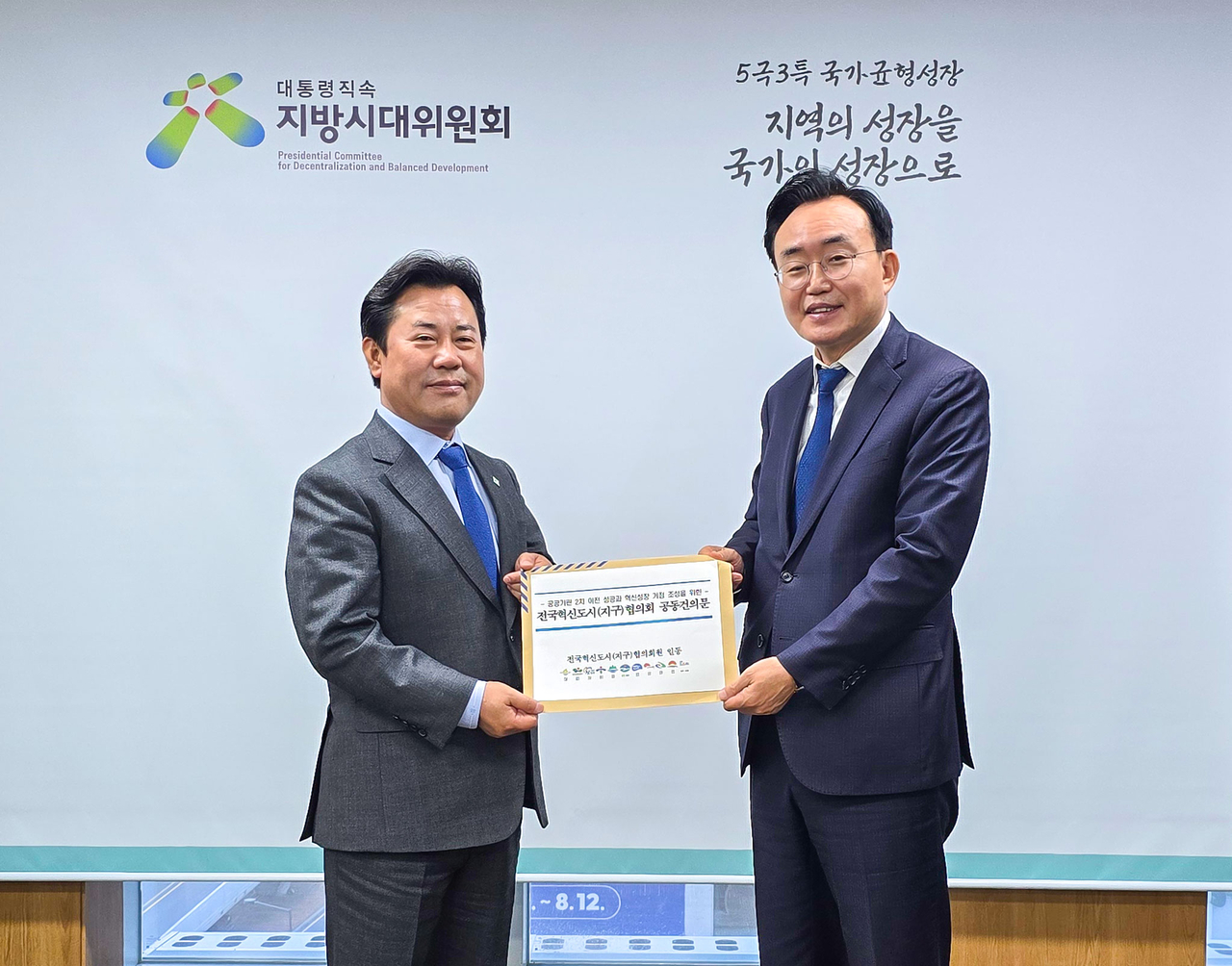
Naju, part of the newly merged South Jeolla-Gwangju Special Metropolitan City, has called on the government to uphold the principle of clustering public institutions around existing innovation cities as it finalizes plans for a second round of public institution relocations from Greater Seoul.
According to the city, Mayor Yun Byeong-tae visited the Presidential Committee on Balanced National Development on Monday and met with Committee Chair Park Jeong-hyeon. Yun requested a doubled relocation quota for the second round, preferential transfers linked to the administrative merger, the consolidation of five state power generation companies' unified headquarters in Naju, and strict adherence to the clustering principle centered on existing innovation cities.
The visit was arranged to request preferential relocation treatment in recognition of the Gwangju-South Jeolla joint innovation city and the country's first inter-metropolitan administrative merger, and to press the government to implement the public institution relocation policy it announced Sept. 3. Yun also attended in his capacity as chair of the 19th National Innovation City Council.
Yun said that given the founding purpose of Bitgaram Innovation City — the country's only inter-metropolitan joint innovation city — the second round of relocations should reflect the combined demand of both Gwangju and South Jeolla Province, effectively doubling the allocation.
Because Bitgaram was built by consolidating institutions originally assigned separately to Gwangju and South Jeolla during the first relocation round, Yun said the second round must give full weight to that unique character and policy background.
Yun also said the government's promised preferential relocation treatment must be written into the final relocation plan so that the South Jeolla-Gwangju Special Metropolitan City — the country's first inter-metropolitan administrative merger — can serve as a leading model for balanced national development.
To that end, Yun requested faithful implementation of the preferential relocation provisions for the merged special metropolitan city under Article 144 of the Special Act on the Establishment of the South Jeolla-Gwangju Special Metropolitan City, as well as the existing innovation city relocation principles under Article 29 of the Special Act on the Creation and Development of Innovation Cities.
Yun also urged the government to relocate additional public institutions linked to the region's strategic industries — including the National Agricultural Cooperative Federation and the Korea Energy Technology Evaluation and Planning Institute — and pushed for Naju to host the unified headquarters of the five state power generation companies.
Naju is already home to Korea Electric Power Corporation, the Korea Power Exchange, Kepco Plant Service & Engineering, Korea Electric Power Data Network and the Korea Institute of Energy Technology, along with a cluster of energy-sector companies in the Energy Valley, making it the country's premier energy industry hub.
Yun said adding the five power companies' unified headquarters would strengthen functional linkages across the entire power industry value chain — from generation and transmission to power trading, power ICT and research and development — and boost both the competitiveness of the energy sector and the spillover benefits to the local economy.
In addition to raising Naju's local priorities, Yun delivered the collective demands of all 11 member cities of the National Innovation City Council, which he chairs.
He conveyed the council's concern that the scale of relocations could fall short of the government's original plan and that the announcement of a detailed relocation schedule has been delayed, and urged the government to faithfully carry out the basic principles for public institution relocation it announced Sept. 3.
Yun handed over a joint petition adopted at a rally held Wednesday in front of the National Assembly building, where all 11 member cities of the council gathered, and called for responsible follow-up action from the government.
The petition laid out five core demands: minimizing the number of institutions that remain in Greater Seoul and ensuring that genuine decision-making authority moves with headquarters; upholding the principle of clustering relocations around existing innovation cities; maintaining the originally planned scale of relocations and having the government commit to a concrete relocation plan; strengthening government support for residential conditions and establishing a dedicated innovation city support agency; and improving the regulatory framework and expanding corporate support to energize industry-academia-research clusters.
Yun said the central government must take responsibility for deciding where each institution is placed — taking into account functional linkages and the characteristics of regional industries — so that the relocation policy does not devolve into a competition among regions, and must maximize the clustering benefits of existing innovation cities.
"The second round of public institution relocations is a national task to create new engines of regional growth by clustering related institutions around existing innovation cities," Yun said. "The unique circumstances of South Jeolla-Gwangju — the country's only inter-metropolitan joint innovation city and its first inter-metropolitan administrative merger — must be reflected in the government's final plan through a doubled and preferential relocation quota."
"We will attract the unified headquarters of the five power generation companies to Naju, the heart of Korea's energy industry, to strengthen the sector's competitiveness and open new growth opportunities for the region," Yun added. "As chair of the National Innovation City Council, I will work alongside all 11 member cities to ensure the government's relocation policy is faithfully implemented and that innovation cities can emerge as key growth hubs for balanced national development."
kkm9971@heraldcorp.com




