
- Design and operation platform to be completed by 2030
- Technology to link with KSTAR experiments and future reactor design
South Korea is moving ahead with a project to develop AI technology that would allow researchers to design and operate a nuclear fusion reactor entirely in a virtual computer environment before any physical device is built.
The Korea Institute of Fusion Energy held a symposium Tuesday at its headquarters in Daejeon to present progress on its AI-based digital virtual fusion reactor platform project and outline plans for its future use.
Fusion power works by replicating on Earth the process the sun uses to generate energy — fusing light atomic nuclei together in an ultra-high-temperature plasma state to produce energy.
Optimizing the design and operating conditions of a fusion reactor is notoriously difficult, however, because the ultra-hot plasma, magnetic fields and complex device structures inside the reactor interact in intricate ways. Building and testing physical devices also demands enormous time and cost.
The AI-based digital virtual fusion reactor is the key technology aimed at overcoming those challenges.
The approach recreates the structure and operating environment of a real fusion device inside a computer, then uses AI to run simulations across a wide range of design conditions and operating scenarios. Researchers can identify design flaws and search for optimal operating conditions before any physical hardware is built.
The institute has been running the AI-based digital virtual fusion reactor platform development project since this year, with a target completion date of 2030.
The goal is to integrate reactor design and analysis technology into a single digital environment and develop AI-driven design optimization, virtual experimentation, and plasma diagnostics and control capabilities.
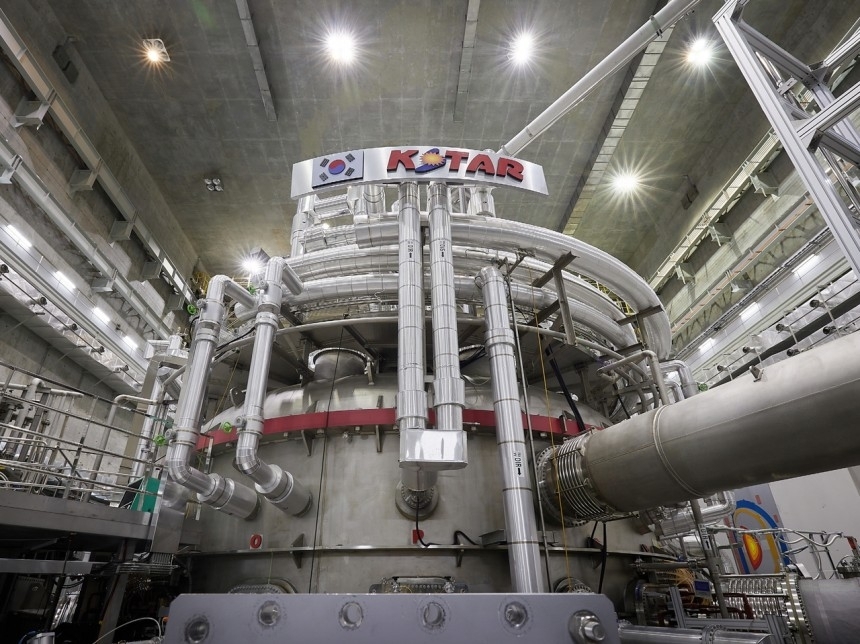
Central to the effort is V-KSTAR (Virtual KSTAR), a digital replica of KSTAR, South Korea's superconducting fusion research device.
V-KSTAR is a virtual fusion device that reproduces the structure and operating conditions of the real KSTAR in digital space, enabling researchers to test various plasma operating conditions and validate AI diagnostics and control technologies.
Researchers plan to link V-KSTAR with actual KSTAR experiments to improve the accuracy and reliability of the AI systems, with the aim of developing technology that can analyze plasma states with greater precision and identify stable operating conditions.
The technology is expected to advance KSTAR's experimental and operational capabilities and inform the design of South Korea's next-generation innovative fusion reactor.
"AI and digital technology are essential tools for overcoming the limitations inherent in the complex design and operation of fusion reactors," Korea Institute of Fusion Energy President Oh Young-kook said. "We will strengthen collaboration by pooling the research capabilities of industry, academia and research institutions to improve the efficiency and reliability of fusion technology development."
nbgkoo@heraldcorp.com




