
Ministry of SMEs and Startups, Ministry of Land, Infrastructure and Transport expand bank loan interest support
Lawmakers question why direct loans are being cut despite growing budgets
Critics warn savings may be funneled to other programs; vulnerable borrowers at risk
The government's push to scale back direct lending programs in favor of subsidizing interest on private bank loans — a method known as "icha bojon," or interest rate differential support — is drawing repeated criticism in the National Assembly. Lawmakers have raised concerns that savings freed up by cutting direct loans may be channeled excessively into other programs, and that the accumulating cost of interest subsidies could become a long-term fiscal burden.
The controversy surfaced during the National Assembly's budget and accounts review process, centering on the Ministry of SMEs and Startups' small business policy funds and the Ministry of Land, Infrastructure and Transport's Housing and Urban Fund. Interest rate differential support is typically used for emergency or temporary programs, and lawmakers are questioning whether converting direct loans to this format is appropriate even as overall budgets are expanding.
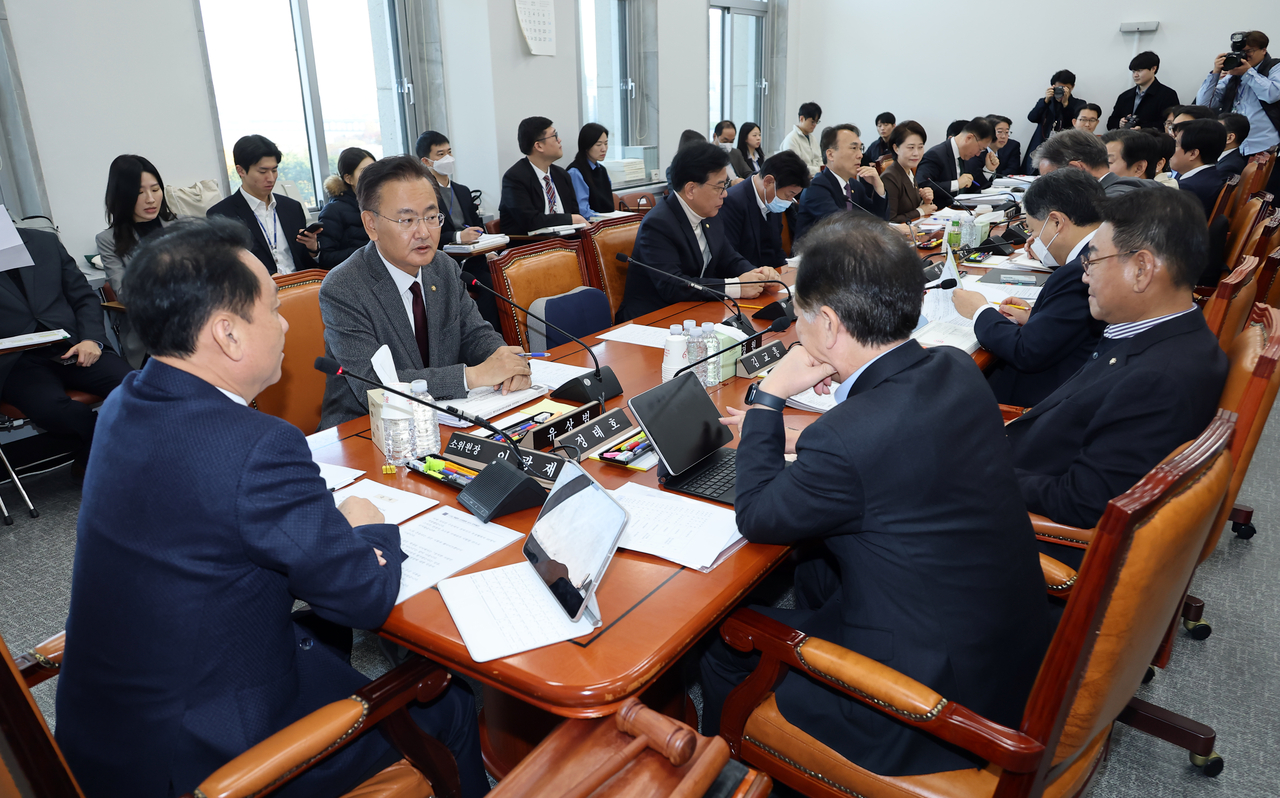
The Ministry of SMEs and Startups eliminated a 1.22 trillion won ($906 million) direct loan program for small business general management stabilization funds for next year, replacing it with a 20 billion won interest subsidy program. At the National Assembly Budget and Accounts Special Committee's budget subcommittee on Friday, People Power Party lawmaker Song Eon-seog said he could not understand why the government was cutting 1.2 trillion won in loans and converting them to interest subsidies while squeezing out additional funds when revenues are growing. "When tax revenues are coming in well like now, the longstanding fiscal principle has been to convert programs that were run as interest subsidies back into direct loans," Song said.
Fellow People Power Party lawmaker Lee Jong-wook also raised concerns, saying that while the Ministry of SMEs and Startups' budget for next year increased by 1.5 trillion won, factoring in the reduction in direct loans meant the ministry's spending power had in effect grown by 2.7 trillion won. "The conversion to interest subsidies must not be used as a means of securing funds for other programs," Lee said.
The Ministry of SMEs and Startups has maintained that the shift allows it to expand loan supply with a smaller budget. However, a review report by the National Assembly's Trade, Industry, Energy, SMEs and Startups Committee warned that the change could reduce access to policy funds for low-credit, low-collateral small business owners who would struggle to pass a commercial bank's loan screening.
Similar concerns have emerged around the Housing and Urban Fund. An analysis by the office of Democratic Party of Korea lawmaker Jang Jong-tae found that the fund's interest subsidy budget reached 1.69 trillion won in 2025. Even as interest rates fell in 2024 and 2025, the amount disbursed rose 49 percent and 22 percent in those respective years, as new loans were added on top of existing ones still receiving interest support, causing costs to accumulate.
Jang has argued that as interest subsidy programs multiply, it becomes increasingly difficult for the National Assembly to track the long-term costs the government will be obligated to bear. In August, Jang introduced a bill to amend the National Finance Act that would require the government to attach a fiscal projection covering at least five future fiscal years — including outstanding loan balances for each interest subsidy program — whenever it submits a budget proposal or fund management plan.
thanks@heraldcorp.com




