
Tuesday morning forum at Le Méridien Seoul Myeong-dong
'Gasoline sales in Korea fell just 1.5% from April to September — price controls distorting market'
'Price cap benefits concentrated among high-income households, raising equity concerns'
Government urges caution, citing difficulty in gauging oil price stability
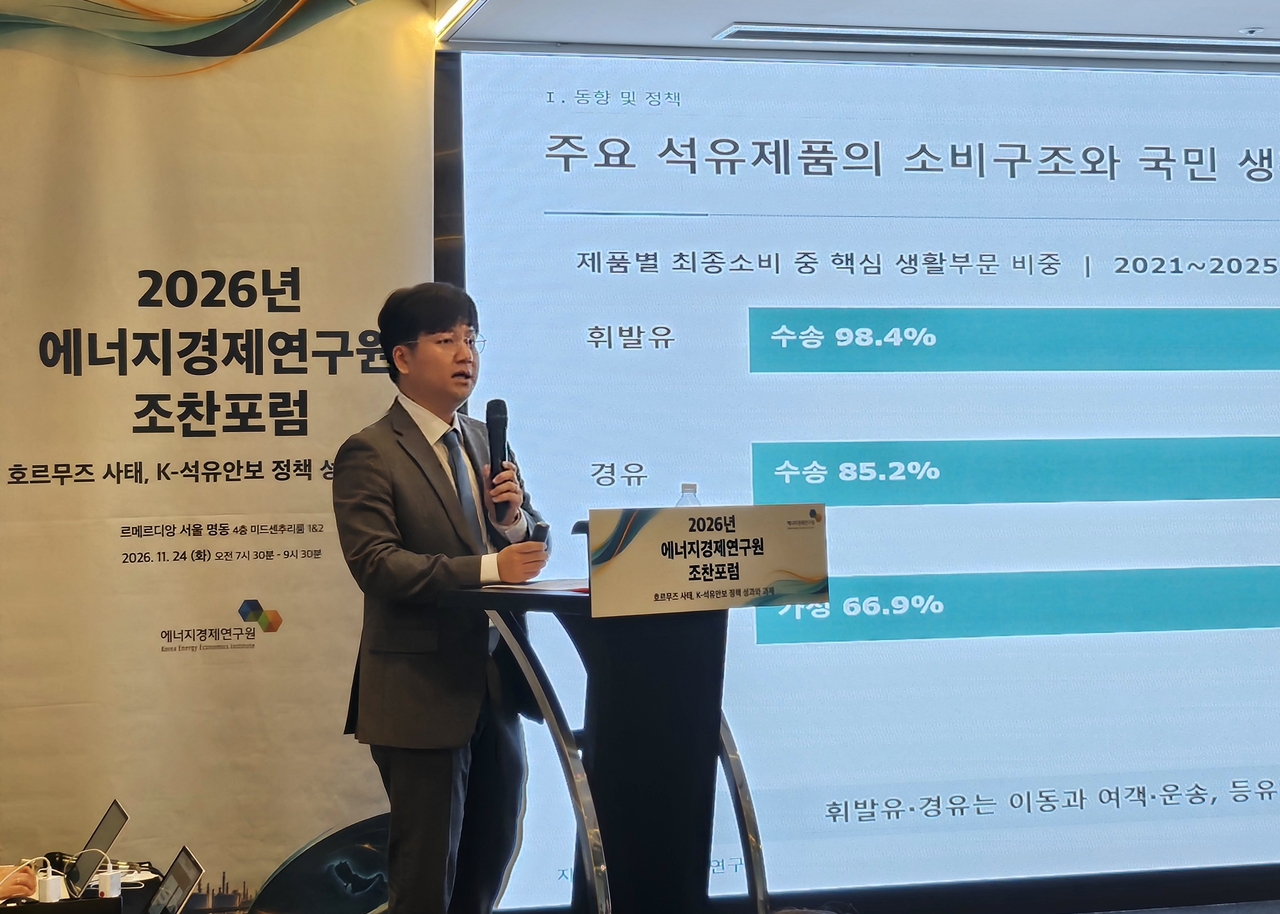
The Korea Energy Economics Institute, a state-run energy research body, has called on the government to develop a phased exit strategy for the petroleum product price cap and to notify the market in advance of when the policy will end. The government, however, stood firm in its cautious stance, saying the ongoing Middle East war leaves little sign of international oil prices stabilizing.
Jang Tae-hun, an associate research fellow at the institute's petroleum policy research division, made the remarks Tuesday morning at a breakfast forum titled "Hormuz Crisis: Achievements and Challenges of Korea's Oil Security Policy," hosted by the Korea Energy Economics Institute at Le Méridien Seoul Myeong-dong.
The institute's analysis found that the prolonged enforcement of the petroleum price cap — in effect since March — has generated a range of market distortions. "The market is in a distorted state due to artificial price controls," Jang said. "Looking at gasoline sales volumes, Korea saw a 1.5 percent decline from April to September compared with the same period last year, while the United States, which made no market intervention, recorded a 2.5 percent drop."
Jang also raised equity concerns. "The groups benefiting from the price cap policy are those who own cars and drive frequently," he said. "Given that relatively affluent households tend to own more vehicles, the policy has created an equity problem."
Jang went on to say that while the policy's core goal of easing the public's financial burden had been effective, the prolonged duration was allowing costs to accumulate. "If the policy were scrapped today, it could cause significant disruption," he said. "We need to think about an exit strategy and announce in advance under what conditions the policy will be phased out, so that consumers and producers can make informed decisions."

The government, however, said it has no choice but to take a conservative approach to ending the price cap given market volatility. Yang Jeong-hwa, director of the petroleum industry division at the Ministry of Trade, Industry and Resources, said at the subsequent panel discussion that gasoline prices had fallen to $96 in July before nearly doubling shortly afterward. "Because oil prices fluctuate so sharply depending on the intensity of the Middle East war, it is difficult to judge whether a price decline marks a period of full stability," Yang said.
On the question of announcing a price cap end date in advance, Yang drew a line, saying such a move "would have the advantage of improving predictability, but could also trigger disruption in the retail market, such as hoarding, and must therefore be reviewed with caution." Regarding the scale of the first round of loss compensation to be paid to refiners — which the government plans to notify soon — Yang said the ministry was "moving through the relevant procedures as quickly as possible to ensure disbursement and support within the year."
Participants also argued that the policy of diversifying crude oil sources to reduce dependence on Middle Eastern supply should continue beyond the current crisis. According to a Korea Energy Economics Institute survey, Japan's crude oil procurement from the Middle East fell 52 percent after the conflict began in March, while Korea's declined by only 22 percent.
The institute attributed Korea's smaller reduction to government support measures, including reimbursing refiners for the additional freight costs of sourcing crude from outside the Middle East. The share of Middle Eastern crude in Korea's total imports, which had exceeded 70 percent, fell to the low-60-percent range between January and August.
Kim Tae-hwan, a research fellow at the institute's petroleum policy research division, said that while Japan had relied primarily on its stockpiled crude to manage the crisis, Korea had responded by actively sourcing oil from non-Middle Eastern regions on top of drawing down its reserves.
Kim then said the crude oil supply diversification support regime was first established in the 1980s, was later abolished, and has seen its volume and contract requirements revised repeatedly. "However, because refiners plan their contracts on a quarterly — and over longer horizons, annual — basis, the system needs to operate as a permanent regime to eliminate uncertainty," Kim said.
klee@heraldcorp.com




