Triple bill marks first anniversary of the choreographer's death
Van Manen arranged the program order four days before he died
A fledgling company received his first licensed works
As the bandoneon draws a ragged breath, a single body enters the stage. That body is a collection of musical notes: every shift of the foot becomes a melody, a rhythm. The dancer is Choi Young-gyu, principal guest artist of the Seoul Ballet Theatre and a principal with the Dutch National Ballet. He springs and turns over the percussion's staccato, then stops blade-sharp at the end of each phrase. A slow curl of the lips, a gaze laced with quiet seduction — the musicalized body heats the auditorium in an instant.
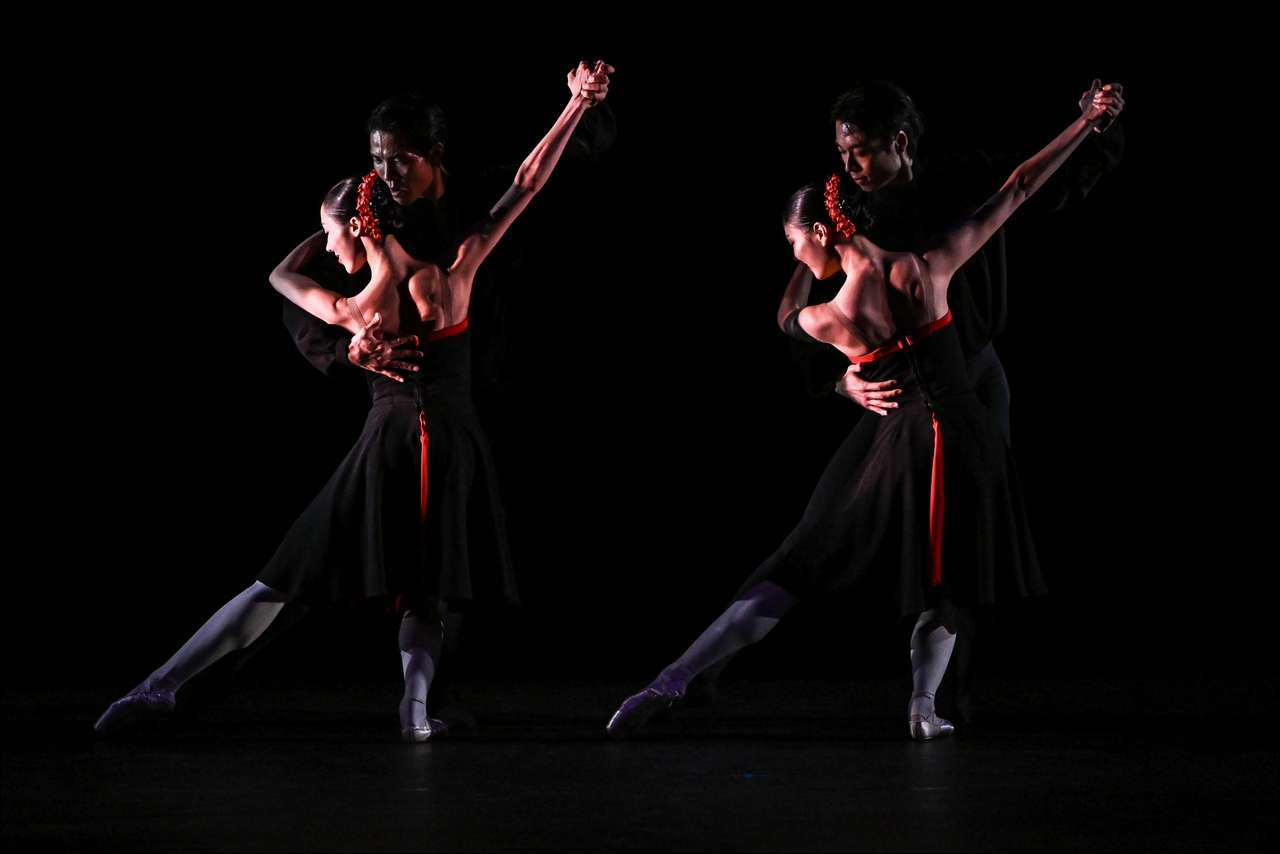
Before that warmth can fade, the stage's heat condenses into taut silence. Two male dancers in black fix their eyes on each other and close the distance one step at a time, their expressions impossible to read as partner or rival. Without a word, they intertwine and generate a strange gravitational pull. Female dancers in dresses that flash red beneath black skirts glide in, and the precarious tension hovering between the two men shifts, almost imperceptibly, into the dense sensuality of male-female couples. It is the climactic moment of Dutch choreographer Hans van Manen's "5 Tango's" (1977).
The Seoul Ballet Theatre's triple bill "All for Hans van Manen" — staged Thursday through Sunday at the Sejong Center for the Performing Arts — was a first-anniversary tribute to the "Mondrian of dance," who died last December. "Kammerballett" (1995), "Grosse Fuge" (1971) and "5 Tango's" (1977) were presented in that order over 120 minutes, separated by two intermissions. The sequence, which runs counter to the works' chronology, was chosen by van Manen himself. It was the last cue sheet he ever wrote — handed to Sejong Center for the Performing Arts President Ahn Ho-sang at van Manen's Amsterdam home on Dec. 14 last year, four days before the choreographer died.
Van Manen left no explanation for the order. Yet once all three works have been seen, a precise dramatic arc comes into focus. The cast expands from eight dancers over a solo piano ("Kammerballett") to eight over Beethoven's string ensemble ("Grosse Fuge") and then to fourteen over Piazzolla's tangos. The textural density of the sound and the physical density of the bodies both build in step. So does the quality of the gaze. In "Kammerballett," dancers seated apart size each other up from a distance; in "Grosse Fuge," bodies press together yet eyes still slide past each other; only in "5 Tango's" do they finally lock head-on. The arc moves from reconnaissance to collision to confrontation — a dramatic curve whose final image is earned.
Turning chairs, gripping belts
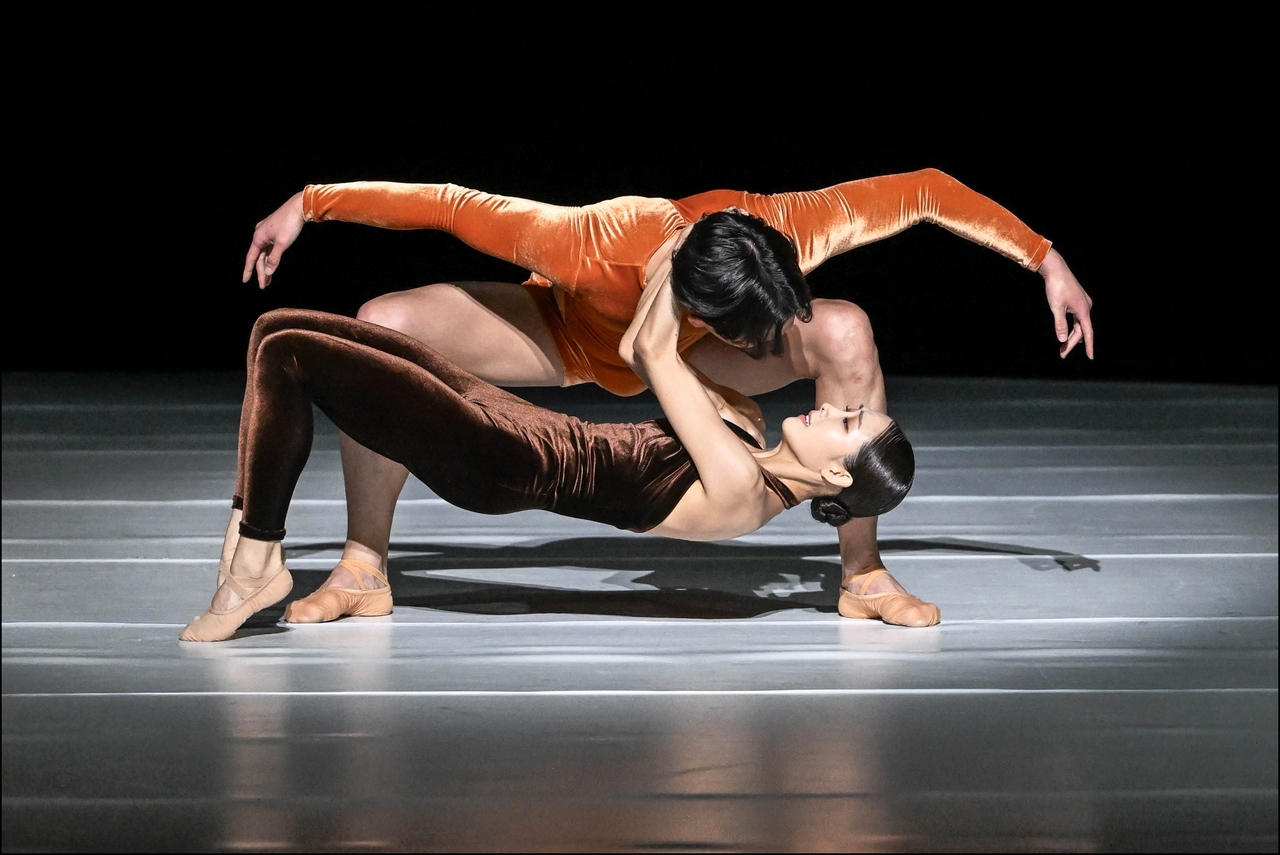
A small room defined by a circle of light — that is the world of "Kammerballett." Eight dancers in yellow, orange, brown and black leotards each carry a backless wooden chair onto the stage. Where a dancer sets the chair down becomes personal territory; the moment someone encroaches, the boundary trembles. As piano preludes by Kara Karayev, sonatas by Domenico Scarlatti and John Cage's "In a Landscape" take turns flowing through the space, the dancers move between pas de deux and ensemble around their chairs, gathering and dispersing. Scarlatti's crisp touch and articulation punctuate the tips of the toes with clean precision, while Cage's quiet harmonies and silences spread long and slow across bodies held still.
Dancers seated in a ring at the edges watch whoever is dancing at the center with unwavering attention. Syncopated steps that land just off the piano's downbeat lay a quiet tension over the serene melody. Dancers steal glances, push each other away, catch a tilting body — and yet nothing that could be called a story ever happens. The audience holds its breath all the same. Van Manen once said, "The moment I place two people in an empty room, I am already expressing atmosphere and relationship." The stage proves him right.
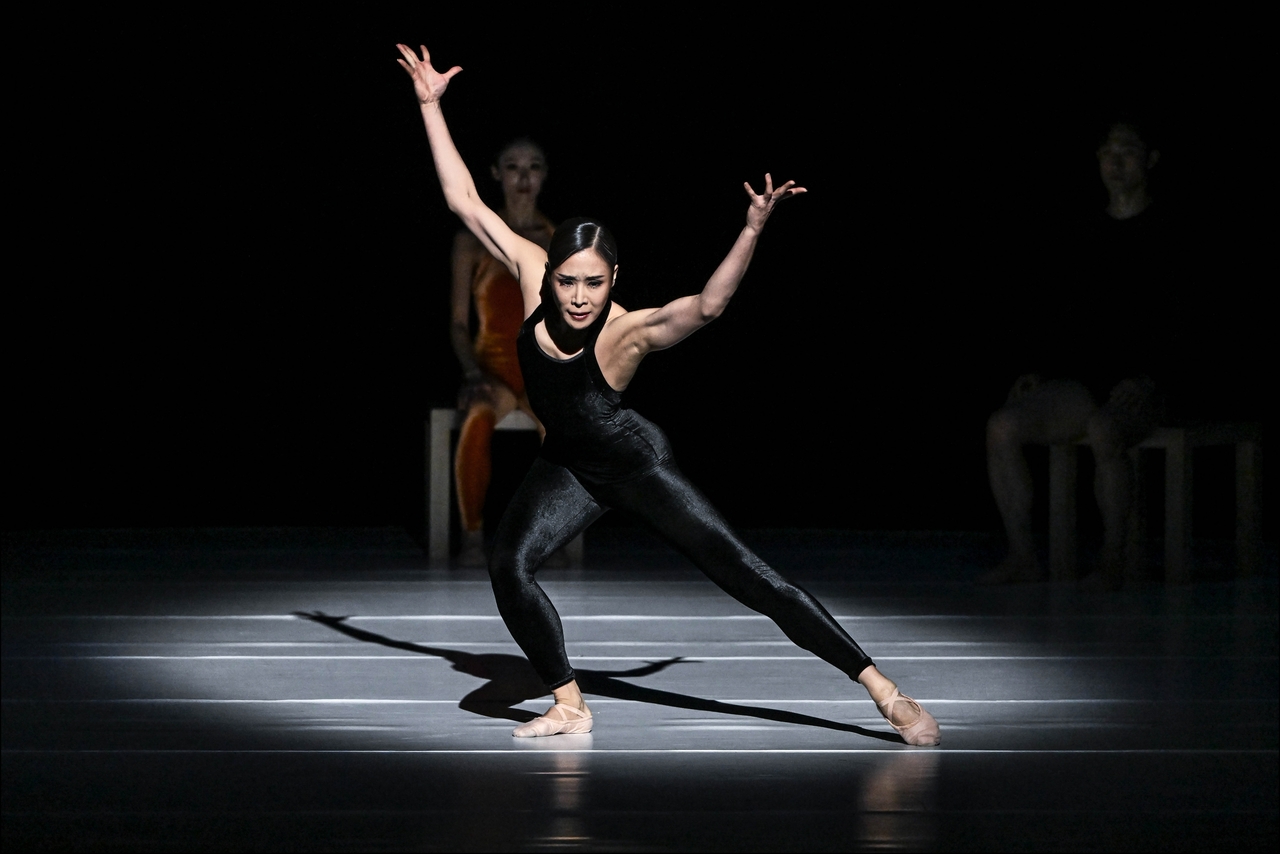
A single figure changes the atmosphere in the second half. As the female principal begins to dance alone, the other dancers turn their chairs to face inward and watch. The moment every gaze converges on one person, the small room's order is overturned. The position that draws all eyes is a throne — and the loneliest place on stage. Principal guest artist Kang Hyo-jeong, a principal with the Semperoper Ballet in Dresden, bears the weight of that position not through facial expression but through the restrained angle of her breathing and port de bras alone. Kang had performed the same work with the Stuttgart Ballet a decade earlier, in 2016.
In "Grosse Fuge," the air ignites. Four male dancers enter bare-chested in long black skirts that drag the floor, stamping their feet and thrusting clenched arms in straight lines overhead. The energy compressed between restraint and release radiates masculinity. Van Manen designed the costumes himself.
Beethoven's "Grosse Fuge" (Op. 133, in Felix Weingartner's orchestral arrangement) — its voices each insisting on their own path, scraping against one another in fierce counterpoint and dissonance — becomes the blueprint for a power struggle between four male-female couples. Four female dancers in sheer costumes stand motionless as sculptures for a long moment, measuring the gaps between the men with sharp eyes.
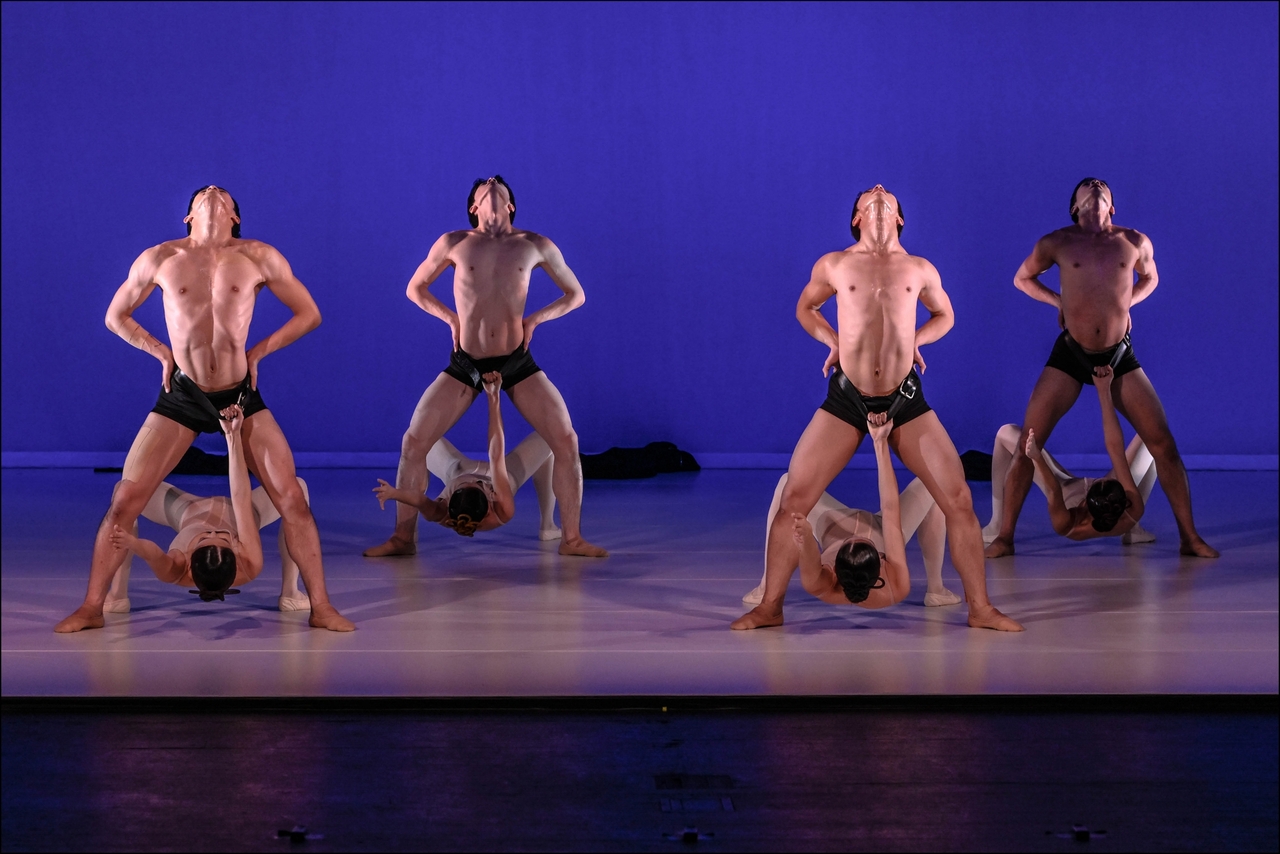
The work's peak arrives after the men shed their skirts. It comes during the slow, deep lyricism of the "Cavatina" — the fifth movement of Beethoven's String Quartet No. 13, Op. 130. The men's short bottoms reveal thick belts and buckles, and the women, lying on their backs, arch their bodies upward and grip those belts. Where classical ballet's grand lifts and leaps once stood, the women now hang from the belts and pull their partners toward them using nothing but their own grip strength and core — no male support required. The scene is boldly suggestive of sex, yet the agency in the partnering belongs to the women. The grammar of classical ballet — man lifts, woman is held — is overturned by a single belt.
The sensuality is real, but the bodies never feel crude. Even as the dancers press against each other, they avoid each other's eyes and focus on their own lines and counts. Explicit desire remains not spectacle but the mechanics of a relationship.
Around 1971, when the work was created, women in the Netherlands were demanding the right to make decisions about their own bodies. In January 1970, the feminist group Dolle Mina launched its first action, and on March 14 that year, ten members stormed a gathering of gynecologists in Utrecht to protest for abortion rights. The words "baas in eigen buik" — "boss of my own belly" — were written across the women's bare abdomens. The photograph of that moment became an iconic image of the second wave of the Dutch women's movement.
Van Manen, too, had touched on bodily taboos the year before, in 1970, when he and Glen Tetley filmed nude dancing in "Mutations." He had long maintained that "dance expresses only dance," and he never overlaid his works with explicit social messages. Yet "Grosse Fuge" — in which women grip the men's belts and take control of the partnering — captured the air of an era when the old order surrounding women's bodies was beginning to crack.
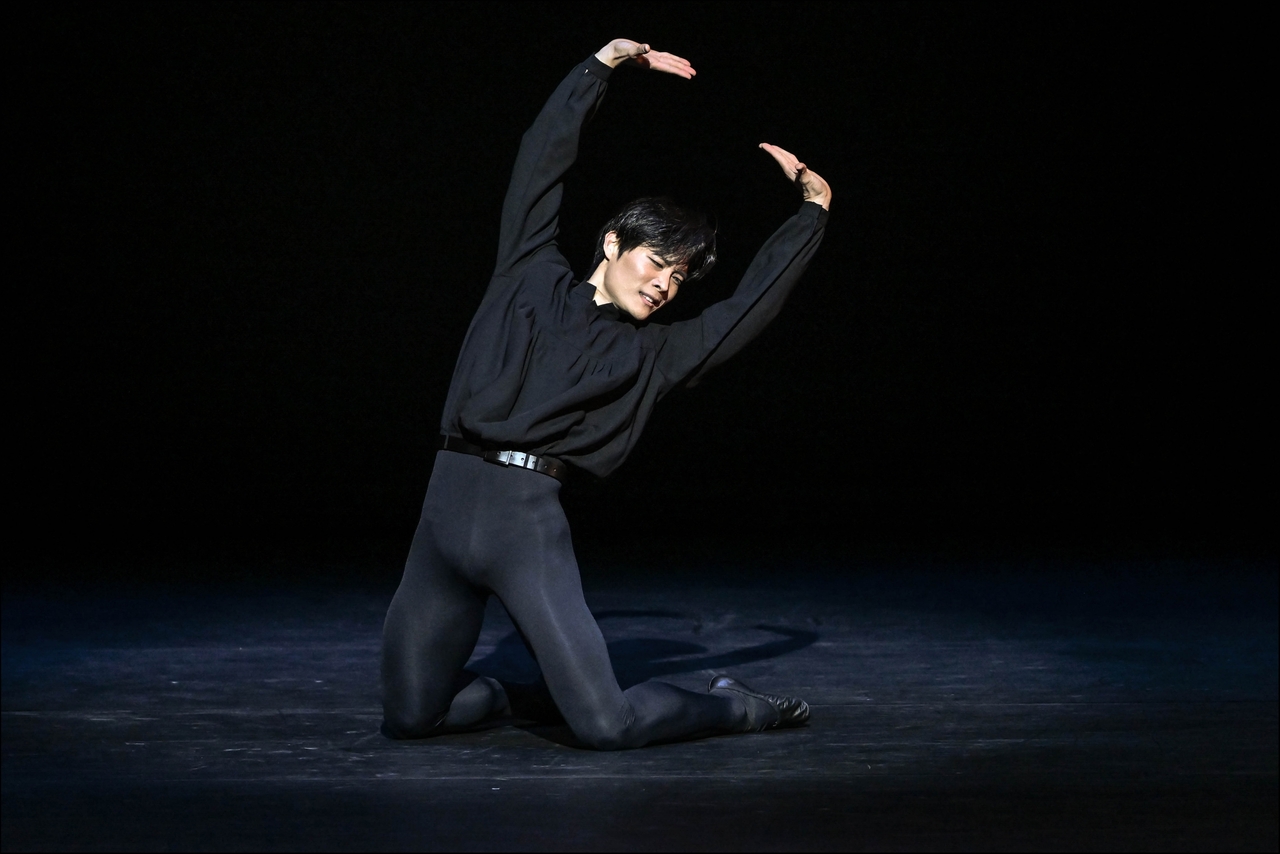
Bodies become music, glances become tango
The final work is an hour of pure sensuality. Jean-Paul Vroom's costumes in red and black sweep away the achromatic restraint of the two preceding pieces entirely. Fourteen dancers race through five of Astor Piazzolla's nuevo tango pieces and raise the temperature of the house. When the work premiered in 1977, Piazzolla was an unfamiliar name in the Netherlands, and local critics dismissed his music as ordinary and simplistic. Yet the piece — fusing the vertical lines of classical ballet with the horizontal closeness and sharp accents of tango — became one of van Manen's signature works, performed by companies around the world.
Choi Young-gyu, who unleashes powerful energy in the third tango, "Vayamos al diablo," is the dancer who has absorbed van Manen's choreography most intimately. Even amid dazzling technique, he never loses the controlled line or the dense breath. The fourth tango's structure is also striking: a male duet that resolves only with the entrance of a woman. In late-19th-century Buenos Aires, the birthplace of tango, European male immigrants far outnumbered women, and men paired with each other to practice the dance while waiting for female partners. The male duet is a mirror held up to that history. The two men's gazes, colliding as if to announce themselves to the world, invite more interpretations than can be counted.
In its obituary, Nederlands Dans Theater honored van Manen as "a pioneer who expressed queer identity through dance at a time when that was not taken for granted." Van Manen had participated in the Dutch gay rights movement, yet in a 2024 Pride interview he drew a line: "I am as gay as can be, but I have never made 'homosexual' art." The two men's gaze, too, remains open space — available to each audience member's own reading. What mattered to van Manen was not the gender of the partner but the tension between two bodies standing face to face.
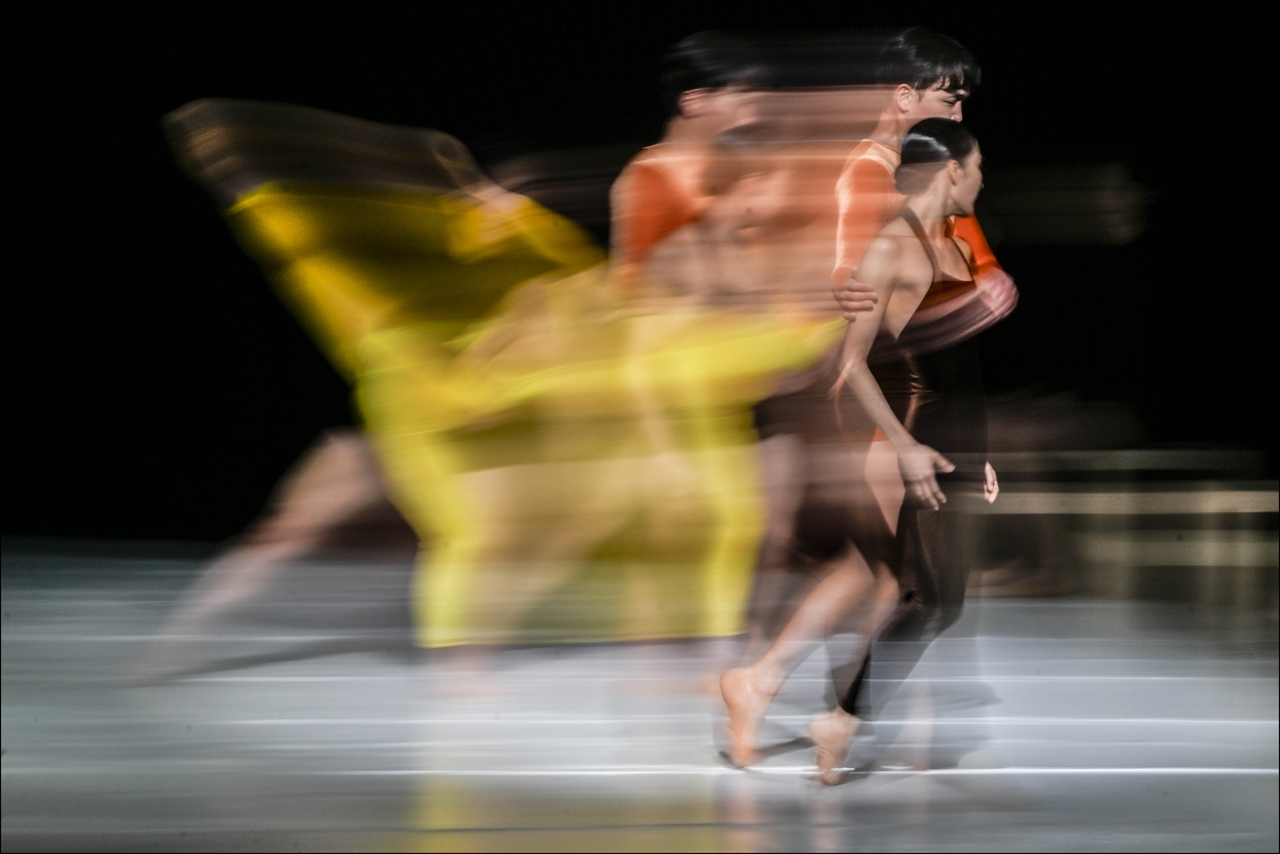
Three works given to a fledgling company
What makes this program especially meaningful is that all three works are woven into the brief history of the Seoul Ballet Theatre itself. Shortly after the company's founding in 2024, when it had yet to build a repertoire, van Manen readily offered "Kammerballett" as its first licensed work from abroad. The company gave the piece its Asian premiere that October. At its first-anniversary program the following August, it staged the Asian premiere of "5 Tango's," and this year it introduced "Grosse Fuge" to Korean audiences for the first time. Rather than consuming a master's repertoire as a one-off event, the company has layered the works into its own physical vocabulary over three years, one piece at a time. When Ahn relayed the Korean audience's response to van Manen last December, the choreographer was said to have been delighted by the young company's growth.
The growth of the company's dancers — now in their third season — was conspicuously evident on stage. Choi Mok-rin, who partnered Choi Young-gyu in "5 Tango's," had taken on a lead role in "In the Bamboo Forest" earlier this year and brought a noticeably deeper presence to this program. Dancing alongside Choi Young-gyu — whose command of movement, performance and musical expression is overwhelming — Choi Mok-rin held the tension taut. Kim Yeo-jin's flawless precision in "Kammerballett," Kang Jeong-a's intensity in "Grosse Fuge" and "5 Tango's," and Kim Young-min's provocative gaze and economical movement — which opened "5 Tango's" to countless interpretations — all showed the season's dancers weaving van Manen's grammar, calculated down to the smallest step and glance, without a single falter.
"In my ballets I try to use less and less movement. All unnecessary steps must be discarded," van Manen once said. True to that principle, he left his sharpest questions in the spaces he cleared. He shifted the center of power by turning a chair, upended the hierarchy of desire with a single belt, and dismantled the old boundaries of partnership through nothing more than the crossing of two gazes. On a Seoul stage, the master's choreography found its most contemporary body. It was a night of mourning — and of inheritance.
shee@heraldcorp.com