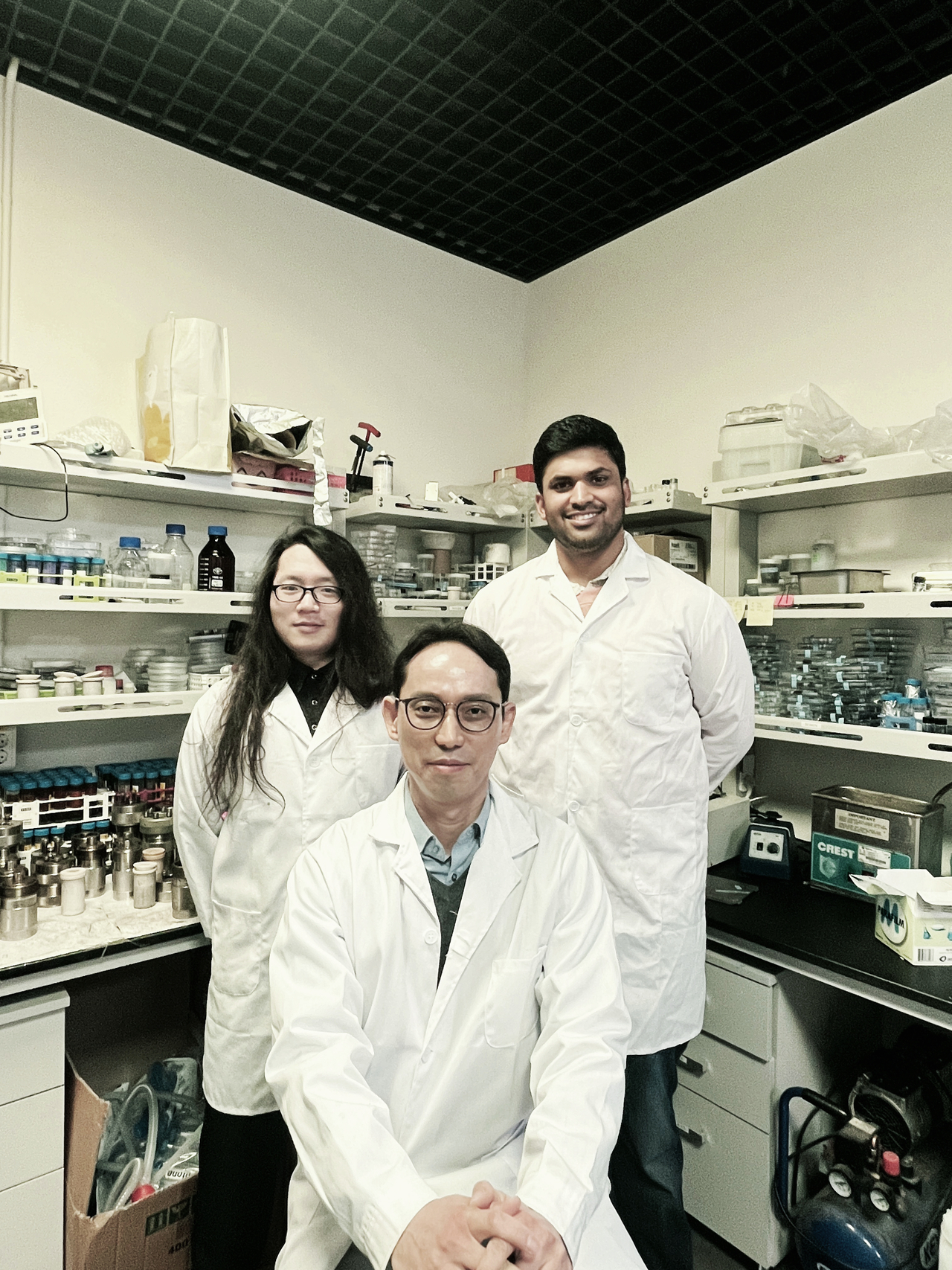
A research team at Ajou University has developed a technology capable of simultaneously mass-producing high-purity clean hydrogen and high-value solid carbon using a liquid metal nickel-bismuth (NiBi) alloy enhanced with a copper catalyst, the university announced.
The research, titled "Sub-valent copper-promoted nickel-bismuth alloy for enhanced methane conversion and high-quality carbon recovery during methane pyrolysis," was published in the November issue of Chemical Engineering Journal, an international peer-reviewed journal in chemical engineering. Doctoral students Gourab Mohapatra and Lee Young-jae of Ajou University's Graduate School of Energy Systems served as co-first authors, with Professor Seo Hyung-tak of the Department of Advanced Materials Engineering and Graduate School of Energy Systems as the corresponding author.
Hydrogen is widely regarded as a key energy source capable of shifting the global energy paradigm away from fossil fuels such as oil, coal and gas, which generate large amounts of greenhouse gas emissions. Because hydrogen makes up about 75 percent of the universe's mass, it can be used without producing greenhouse gases — only water is emitted — and hydrogen can in turn be produced from that water, making it a virtually inexhaustible resource. It is already used as fuel in passenger vehicles and various other forms of mobility, as well as in industrial and manufacturing processes, power generation and energy storage.
About 40 percent of the world's industrial hydrogen, however, is currently produced as "gray hydrogen" through steam methane reforming, a process that reacts methane — the primary component of natural gas — with high-temperature steam. The process generates large amounts of carbon dioxide, a leading driver of global warming. "Green hydrogen," produced by splitting water through electrolysis, has drawn attention as an ideal clean-energy alternative, but it consumes enormous amounts of electricity and requires expensive precious-metal catalysts such as platinum and iridium. As a result, electrolysis accounts for only about 2 percent of global hydrogen production.
To overcome these limitations, the Ajou team focused on catalytic methane pyrolysis, a process that directly decomposes methane into hydrogen and solid carbon without producing any carbon dioxide. The resulting "turquoise hydrogen" is considered the most practical and economical pathway to carbon neutrality.
The team addressed a critical weakness of conventional solid catalysts: surface deactivation, in which carbon deposits build up on the catalyst surface and interrupt continuous hydrogen production. In the team's approach, using a downward-injection bubble column reactor, methane gas passes through liquid metal in the form of bubbles and decomposes. The lightweight solid carbon produced in the process naturally floats to the surface of the liquid metal and can be easily separated, enabling continuous mass production without process interruption.
The core innovation lies in adding a small amount of copper chloride (CuCl₂) precursor to the liquid NiBi alloy catalyst, which dramatically improved both performance and stability. At a reaction temperature of 1,050 degrees Celsius, a NiBi catalyst containing 2 weight percent copper improved methane conversion — the decomposition rate — by 18.97 percent compared with a pure NiBi catalyst. It also significantly lowered the activation energy barrier required to drive the chemical reaction, from 209.08 kilojoules per mole to 196.68 kilojoules per mole, boosting reaction efficiency. In testing, the catalyst maintained a stable methane conversion rate of 47.21 percent for 25 hours in a pure methane environment and 42 hours in a diluted methane environment, with no catalyst deactivation, demonstrating outstanding long-term durability.
The carbon byproduct generated alongside hydrogen was recovered as high-quality few-layer graphitic carbon, which has significant industrial value. Such carbon materials are used as raw ingredients in tires and inks, as well as in secondary battery components.
Unlike conventional water electrolysis, which requires large amounts of expensive electricity, the Ajou team's process draws directly on abundant natural gas while producing no environmental pollution. The high-value graphitic carbon obtained as a byproduct can also be sold to offset the overall cost of hydrogen production, giving the technology strong commercial potential for next-generation clean hydrogen.
"This technology can simultaneously overcome the economic limitations of water electrolysis, which demands massive power infrastructure, and the environmental limitations of fossil fuel-based reforming processes," Professor Seo said. "We expect it to serve as a key foundation for accelerating the commercialization of large-scale turquoise hydrogen production with zero carbon dioxide emissions."
fob140@heraldcorp.com