3,592 CRE cases reported in Incheon through late October, up 10% from a year earlier
Incidence rate of 118.3 per 100,000 people far exceeds national average of 91.9
Long-term care hospitals' share of cases surges from 7.2% to 25.2% over nine years; isolation facilities and test-cost support urgently needed
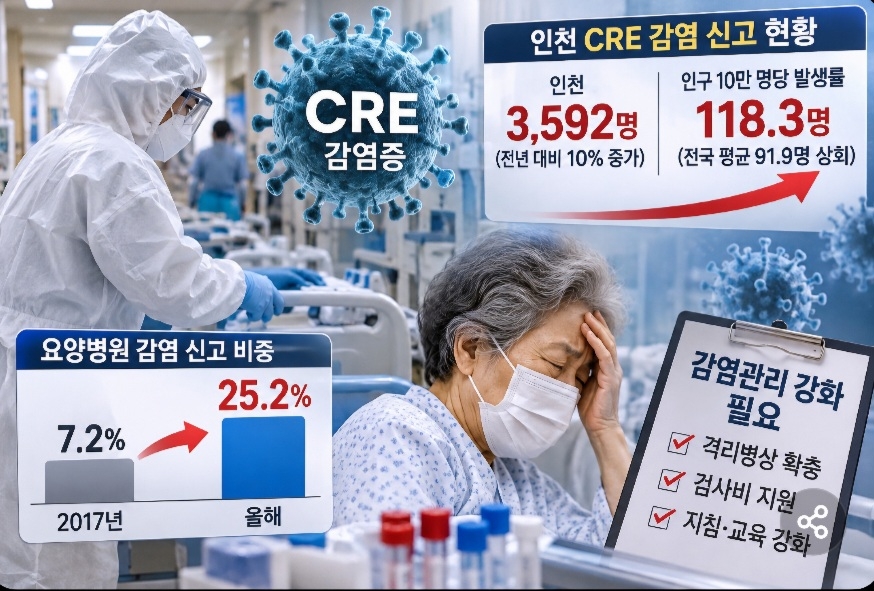
Carbapenem-resistant Enterobacteriaceae, or CRE, infections are rising in Incheon, prompting calls to strengthen infection control systems at medical institutions, including long-term care hospitals.
The share of CRE cases reported from long-term care hospitals has climbed rapidly, yet facilities on the ground are struggling to contain the spread due to shortages of isolation wards and related infrastructure, as well as the financial burden of testing. Pressure is growing for meaningful support from both local governments and the central government.
According to Incheon city, 3,592 CRE cases were reported in the city through late October this year, a 10 percent increase from the same period last year.
The incidence rate of 118.3 per 100,000 people significantly exceeded the national average of 91.9. The figures for this year are preliminary.
More alarming is the growing share of cases originating from long-term care hospitals. That share stood at just 7.2 percent of all reported cases in 2017 but has climbed to 25.2 percent this year, reflecting a mounting infection control burden at facilities that concentrate elderly patients.
The core problem is that medical institutions recognize the need for stronger infection control but lack sufficient facilities, personnel and funding to act on it.
A joint inspection of 10 long-term care hospitals in the greater Seoul area, conducted by central health authorities and local governments from June through August, found that basic management systems — including the operation of infection control offices — were in place. Gaps remained in day-to-day practice, however: continuous surveillance, contact precautions and antibiotic stewardship all fell short.
In other words, the institutional framework exists, but meaningful gaps persist at the implementation stage, where actual prevention of transmission takes place.
Recommendations that emerged from the inspection called for reinforcing infection control guidelines and expanding ongoing consulting services and surveillance culture support for individual medical institutions.
Experts also noted that the effectiveness of infection control cannot rest on the efforts of medical institutions alone.
Jung Jae-hoon, a professor of preventive medicine at Korea University College of Medicine, said that implementing multifaceted infection control interventions — drawing on domestic and international research — could reduce healthcare-associated infections by 35 to 55 percent.
Jung also said regular surveys are needed to establish an objective picture of the disease burden, along with evidence-based policy development.
The specific difficulties faced by frontline medical institutions also came into sharp focus.
In a pre-forum survey conducted by Incheon city, respondents identified isolation and cohort management (33.3 percent) as the single biggest challenge in infection control. The leading cause cited for that difficulty was a shortage of facilities and isolation beds (32.2 percent).
When asked what form of support between local governments and medical institutions was most urgently needed, 62.2 percent of respondents pointed to financial assistance for testing and supplies — the highest share by far.
The results signal that what is needed most is not more guidelines or training, but concrete fiscal backing: expanded isolation facilities, test-cost coverage and supplies for infection prevention.
Incheon city held a forum Monday at Oakwood Premier Incheon, bringing together about 120 officials from the Korea Disease Control and Prevention Agency (KDCA), the medical community and local health authorities to discuss community-level response strategies for strengthening the prevention and management of healthcare-associated infections.
Co-organized by Incheon city and the Incheon Metropolitan City Infectious Disease Control Support Center, the forum shared the findings of the joint CRE inspection at greater Seoul area long-term care hospitals and focused discussion on the state of infection control at medical institutions and possible community-level support measures.
A panel discussion moderated by Eom Jung-sik, head of the Incheon Metropolitan City Infectious Disease Control Support Center, brought together representatives from the KDCA, Incheon city, the Yeonsu-gu public health center, the Korean Society for Healthcare-associated Infection Control and Prevention, and the Korean Long-term Care Hospital Association to discuss on-the-ground difficulties and avenues for inter-agency cooperation.
Incheon city said it plans to review the expert recommendations and institutional requests raised at the forum and incorporate them into policy proposals and the direction of its healthcare infection management project for 2027.
"Healthcare-associated infections cannot be addressed by individual medical institutions acting alone," said Jo Myeong-hui, head of Incheon city's infectious disease management division. "We will review effective support measures based on what we heard from the field."
gilbert@heraldcorp.com