Ministry of Health and Welfare unveils fourth comprehensive basic livelihood security plan (2027–2029); 'self-reliance transition' exemption for medical benefits under review
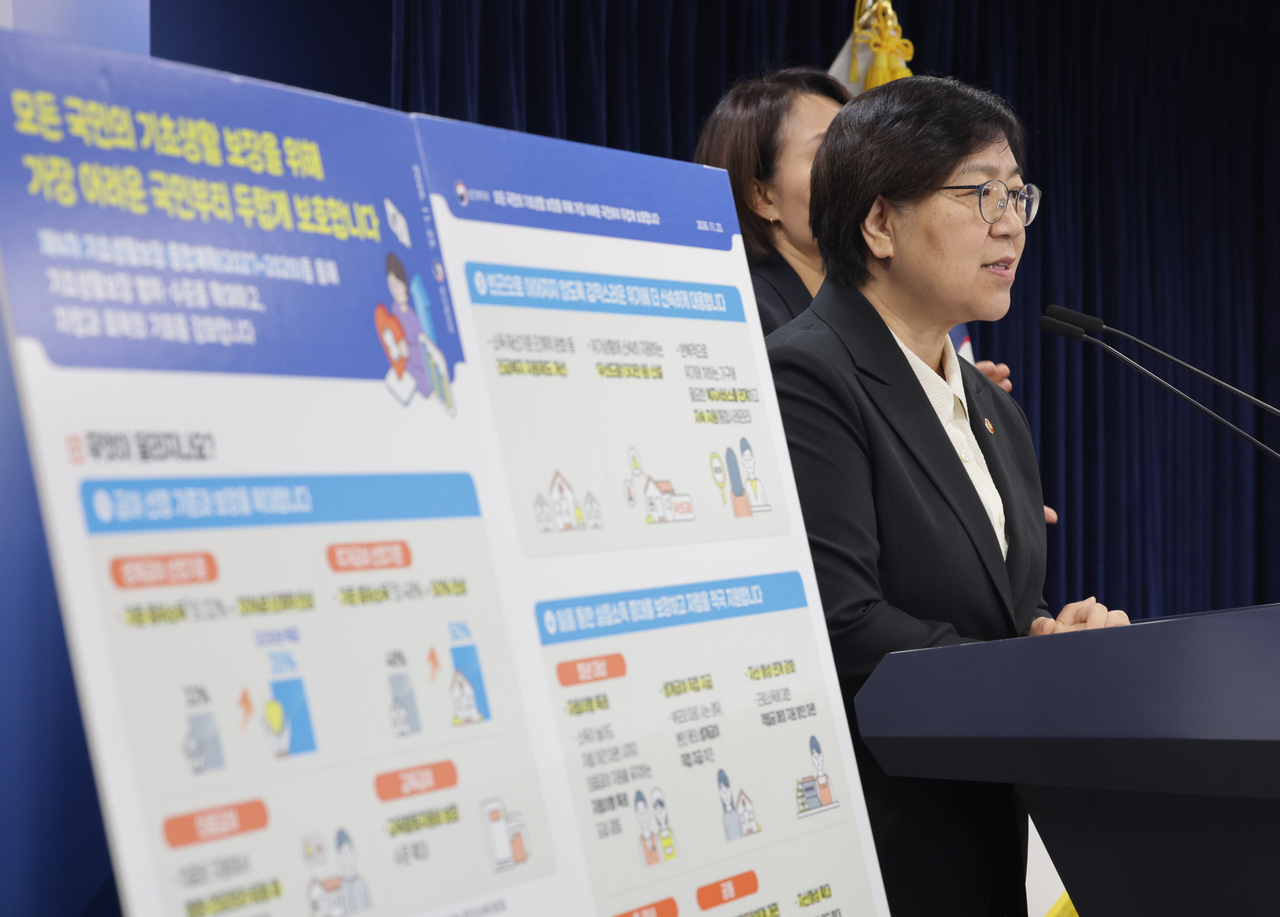
The government plans to gradually raise the eligibility threshold for livelihood benefits from the current 32 percent of median income to 35 percent by 2030, expanding the pool of recipients. It will also abolish the family support obligation requirement for livelihood and medical benefits for households with severely disabled members, and introduce a new emergency assistance program called "Useon Dream" that provides 300,000 won ($224) on the same day to households facing sudden crises.
The Ministry of Health and Welfare said Monday it had deliberated and approved the "Fourth Comprehensive Basic Livelihood Security Plan (2027–2029)" at the 81st Central Livelihood Security Committee meeting.
The fourth plan focuses on strengthening basic livelihood protections, closing gaps in coverage, preventing and helping people escape poverty, and laying the groundwork for earned income to lead to self-sufficiency.
Raising benefit levels and broadening coverage for those outside the system
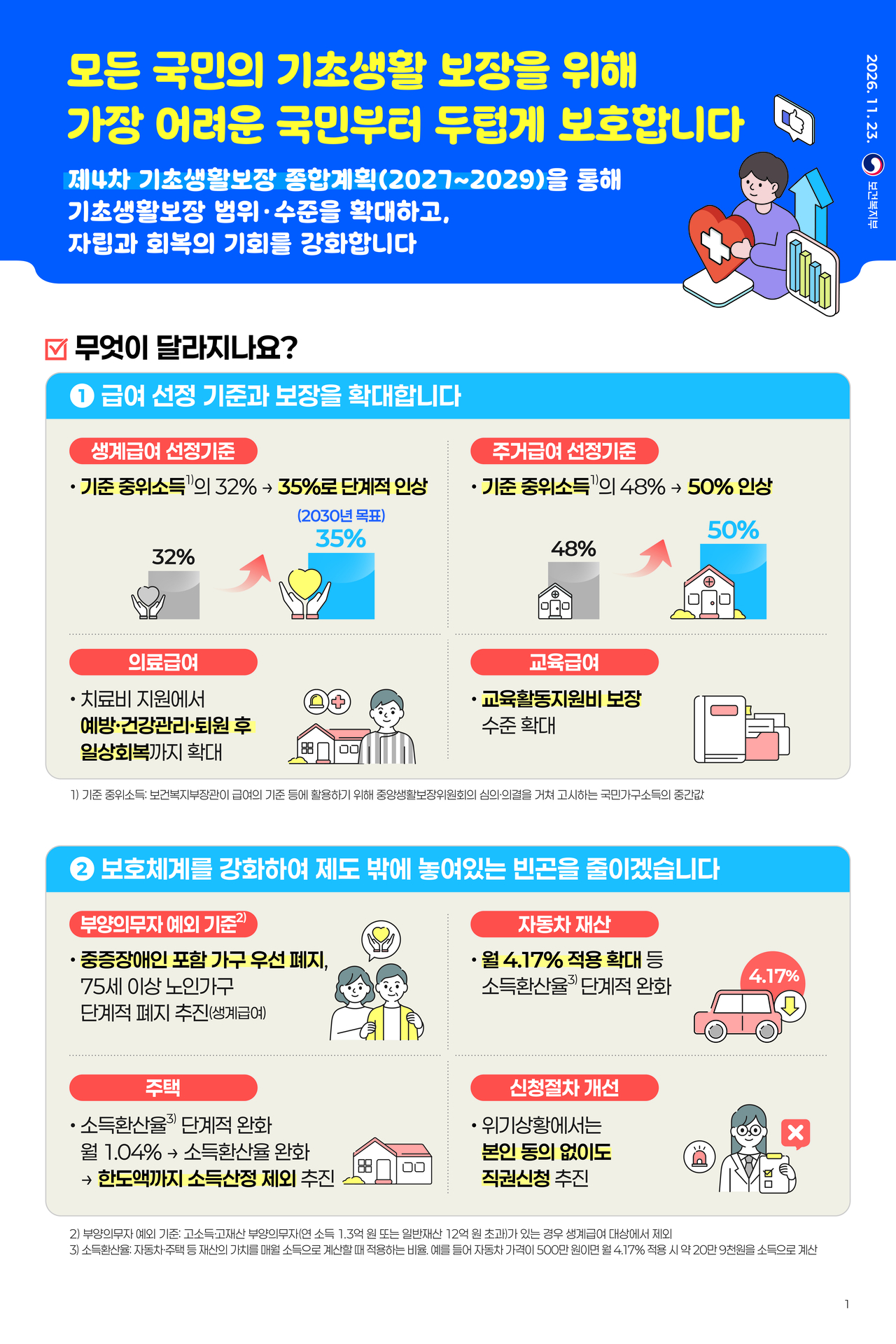
The government will expand the number of people eligible for livelihood benefits as part of efforts to strengthen basic protections for low-income households.
The eligibility threshold for livelihood benefits, currently set at 32 percent of the standard median income, will rise by 1 percentage point each year starting in 2028, reaching 35 percent by 2030.
The standard median income is the midpoint of household income nationwide and serves as the benchmark for determining eligibility for basic livelihood security benefits.
Because livelihood benefits are structured as a supplementary payment that fills the gap between a recipient's recognized income and the eligibility threshold, raising the threshold will also increase the maximum benefit amount, the ministry said, strengthening the minimum living standard guarantee for recipients.
For medical benefits, the government will expand health screening items available to recipients to eliminate disparities with national health insurance subscribers, and plans to cover nursing care costs at long-term care hospitals starting in the second half of next year.
The eligibility threshold for housing benefits will be raised in stages from the current 48 percent of median income to 50 percent, and the standard rental rate used to calculate housing benefits will also increase next year.
For education benefits, the educational activity support allowance per student will be raised to 100 percent of the minimum education cost for all levels — elementary, middle and high school — next year.
The application process for education benefits will also be streamlined. Currently, recipients must apply to their local government and then separately obtain a voucher from the Korea Student Aid Foundation. Starting with recipients in 2028, the benefit and voucher will be available through a single application.
Family support obligation scrapped for severely disabled households; 300,000-won 'Useon Dream' emergency aid launched
The family support obligation requirement for both medical and livelihood benefits will be fully abolished for households with severely disabled members.
Under current rules, even if a person is in financial hardship, they are excluded from livelihood benefits if a family member with a legal support obligation — such as a parent or child — earns more than 130 million won annually or holds assets exceeding 1.2 billion won.
The ministry expects the change to bring about 20,000 households that had previously been disqualified under the family support obligation rule back into the benefit system.
On top of that, the government is reviewing a plan to phase out the family support obligation requirement for livelihood benefits for households headed by people aged 75 or older by 2030. If abolished, an estimated 78,000 additional households would become eligible.
The government also plans to review easing the family support obligation requirement for medical benefits for households with high medical and care needs.
The formula for converting assets into income when determining benefit eligibility will be revised to better reflect current economic conditions. The existing conversion standard has drawn criticism for being overly complex and out of step with the times.
The income conversion standard for vehicles, which currently varies based on engine displacement, vehicle age, type and household size, will be simplified to focus primarily on market value. Luxury and high-end vehicles will be excluded.
The government also plans to ease the income conversion rate applied to housing assets and, over the long term, to exclude residential property up to a certain threshold from income calculations, in order to ensure housing stability for benefit recipients.
Limits stemming from the application-based system will also be addressed. When a person is unable to apply on their own or when it is difficult to obtain consent from a potential recipient, the responsible civil servant will be empowered to file an application on their behalf.
Even if such an ex officio application is rejected, the civil servant may refer the case to a local livelihood security committee for review if they determine that protection is still warranted.
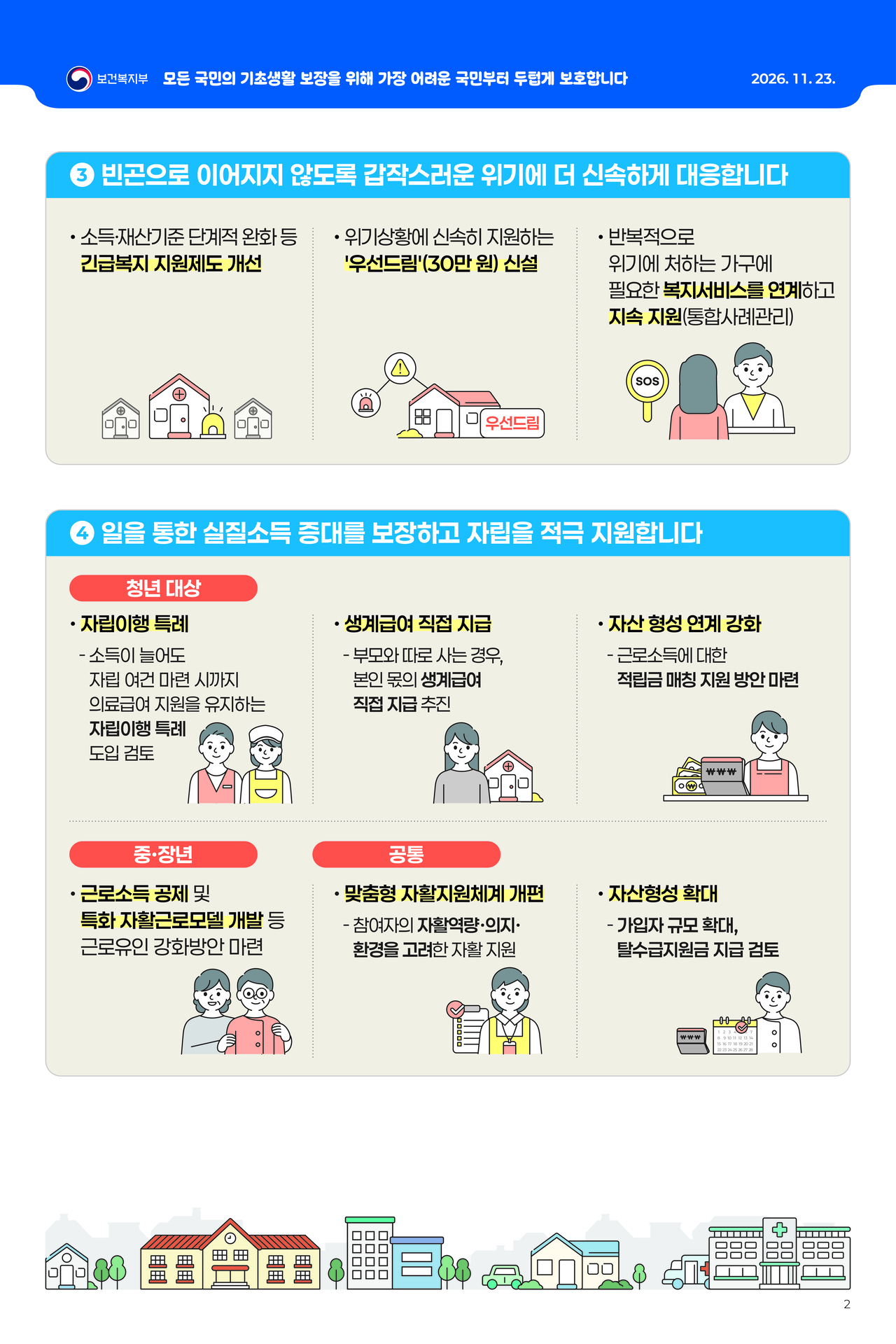
Emergency welfare support for households in crisis will be expanded. A new emergency assistance service called "Useon Dream" will be established at the township and neighborhood level, providing an immediate payment of 300,000 won to households that need urgent help resolving a crisis.
The program targets households unable to access essential medical services or facing other immediate hardships due to a sudden deterioration in their finances. Upon request, a caseworker will conduct an on-site assessment of the household's living conditions and disburse the payment on the same day.
Building a path to self-sufficiency through work, asset formation and benefit exit support
The plan also includes measures to help benefit recipients achieve financial independence.
The government is reviewing the introduction of a "self-reliance transition exemption" targeting youth with strong prospects for self-sufficiency. Under the proposal, young people receiving medical benefits whose income rises above the eligibility threshold through employment would be allowed to retain their medical benefit status for a set period.
The measure is intended to ease anxiety among young people who might otherwise forgo job opportunities out of fear of losing medical coverage, while allowing them to continue necessary treatment and prepare for independence on stable footing. The exemption period under discussion is around three years.
The government is also reviewing a plan to pay livelihood benefits directly to recipients between the ages of 19 and 29 who live apart from their parents.
Under the current basic livelihood security system, livelihood benefits are paid on a household basis, and unmarried children under 30 are treated as part of their parents' household even if they live separately.
Because all household members' benefits — including those of children living apart — are paid to the head of household, young people who have severed ties with their parents have been unable to access their entitlements. The proposed change aims to close that gap.
For middle-aged and older recipients, the government will develop personalized self-sufficiency work models and is reviewing an expansion of the earned income deduction, which excludes a portion of earned income from the income calculation, to help them sustain employment.
Asset-building support to help recipients escape long-term poverty will also be strengthened.
The government plans to review expanding enrollment in the Hope Savings Account and Youth Tomorrow Savings Account programs, and providing additional grants to recipients who successfully exit the benefit system.
Particular attention will be paid to ensuring young recipients do not miss payments or withdraw early due to financial hardship, with one-on-one case management support to be provided.
On healthcare coverage, the government will proactively identify recipients who have discontinued treatment or underutilize medical services and connect them with the care they need, while also screening for and managing cases of excessive use.
The ministry is reviewing applying a tiered cost-sharing system for recipients who exceed 300 outpatient visits per year, and requiring those who exceed 180 outpatient visits to designate and use a specific medical institution.
The fourth plan also includes a proposal to apply AI technology across benefit administration to improve the efficiency of the basic livelihood security system.
By using AI to handle repetitive administrative tasks, the plan aims to free up civil servants to focus on fieldwork such as visiting and counseling vulnerable populations.
The government also plans to establish a "Basic Livelihood Security Future Planning Group" — a working title — to guide the long-term development of the system. The group would be tasked with reviewing the role and functions of the basic livelihood security system, assessing benefit levels, and discussing reforms that account for structural social changes such as the rise of one- and two-person households.
"The fourth plan contains a wide range of institutional reform tasks aimed at providing stronger protection for those in the most difficult circumstances," Health and Welfare Minister Jeong Eun-kyeong said. "We will ensure that the basic livelihood security system serves as a social safety net guaranteeing people's basic living standards, while also expanding opportunities for self-reliance and recovery."
thlee@heraldcorp.com