Assembly committee reviews motion to extend Cheonghai Unit deployment and expand operational area
Kang says National Assembly will be briefed if situation arises in Strait of Hormuz
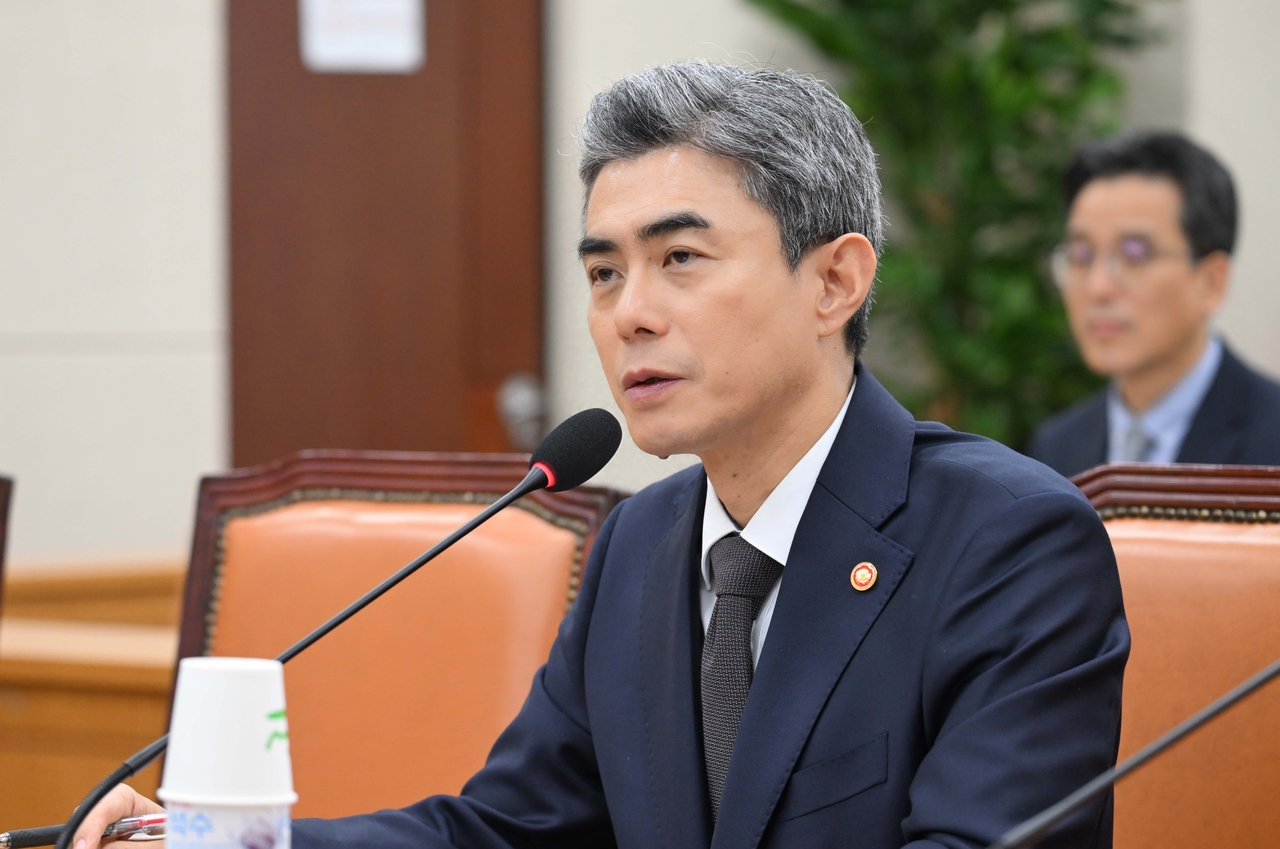
Defense Minister Kang Shin-chul said Monday that expanding the Cheonghai Unit's operational area to the outer waters south of Oman would be carried out "under the principle of non-involvement and non-intervention in war, to protect our vessels and citizens." The remarks were a direct rebuttal to allegations that the move amounts to a roundabout deployment near the Strait of Hormuz.
Kang presented a revised motion at a plenary session of the National Assembly's National Defense Committee to extend and expand the deployment of South Korean forces in the Gulf of Aden off Somalia and the outer waters south of Oman. "We are expanding the mission area and reinforcing assigned forces to more actively protect South Korean vessels passing through Middle Eastern waters," he said. The revised motion would extend the Cheonghai Unit's deployment — currently set to expire Dec. 31 — by one year through Dec. 31, 2027. A maritime patrol aircraft and unmanned minesweeping equipment would also be newly deployed.
Kang cited the growing piracy threat as the reason for expanding the operational area. "Piracy activity has increased more than threefold this year compared to last year," he said. "Looking at the sea lanes, we need to protect our vessels and citizens from that point onward." He added that security gaps were widening as coalition forces were being committed to both straits, and warned that "unless the war ends quickly, the threat will only grow."
Kang drew a line on allegations of war involvement. Asked whether South Korea's Ministry of National Defense position of non-involvement in war and combat remained unchanged, he replied, "Yes, it does." He also flatly said "no" when asked whether the motion amounted to intervention in the war between the United States and Iran. However, on the possibility of an emergency arising in the Strait of Hormuz — such as the international community requesting South Korean military participation — he said the non-intervention principle "would fundamentally be maintained," adding that "if such a situation arises, we will report back to the National Assembly."
Kang also outlined safety measures for the troops. "Troop safety is the top priority," he said, explaining that the patrol aircraft would be deployed to clearly define the mission area and detect signs of threat. On the risk of floating mines, he said no threat had yet been identified in the area, and announced that a minesweeping team and an explosive ordnance disposal team would be additionally deployed.
The hearing also exposed some gaps. People Power Party lawmaker Im Jong-deuk, who leads his party's side on the committee, pressed Kang on whether underwater activity had increased in the area, given that the operational zone would roughly double in size. When Kang said "some activity had been identified," Im rebuffed him, saying he had checked with the Defense Ministry and was told there was none. People Power Party lawmaker Han Ki-ho asked whether the change in operational area had gone through a Joint Chiefs of Staff resolution, and Kang was unable to say definitively whether such a resolution was required. On intelligence sharing, Kang said South Korea was "working closely with the Combined Task Force and CENTCOM."
The budget for the expansion has not been fully secured. Kang acknowledged that costs for operating the patrol aircraft and unmanned minesweeping equipment, as well as for additional personnel, had not been reflected in the motion due to the submission timeline. "I expect there will be some additional requirements," he said, adding that the ministry would consult with the National Assembly. The number of additional personnel is around 75.
The ruling and opposition parties agreed to attach supplementary opinions to the motion expressing their concerns. Democratic Party of Korea lawmaker Kim Byung-joo proposed requiring National Assembly approval in cases such as deploying the patrol aircraft to the Strait of Hormuz. Kang said he "fully sympathized with the intent."
rimsclub@heraldcorp.com