Seoul city government says personnel situation is normal but acknowledges limitations; unable to explain delay or offer alternatives
Oversight of public enterprise personnel, supplementary budget and fiscal strategy functions questioned
Seoul bearing additional 3.57 trillion won annually due to discriminatory national subsidy rate
Controversy is growing over the stability and accountability of Seoul's administrative command center after the director post at the Office of Planning and Coordination — which oversees the city's budget, organizational structure and public enterprises — has been filled by an acting official for 11 months. The Seoul Metropolitan Government has acknowledged limitations in external activities stemming from the prolonged acting arrangement, yet has been unable to clearly explain why a permanent appointment has been delayed or offer any solution, prompting calls for decisive action to fill the vacancy.
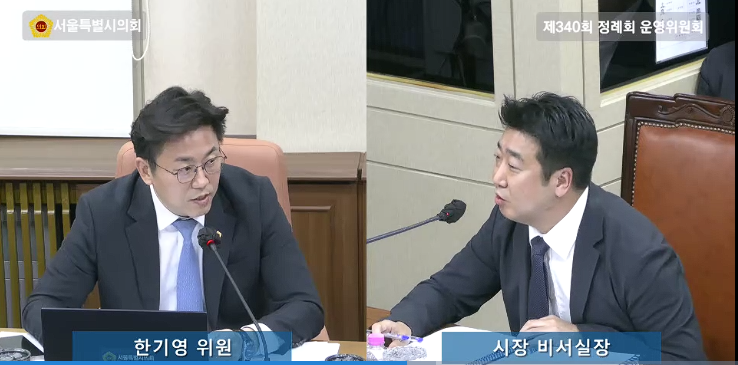
Han Ki-young, a Democratic Party of Korea lawmaker on the Seoul Metropolitan Council's steering committee representing Mapo District 2, pressed city officials on the issue during an administrative audit of the Seoul mayor's secretariat at the 340th regular session on Nov. 16, examining the city's personnel management and the planning office's overall coordination functions.
Lee Dong-ryul was appointed acting director of the Office of Planning and Coordination on Dec. 31 last year, the same date Jeong Sang-hun was named acting first administrative deputy mayor. Neither has since received a permanent appointment, leaving the acting arrangement in place for nearly 11 months.
Han asked whether the prolonged vacancy in the planning director post was affecting subsequent personnel moves and promotion opportunities for civil servants. Seoul Mayor's Chief of Staff Song Gwang-nam said personnel operations were functioning normally and that there were no particular problems.
When Han followed up by asking whether there would be no problem if the acting arrangement continued indefinitely, Song acknowledged that it posed limitations for external activities and should be resolved as soon as possible. Han said the city's position was contradictory — claiming no personnel problems while simultaneously admitting the acting arrangement had its limits.
The reason for the delay in making a permanent appointment also became a point of contention. Song said that when Jeong Sang-hun previously served as acting planning director, presidential approval had been granted, but that no such approval had come through this time despite no apparent change in circumstances. When pressed for a specific explanation, Song said it would be difficult to answer at that forum.
When Han asked whether the city was considering alternatives — such as reassigning the official to a different post or lifting the acting designation — Song said no such options were under active consideration.
"If the city acknowledges there is a problem, it is Seoul's responsibility to identify the cause and present a solution," Han said. "It is hard to accept that after 11 months of the same situation, there are no alternatives whatsoever."
The planning office's management and coordination functions also came under scrutiny. Han focused on three areas — personnel management at public enterprises, supplementary budget compilation and long-term fiscal strategy — to examine the office's role and accountability.
Han first raised the appointment of a person with two prior criminal fines for fraudulent travel expense claims during a previous term as a district council member to the chief executive post at Seoul Metro Environment, a subsidiary of Seoul Metro. Han said the city had deflected responsibility by characterizing the appointment as a matter for Seoul Metro alone, and stressed the city's duty to oversee its affiliated public enterprises.
On the budget oversight function, Han cited the Youth AI Ladder and nighttime economy revitalization projects included in the second supplementary budget passed in September, saying the budget had been drawn up before detailed project plans were in place and that an internal city document had allegedly been leaked externally during the review process.
Han said poor coordination with the digital policy office had created confusion between project implementation plans and budget allocations, and called for a review of whether the Office of Planning and Coordination's policy coordination and oversight functions had worked properly.
Han also raised concerns about Seoul's long-term fiscal strategy and its ability to secure central government funding. Han said Seoul was bearing an additional 3.57 trillion won ($2.67 billion) annually because it receives a lower national subsidy rate than other local governments, and called on the Office of Planning and Coordination to take a more active role in fiscal negotiations with the central government.
Song said the city had continuously requested improvements to the national subsidy rate from the central government, but added that the issue could not be resolved through the efforts of the planning director alone.
Han said that given the planning office's role in overseeing Seoul's fiscal strategy and central government funding, it must engage more responsibly in negotiations and policy coordination with the central government.
"A situation that Seoul itself has acknowledged as a problem has now persisted for 11 months," Han said. "Failing to identify the cause and refusing to consider alternatives is, in effect, leaving the problem unaddressed."
Han added: "The director of the Office of Planning and Coordination oversees the city's budget, organization and public enterprises — a vacancy in that post is a vacancy in city governance itself. Simply staying in the position is not accountability. What is needed now is not clinging to the post, but a responsible decision befitting a senior public official."
7toy7@heraldcorp.com