Korea-Japan joint talent development proposed at Tokyo Forum 2026
Chey calls on companies and universities to share responsibility for training the next generation
SK Group Chairman Chey Tae-won proposed building a joint platform through which Korean and Japanese companies and universities would work together to train AI specialists. The plan envisions a new industry-academia cooperation model in which businesses participate directly in university education, take on real-world industry projects alongside students, and connect participants to internships and full-time jobs.
Chey shared his views on how university education must change in the AI era and what direction talent development should take at the business leaders' session of Tokyo Forum 2026, held Saturday at Yasuda Auditorium on the University of Tokyo campus in Bunkyo-gu, Tokyo.
Co-hosted by the University of Tokyo and the Chey Institute for Advanced Studies, this year's forum ran for two days from Friday under the theme "AI as a Transformative Technology: Humans, Knowledge and Civilization."
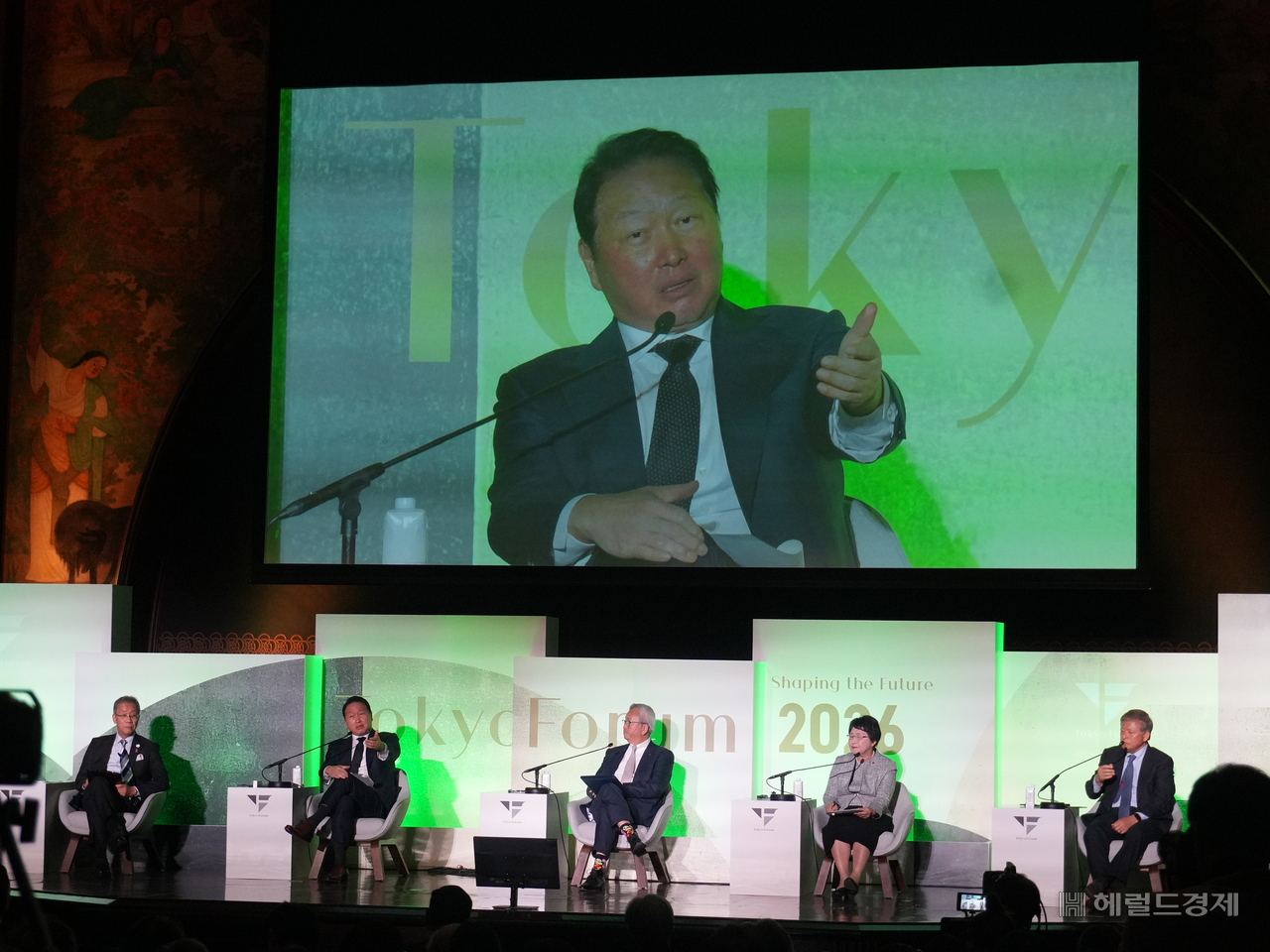
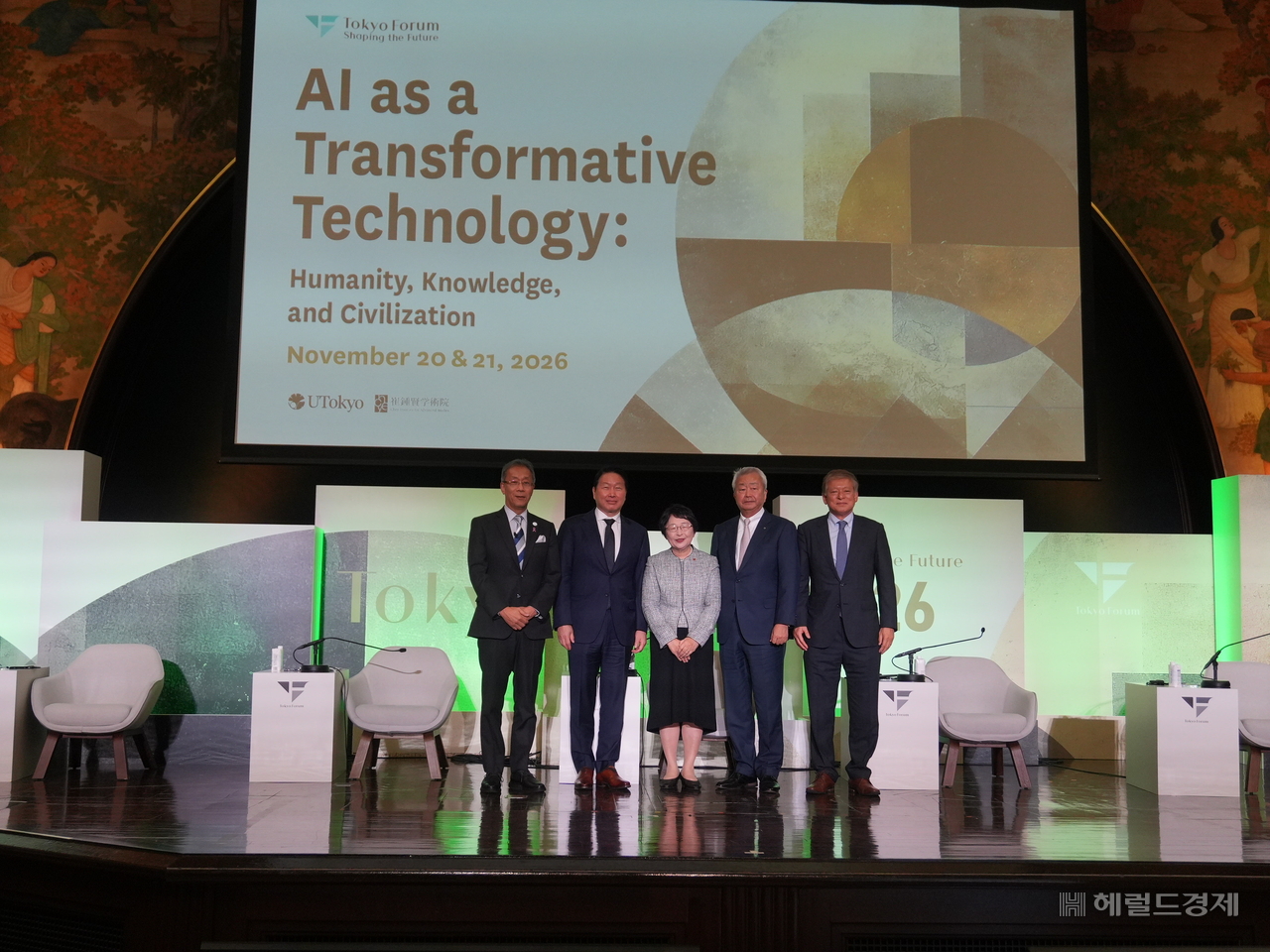
The Saturday business leaders' session was moderated by University of Tokyo President Fujii Teruo and brought together Chey alongside NTT Chairman Sawada Jun, Sophia University President Sugimura Miki and Taejae University President Yeom Jae-ho. The participants discussed AI's broad impact on society, the competencies future talent will need, and new avenues for cooperation between universities and businesses.
Chey opened by referencing Japan's "Society 5.0" concept introduced a decade ago, then underscored the shift toward what he called an "AI-native society" — one in which AI becomes the basic fabric of social life.
He said an AI-native society is fundamentally different from one that merely uses AI as a tool. Rather than treating AI as a technology or a work utility, he argued, every institution and system in society must be redesigned from the ground up on the assumption that AI exists.
He particularly noted that the current university education system rests on structures and operating practices that have been in place for a very long time.
Simply adding AI-related courses to existing universities or introducing new educational technology is not enough, Chey said. Universities suited to the AI era must fundamentally redesign not only their curricula but also their assessment methods, degree systems and governance structures.
He said universities need to have serious discussions about what assessment methods to adopt, what degrees to confer, how to incorporate AI into teaching, and how to redefine the roles of faculty and students.
Chey said generations yet to be born will grow up treating AI as naturally as they use smartphones today, and argued that university students and young people studying under the existing education system need a new educational model.
He also put forward a proposal to connect real industry problems that companies face with university education, arguing that the approach to learning must shift so that students first encounter real-world challenges and acquire the knowledge and skills they need in the process of finding solutions.
Chey introduced SK Group's education programs in AI and semiconductors, saying that instruction in technical knowledge and education that builds problem-solving ability in actual business environments must go hand in hand.
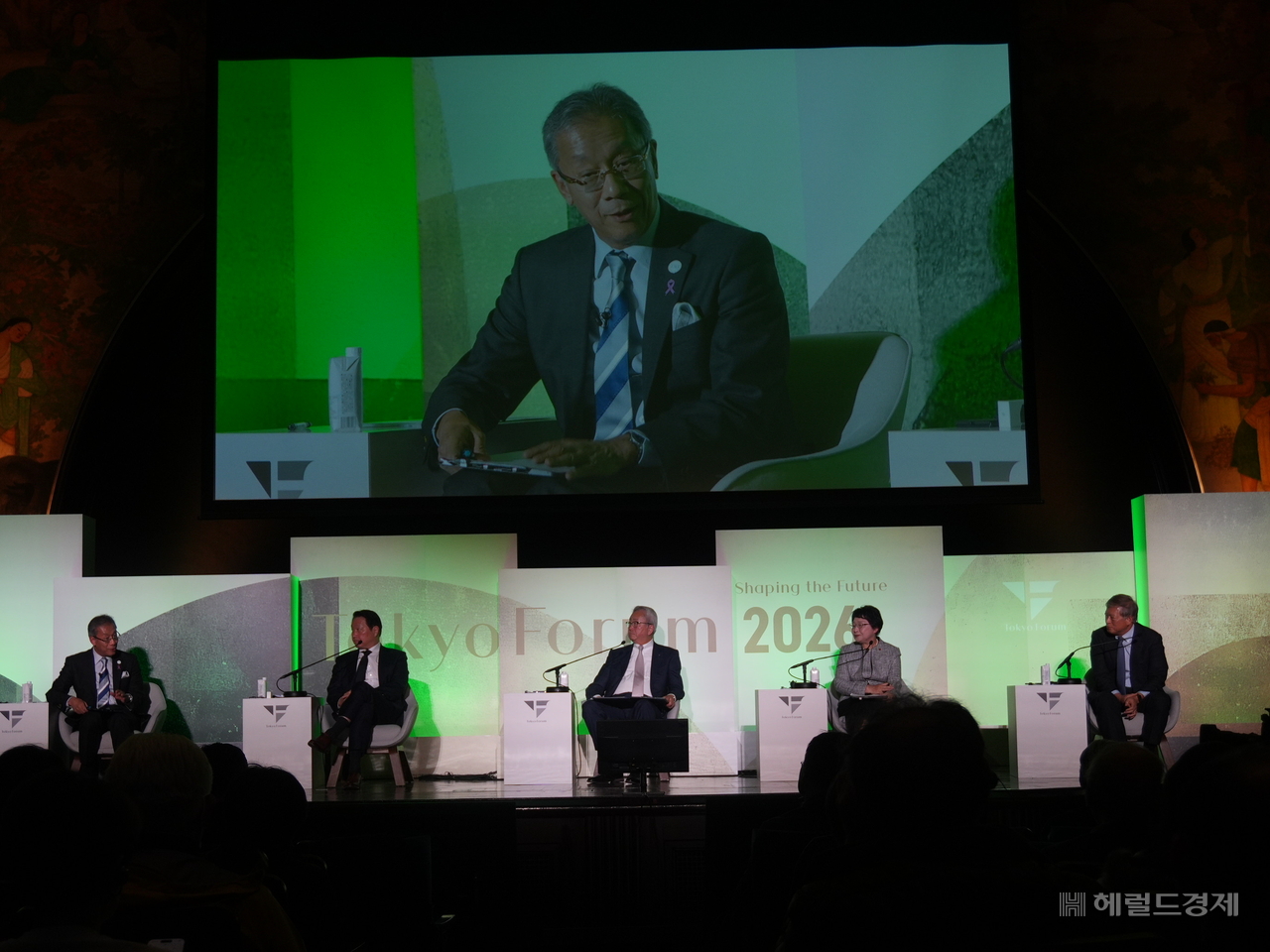
When President Fujii asked about concrete ways for Korean and Japanese companies and universities to cooperate, Chey laid out a specific vision: a joint education platform.
Using the University of Tokyo's five-year degree program as an example, Chey proposed that companies participate directly in the final two years of the program, working with students on new projects.
The idea is for universities to contribute their educational and research capabilities while companies bring real industry problems and projects, allowing students to develop both theoretical knowledge and practical skills at the same time.
Chey said talented people developed through such a process would be exactly the kind of candidates SK Group would actively want to hire.
Chey added that if Korean and Japanese companies and universities built a shared platform together, it would be possible to offer students internship opportunities and connect them to full-time positions.
The point, Chey said, is that cooperation between the two countries should move beyond simple student exchanges or joint research and develop into substantive collaboration that links education, industry and employment.
Chey said such cooperation could also contribute to solving social problems, arguing that companies and universities working together on challenges common to both Korea and Japan could generate new industries and social value.
Chey also described past experience running a social enterprise education program that produced hundreds of business leaders engaged in addressing social problems, and suggested that model could be expanded into a Korea-Japan joint education program.
The discussion also touched on the view that distinctly human experience and judgment remain important even in the AI era.
NTT Chairman Sawada said that however advanced AI becomes, human sensory perception and physical experience cannot be fully replaced. Sawada said craftspeople and skilled workers who have accumulated hands-on experience could create new value by harnessing AI.
Sawada said philosophical thinking is essential for future leaders and that they must develop the ability to connect abstract concepts with concrete reality. Education should involve direct experience in the field, developing that experience into new ideas, and then testing those ideas back in the real world, Sawada said.
Sophia University President Sugimura said universities must go beyond simply transmitting knowledge and take on the role of cultivating critical thinking and social competencies. Sugimura called for education that builds the ability to assess the accuracy of AI-generated information alongside skills in human relations, emotional intelligence and cross-cultural collaboration.
Taejae University President Yeom introduced a new university education model that combines online learning, overseas field study and corporate internships.
Yeom said Taejae students receive their education while moving between cities around the world, including Seoul, Tokyo, New York and Beijing. In Tokyo in particular, students gain direct experience of Japanese society and industry through corporate internships, Yeom said.
Yeom also described using AI to analyze student participation and discussion in class, reducing the time faculty spend delivering one-way lectures and instead encouraging students to solve problems on their own.
Yeom proposed dual-degree programs between Korean and Japanese universities and a joint curriculum for East Asian students, saying the active people-to-people exchanges between Korea and Japan need to be extended into cooperation between university education and industry.
Moderator Fujii said he agreed that universities in the AI era must work with businesses to equip future generations with the new competencies they will need.
Closing the session, Fujii said he hoped to see a collaborative platform built with universities and companies participating together, and for substantive cross-border educational activities to expand going forward.
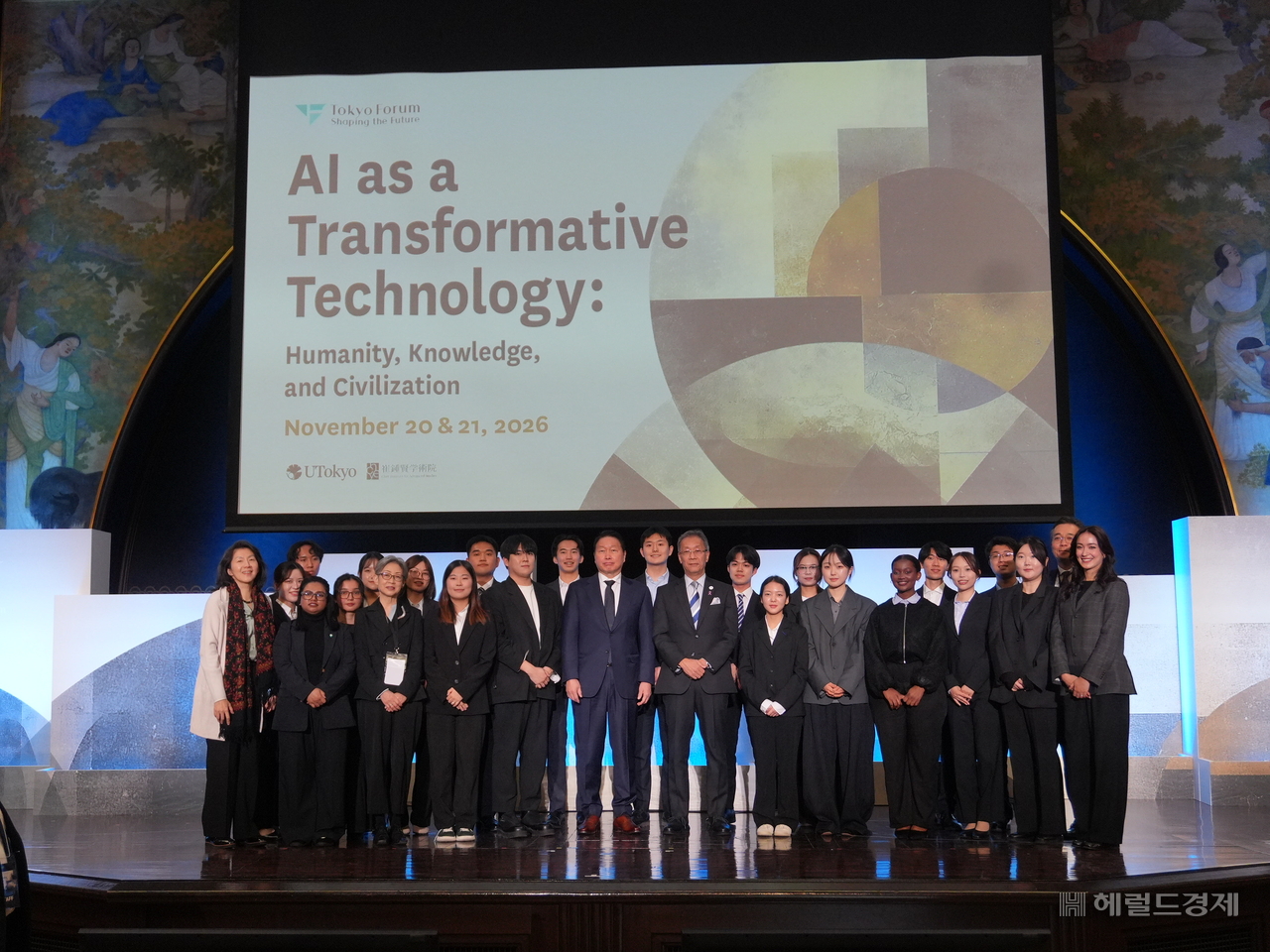
Elsewhere at the forum that day, a youth session brought together university students from Korea and Japan, and a separate expert panel discussed how AI can support mental health and promote social inclusion.
The expert panel, held under the theme "Knowledge Beyond Borders: Designing AI for Mental Health and Social Inclusion," featured Lee Eui-jin, a KAIST professor; Sharath Chandra Guntuku, an associate professor at the University of Pennsylvania; and Neha Kumar, a professor at Georgia Tech. University of Tokyo Professor Yatani Koji moderated the session, which explored how AI can support individual mental health and social connection.
A special session marking the University of Tokyo's 150th anniversary took up the theme "Streams of Memory: Digital Archives Across Time," examining how AI and digital technology can be used to preserve and pass on historical records.
The forum concluded with a plenary discussion titled "Dialogues for Tomorrow," followed by closing remarks from University of Tokyo Executive Vice President Hayashi Kaori and Chey Institute for Advanced Studies President Kim Yu-seok.
Launched in 2019, Tokyo Forum is an international academic conference co-hosted by the University of Tokyo and the Chey Institute for Advanced Studies, bringing together scholars and industry experts from around the world to seek solutions to major global issues.
This year's forum took a broad look at AI's impact on people and society, with Chey's proposal for a Korea-Japan joint talent development platform emerging as a concrete cooperation model that bridges innovation in university education with the workforce needs of industry.
sjkim@heraldcorp.com