"I'm too scared to open my stock app."
Stock market online communities were flooded with sighs and laments from retail investors gripped by "Black Monday" fears over the weekend, as global equity markets suffered a sharp correction last week after the AI theme that had led the rally ran into a string of setbacks.
Deputy Prime Minister and Finance Minister Lee Hyeong-il has now called an emergency market situation review meeting — known as the F4 meeting — to discuss measures to stabilize the stock market.
According to Yonhap Infomax, the government will hold the emergency session Sunday afternoon, chaired by Lee. Bank of Korea Governor Shin Hyun-song, Financial Services Commission Chairman Lee Eok-won and Financial Supervisory Service Director General Lee Chan-jin are set to attend.
The meeting will discuss steps to stabilize domestic markets amid a sharp global equity sell-off driven by mounting regulatory pressure and profitability concerns surrounding the AI industry.
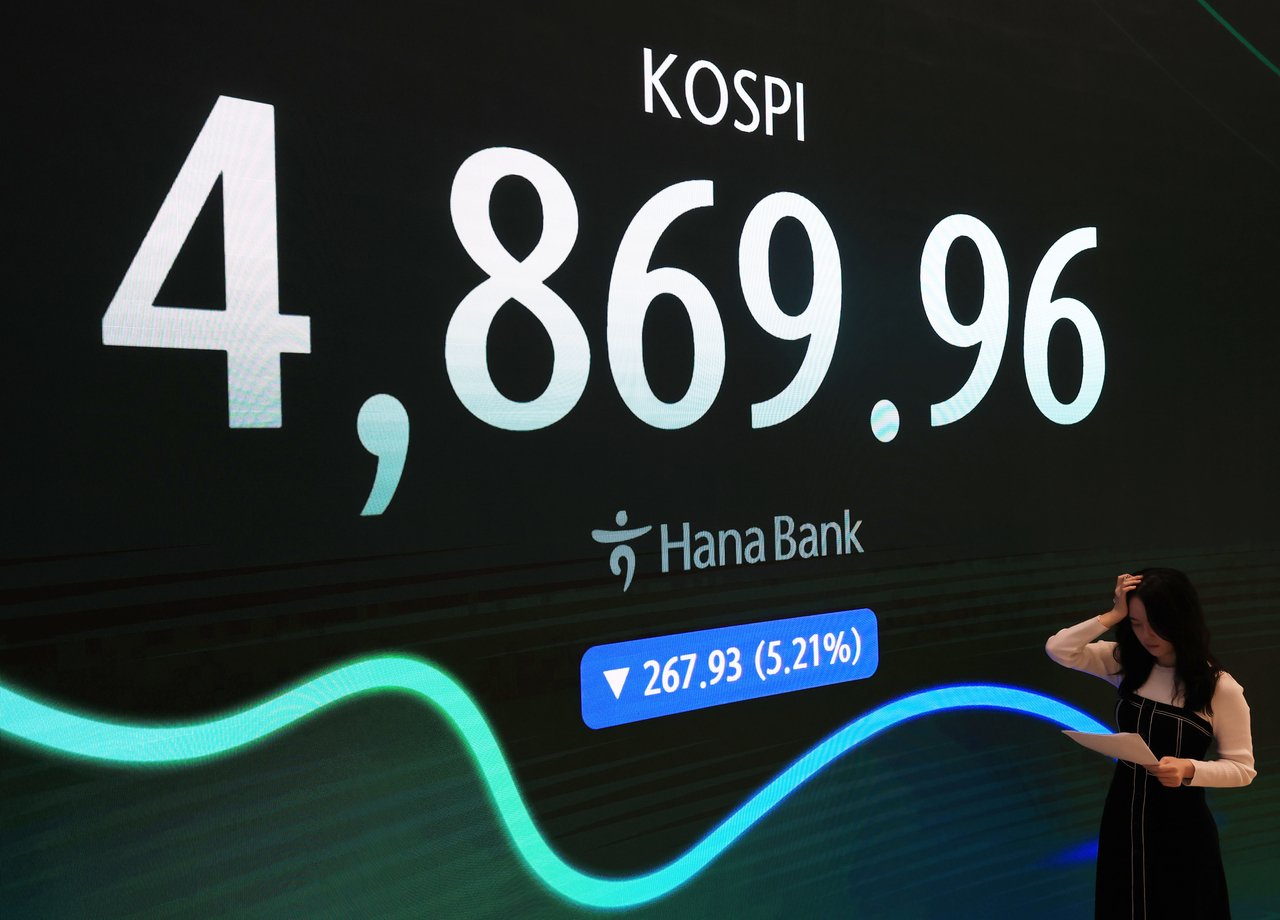
The Kospi closed down 5.21 percent at 4,869.96 on Friday — its lowest closing level since Jan. 16 this year, when it finished at 4,840.74, marking the weakest close in roughly 10 months. The index shed 420.57 points, or 7.95 percent, for the week. The Kosdaq also fell 53.98 points, or 7.72 percent, on the week to close at 645.68.
Investor sentiment turned sharply negative after the US Commerce Department's Bureau of Industry and Security moved to restrict Chinese remote access to data centers using American AI chips, following a scandal involving former Nvidia CEO Jensen Huang that allegedly implicated a Chinese spy.
Wall Street also closed sharply lower on Friday, the last trading day of the week, with all three major indexes tumbling in unison.
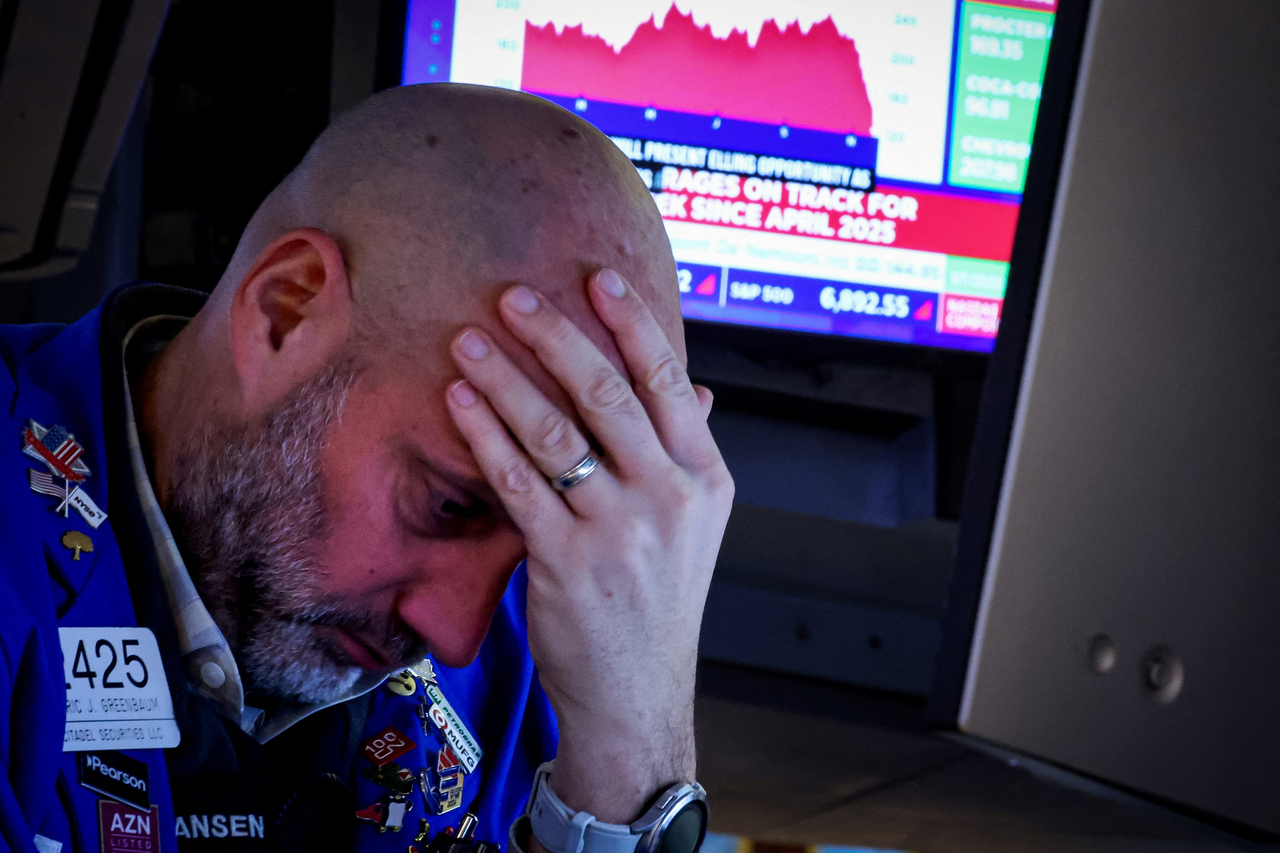
The Dow Jones Industrial Average fell 1.93 percent, the S&P 500 dropped 3.70 percent, and the NASDAQ Composite slid 5.28 percent.
The Dow and the S&P 500 entered correction territory, each falling more than 10 percent from their recent peaks, while the NASDAQ gave back all of its gains for 2026.
Major semiconductor stocks posted double-digit losses across the board — Nvidia fell 14.01 percent, AMD 13.25 percent, Broadcom 12.19 percent, Micron 13.89 percent and SanDisk 16.05 percent — sending the Philadelphia Semiconductor Index crashing 10.73 percent.
Anthropic, in its second day of trading after its initial public offering, closed down 8.50 percent at $88.91, while SK hynix's American depositary receipts fell 13.11 percent to $103.57.
Even positive catalysts — including Nvidia's third-quarter earnings beat and Anthropic's record-breaking IPO — were not enough to restore investor confidence.
Indicators tracking investor sentiment in the Korean market also tumbled sharply.
The MSCI Korea exchange-traded fund fell 8.42 percent, the MSCI Emerging Markets ETF dropped 5.13 percent, and KOSPI 200 overnight futures plunged 6.99 percent.
Fear among retail investors peaked over the weekend, with the domestic market widely expected to extend its losses this week.
As anxiety in the stock market intensified, the opposition party also called for emergency measures.
People Power Party Floor Leader Jeong Jeom-sik said Sunday that "the government should prepare emergency response measures in advance against the possibility of a Black Monday."
In a Facebook post, Jeong said the market situation was "far from normal," noting that both the Kospi and Kosdaq had plunged more than 5 percent on Friday. "There are widespread concerns that tomorrow's market could see an even worse Black Monday," he said.
"I urge the authorities to prepare emergency response measures now for the sharp drop expected tomorrow," Jeong said. "Rather than standing by and watching, I hope they will work to ease market anxiety and prevent further losses and turmoil." He added that "what the government and ruling party should be focused on right now is the stock market, not impeachment."
Jeong said the Kospi, which had at one point surpassed 9,000 points this year, had "crashed to the 4,800 range — nearly cut in half — with market capitalization evaporating by 3,400 trillion won ($2.55 trillion) from its peak." He said the collapse followed a series of reckless market-boosting measures, including the hasty introduction of single-stock leveraged ETFs and a suspension of the national pension fund's rebalancing, and called it "a historic bubble burst comparable to the 2000 dot-com crash — one that will go down in history as the 2026 'Lee Jae Myung bubble.'"
Jeong said that while some remained optimistic that the market had bottomed out and would recover, "the problem is that retail investors have already suffered enormous losses, and investor confidence in the soundness of the Kospi has collapsed." He also criticized the simultaneous news of Seoul apartment prices rising for 93 consecutive weeks, saying it was reinforcing the "real estate never fails" myth and driving people back to property as the only reliable investment.
anju1015@heraldcorp.com