'Procedural violations' in reaching verdict cited as potential impeachment grounds
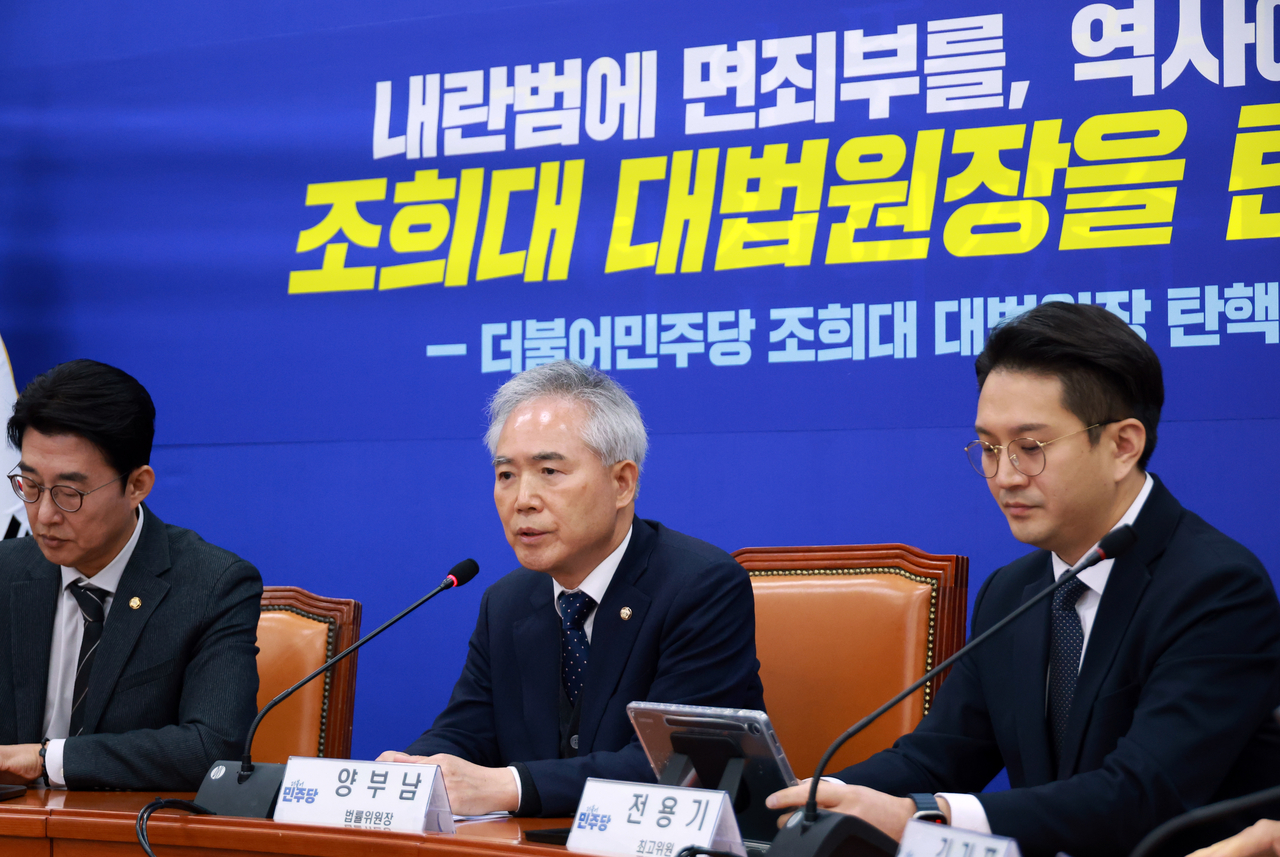
The Democratic Party of Korea's task force to impeach Supreme Court Chief Justice Jo Hee-dae said Sunday it would not use the Supreme Court's ruling on former Prime Minister Han Duck-soo as grounds for the impeachment motion against Jo.
Rep. Yang Bu-nam, who heads the task force, held a press briefing at the National Assembly that day and said the party "fundamentally respects court rulings."
The Democratic Party formed the task force to pursue Jo's impeachment after the Supreme Court, on Thursday, found Han guilty on insurrection charges while partially acquitting him and remanding the case to a lower court.
Yang had said on Friday, immediately after a general assembly of Democratic Party lawmakers, that the Han ruling would not be used as impeachment grounds — only to reverse course after the task force's first meeting, saying the ruling would be reviewed as a potential ground.
The reversal appears to have come after criticism that including a court verdict as an impeachment ground could infringe on judicial independence.
However, Yang said "there have been persistent concerns about serious procedural flaws in the deliberation process leading up to the ruling," adding that "serious procedural violations can fully constitute grounds for impeachment, and we will review this point."
Yang also said the Han ruling "pushed our patience to its limits" and that Chief Justice Jo's "value system is far removed from — and indeed poses a threat to — the protection of democratic values and the defense of constitutional order."
Rep. Noh Jong-myeon, the task force's deputy head, said the impeachment push "is not being launched because of this ruling on former Prime Minister Han," adding that "the substance of the ruling and its legal reasoning are not impeachment grounds — the procedural problems leading up to this ruling are."
Rep. Lee Yong-woo cited specific procedural concerns, pointing to "the unprecedented scheduling change that converted a deliberation date into a sentencing date, and the unlawful procedural conduct that violated the special prosecutor act's mandatory provision requiring a ruling within three months."
Lee then said that while the court had referred the case to the full bench on the grounds that Han Duck-soo and Lee Sang-min were co-conspirators, it ultimately handed down separate rulings.
"The insurrection trial, which demanded the utmost care and gravity, was conducted in the most shoddy, rushed and unlawful manner, gravely undermining procedural legitimacy," Lee said.
On the timing of the impeachment motion, Yang said the task force would "inform the public of the completeness and necessity of the impeachment grounds" and would "deliver the impeachment motion to the floor as quickly as possible."
The task force cited three impeachment grounds against Chief Justice Jo: the Supreme Court's response during the Dec. 3 emergency martial law declaration, the court's decision to remand President Lee Jae Myung's Public Official Election Act violation case, and controversy over the renomination of Supreme Court justices.
yg@heraldcorp.com