Kospi pushed back to 4,800 range, near year's start
Stocks with 1 trillion won market cap down 11% from January
10 trillion won club shrinks by 27; total market cap nearly halved
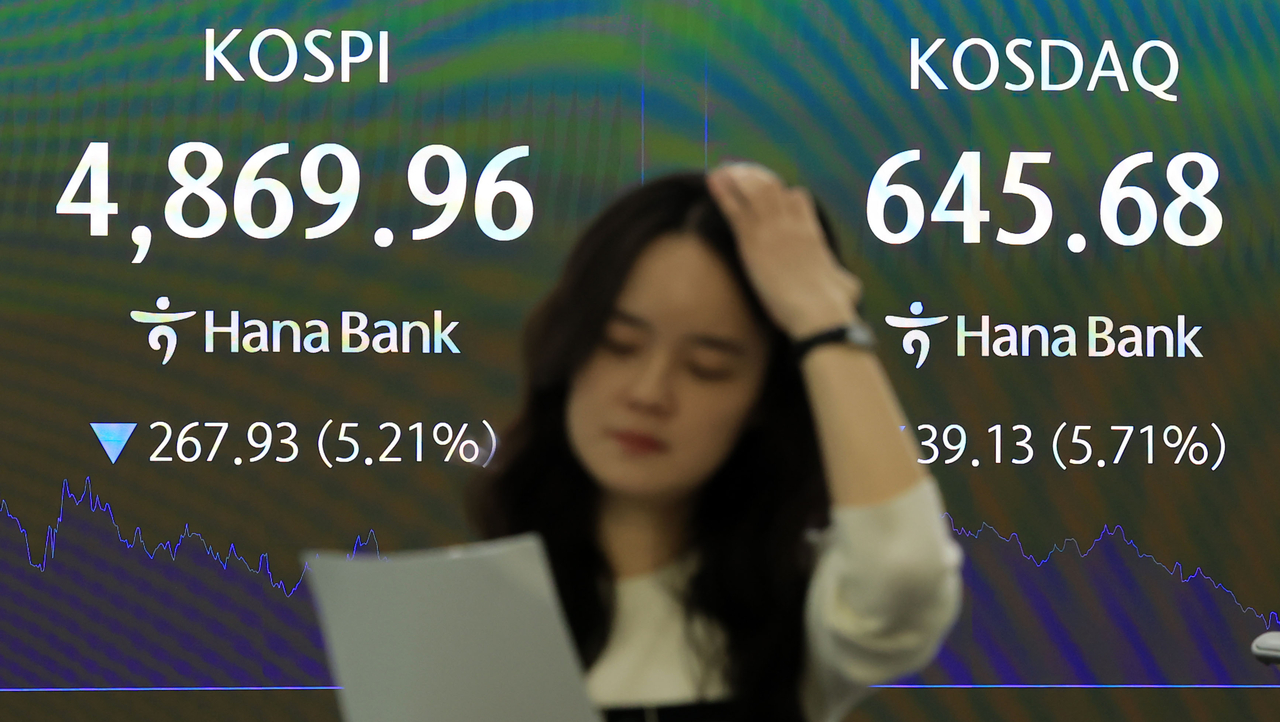
The Kospi plunged more than 5% on Friday, retreating to the 4,800 range last seen at the start of 2026. Analysts say fears that the AI-theme rally may be entering an off-season have reached a peak, compounded by a relentless stream of negative news and macroeconomic headwinds including high interest rates.
Although the Kospi has returned to levels similar to early this year, the number of listed stocks with a market cap of 1 trillion won ($751 million) or more has actually shrunk by 26 compared with that time, raising concerns about the broader health of the domestic stock market. As of Friday, 211 stocks on the Kospi market held market caps of 1 trillion won or above, according to Yonhap.
The Kospi closed at 4,869.96 on Friday, down 5.21% — its lowest closing level in about 10 months since Jan. 16 this year, when it finished at 4,840.74.
Back in January, 237 Kospi-listed stocks carried market caps of 1 trillion won or more. That figure has since fallen to 211, a decline of 26 stocks, or 11.0%. Even as the index has returned to the 4,800 range, fewer companies are maintaining the trillion-won threshold.
Across the entire domestic market — combining the Kospi, Kosdaq and Konex — the number of stocks with a market cap of 1 trillion won or more hit a record high of 405 on April 29. The count then declined steadily, falling below 300 in July. It edged back up to 301 at the end of last month, but the recent market selloff has pushed it back down to 287.
The number of large-cap stocks with market caps of 10 trillion won or more stood at 56 on Friday, down 27, or 32.5%, from a record high of 83 on May 8.
The trend is also visible in total market capitalization. The Kospi market's combined market cap stood at 3,991 trillion won on Friday, falling below 4,000 trillion won for the first time in about 10 months since Jan. 15.
Compared with the record high of 7,450 trillion won set in June, the market cap has shed 3,458 trillion won, a decline of 46% — nearly half.
Individual stock performance has also been weak. Of the 932 stocks listed on the Kospi market, 723 — or 78% — were trading below their Jan. 16 levels, even though the index itself has returned to a similar level. The index may look the same, but most individual stocks have actually fallen further.
Samsung Electronics and SK hynix were notable exceptions, with their share prices rising 27.24% and 48.60%, respectively, over the same period. At the start of the year, buying interest spread broadly across the market on expectations that the Kospi would break through the 5,000 mark. But as the index subsequently tumbled, many stocks gave back their gains faster than the two semiconductor giants. Market analysts say the shift in investor sentiment and supply-demand conditions since the start of the year has deepened the underperformance of individual stocks.
The Philadelphia Semiconductor Index tumbled 10.73% last week, pointing to a weak open for the domestic market this week. On the same day, the Russell 2000 and the Dow Jones Transportation Average fell 2.76% and 2.52%, respectively, while KOSPI 200 overnight futures plunged 6.99%.
However, Friday's drop of more than 5% has already priced in a number of key negative factors — including the US Senate's passage of a bill to streamline energy infrastructure permitting — and some analysts suggest the domestic market may not fully mirror the scale of declines seen in US semiconductor stocks.
anju1015@heraldcorp.com