Impeachment motion requires majority vote; Constitutional Court must rule within 180 days
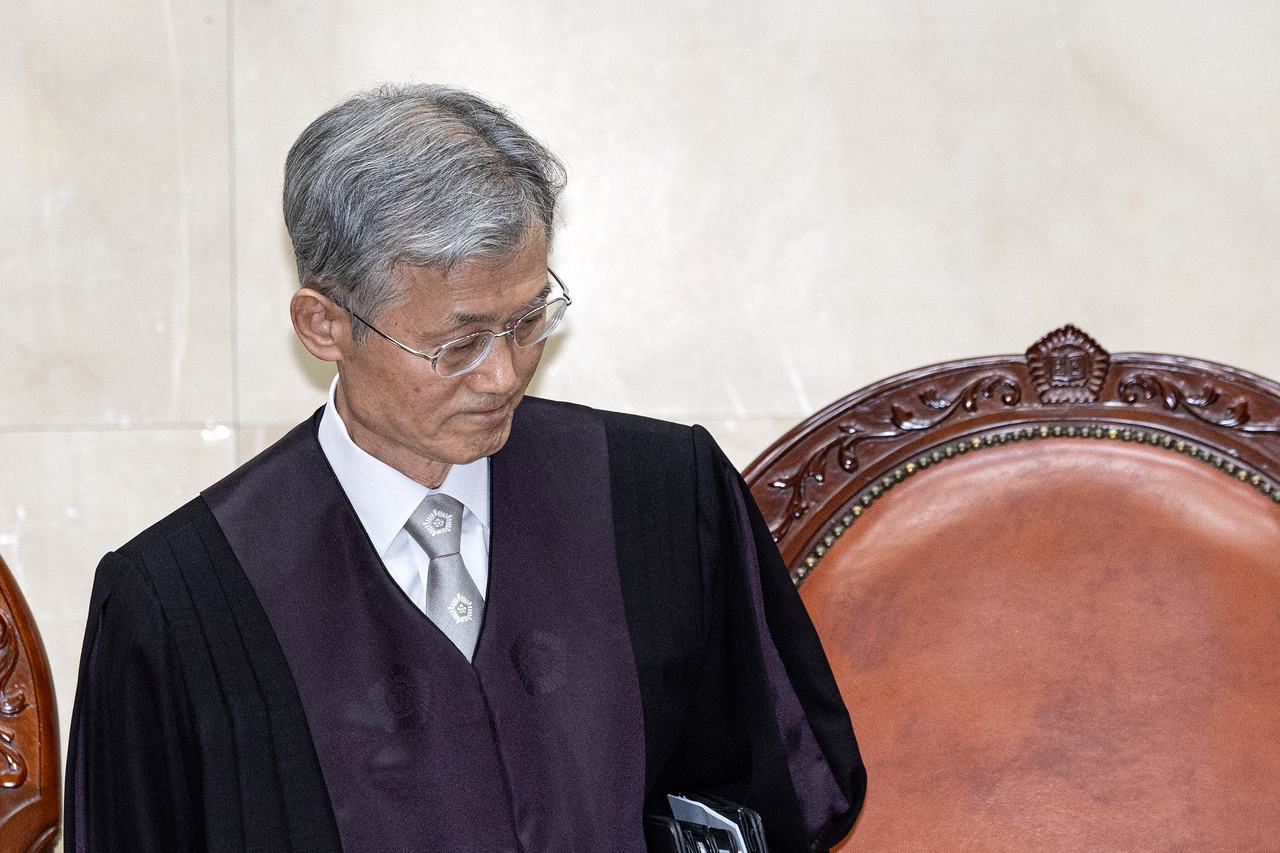
The Democratic Party of Korea has officially adopted the impeachment of Chief Justice Jo Hee-dae as party policy and is moving forward with the effort. Political circles and the legal community are closely watching how the process will unfold and what consequences it may bring.
The Democratic Party is expected to introduce an impeachment motion against Jo around Dec. 3, the second anniversary of the Dec. 3 emergency martial law declaration. If the motion clears the National Assembly, the Constitutional Court would hold the first impeachment trial of a sitting chief justice in the country's constitutional history.
According to political sources, the party formally adopted the impeachment of Jo as its official position at a general assembly of lawmakers on Friday. The decision came one day after the Supreme Court on Thursday overturned former Prime Minister Han Duck-soo's insurrection conviction in part, sending the case back to a lower court while upholding some guilty findings.
The Democratic Party has cited four grounds for the impeachment motion: the Supreme Court's response during the Dec. 3 emergency martial law declaration; the court's ruling overturning President Lee Jae Myung's conviction under the Public Official Election Act and remanding the case; controversy over the renomination of Supreme Court justices; and allegations surrounding the use of discretionary funds and cash incentive payments.
Yang Bu-nam, the lawmaker leading the party's impeachment task force, had initially said the Supreme Court's ruling on Han showed that Jo "should not remain as head of the judiciary," but stopped short of calling it grounds for impeachment. He later reversed course, saying the ruling would be reviewed as a potential impeachment ground.
Democratic Party leader Kim Min-seok criticized the Supreme Court's decision to partially overturn Han's conviction on Thursday, saying it had "reached a point that cannot be historically tolerated." Kim went on to say that pursuing Jo's impeachment was "a matter of obligation," pointing to the ruling as a key reason for pressing ahead.
To impeach a chief justice, at least one-third of the Assembly's sitting members must introduce the motion, and a majority must vote in favor. The ruling bloc currently holds enough seats to pass such a motion on its own. If the motion clears a plenary session, Jo's exercise of official duties would be immediately suspended.
Once the Constitutional Court receives the impeachment referral, it begins deliberations. If six or more of the nine justices find sufficient grounds, the chief justice is removed from office. The court's standard for removal is "whether the respondent violated the Constitution or law, and the gravity of that violation" — weighing the impact on the constitutional order against the benefit of upholding it through removal.
The Constitutional Court is required to issue a ruling within 180 days, though that deadline is considered a guideline rather than a strict requirement. Given that Jo's term runs through early June next year, attention will also focus on whether the court issues its decision before then.
If the impeachment motion passes the Assembly, Jo's authority would be suspended until the Constitutional Court rules, inevitably disrupting Supreme Court proceedings. The full bench can convene with a minimum of 10 of the 14 justices — at least two-thirds — with the chief justice presiding. The chief of the National Court Administration, who holds a justice seat, is excluded from full-bench deliberations. One justice seat is currently vacant; 12 justices participated in the Han deliberations and ruling.
With Jo suspended, 11 justices would remain. The quorum of 10 could still be met, but any recusal or disqualification would put proceedings at risk. Earlier, in the appeal of former President Yoon Suk Yeol's obstruction-of-arrest case, Justice Oh Seok-jun recused himself citing concerns over impartiality, given his connection to Yoon as alumni of Seoul National University's law school.
If Yoon's insurrection leadership case — which faces a second-instance ruling in January — is referred to the full bench, the court would barely meet the quorum. Even if the threshold is met, proceeding with a full-bench ruling on a case of such national significance without a chief justice would carry its own burden. Should Jo be impeached, Senior Justice Cheon Dae-yeop, the most senior member, would serve as acting chief justice.
yg@heraldcorp.com