Semiconductors account for roughly 43 percent of total exports, leaving the country exposed to external shocks
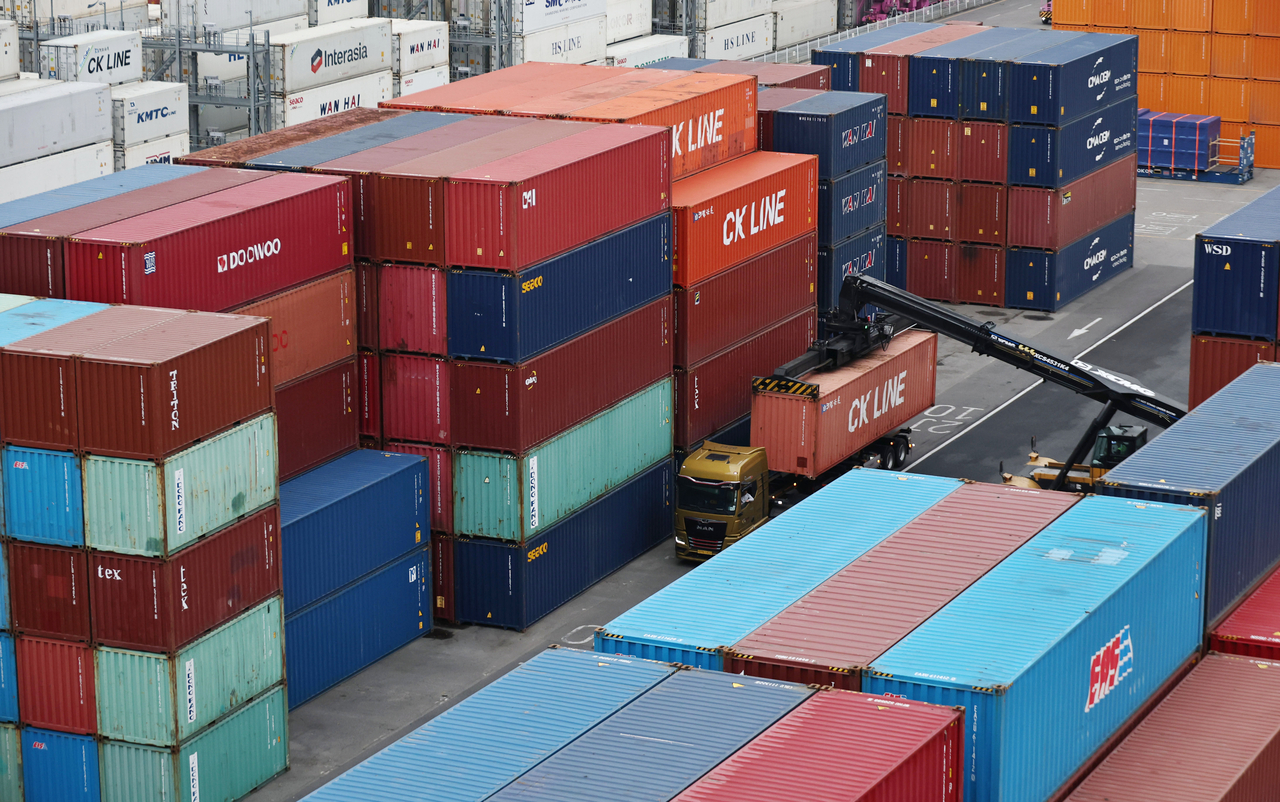
South Korea is on track to achieve $1 trillion in annual exports for the first time in history this year, which would place it among the world's top four exporters. Strip out semiconductors, however, and the country falls to eighth place, trailing Japan and Mexico.
Data from the World Trade Organization and UN Comtrade show that South Korea's exports from January through July totaled $595.3 billion, ranking fifth globally behind China ($2.52 trillion), the United States ($1.44 trillion), Germany ($1.12 trillion) and the Netherlands ($627.7 billion).
South Korea trailed the Netherlands through July but has since overtaken it on the strength of accelerating export growth, according to the Ministry of Trade, Industry and Energy. September exports alone reached $120.9 billion, a monthly record.
South Korea crossed the $1 trillion cumulative export threshold for the year at 2:09:38 p.m. Thursday, becoming only the fourth country to reach that milestone — after the United States, Germany and China — and surpassing a mark that even Japan, once a dominant force in the global economy, has never achieved.
The ministry projects full-year exports will reach $1.17 trillion, enough to overtake the Netherlands and secure fourth place in global export rankings.
The picture changes once semiconductors are removed. South Korea's non-semiconductor exports from January through July totaled $413.6 billion, placing it eighth worldwide — three spots lower than its overall ranking — behind Mexico ($468.8 billion), Italy ($465.8 billion) and Japan ($428.8 billion).
The reason South Korea's ranking drops so sharply when semiconductors are excluded is that chips account for a far larger share of its exports than they do for major competitors.
Semiconductors made up 30.5 percent of South Korea's exports in the January–July period, the second-highest share among the world's top 10 exporters, behind only Taiwan at 32.4 percent.
The concentration has been intensifying. Over the three months through October, semiconductors accounted for 47.5 percent of exports in August, 49.9 percent in September and 49.0 percent in October — approaching half of all outbound shipments.
The semiconductor share, which once hovered around 20 percent, climbed to 24.4 percent last year and soared to 42.7 percent on a cumulative basis through October this year.
Analysts warn that such heavy reliance on a single sector leaves South Korea's exports vulnerable to external shocks. If the Democratic Party, which made gains in the US midterm elections, tightens regulation on data centers, investment by big tech companies in AI infrastructure could slow, dragging down memory chip prices and dealing a blow to South Korean exports.
Some analysts caution, however, that ranking countries by exports after stripping out a specific sector has its limits as a measure of competitiveness.
Because each country's export mix reflects its own comparative advantages, the argument goes, excluding semiconductors from South Korea's tally is no more meaningful than excluding automobiles from Germany's or luxury goods from France's and Italy's.
Non-semiconductor exports are also growing. South Korea's non-semiconductor exports of $413.6 billion in the January–July period were within $15.2 billion of Japan's $428.8 billion — a narrow gap.
On a cumulative basis through October, exports excluding semiconductors rose 20.2 percent from the same period last year, the fastest growth rate in two decades. The export base has also broadened, with consumer goods such as K-beauty and K-food products and emerging industries including nuclear power plants and defense equipment expanding their footprint.
Exports by small and medium-sized enterprises reached $107.6 billion, surpassing $100 billion and setting a record for the fifth consecutive year since 2022. That figure approaches the $125.1 billion in total annual exports South Korea recorded when it first crossed the $100 billion export threshold in 1995.
Even so, the prevailing view is that semiconductors now dominating more than 40 percent of total exports represents a structural problem.
With the semiconductor cycle increasingly tied to the volatile fortunes of the AI industry, there is growing urgency to identify new export growth engines that can carry the load alongside chips.
oskymoon@heraldcorp.com