President inspects Yeongnam mega project site
'AI highway will drive growth just as the Gyeongbu Expressway once did'
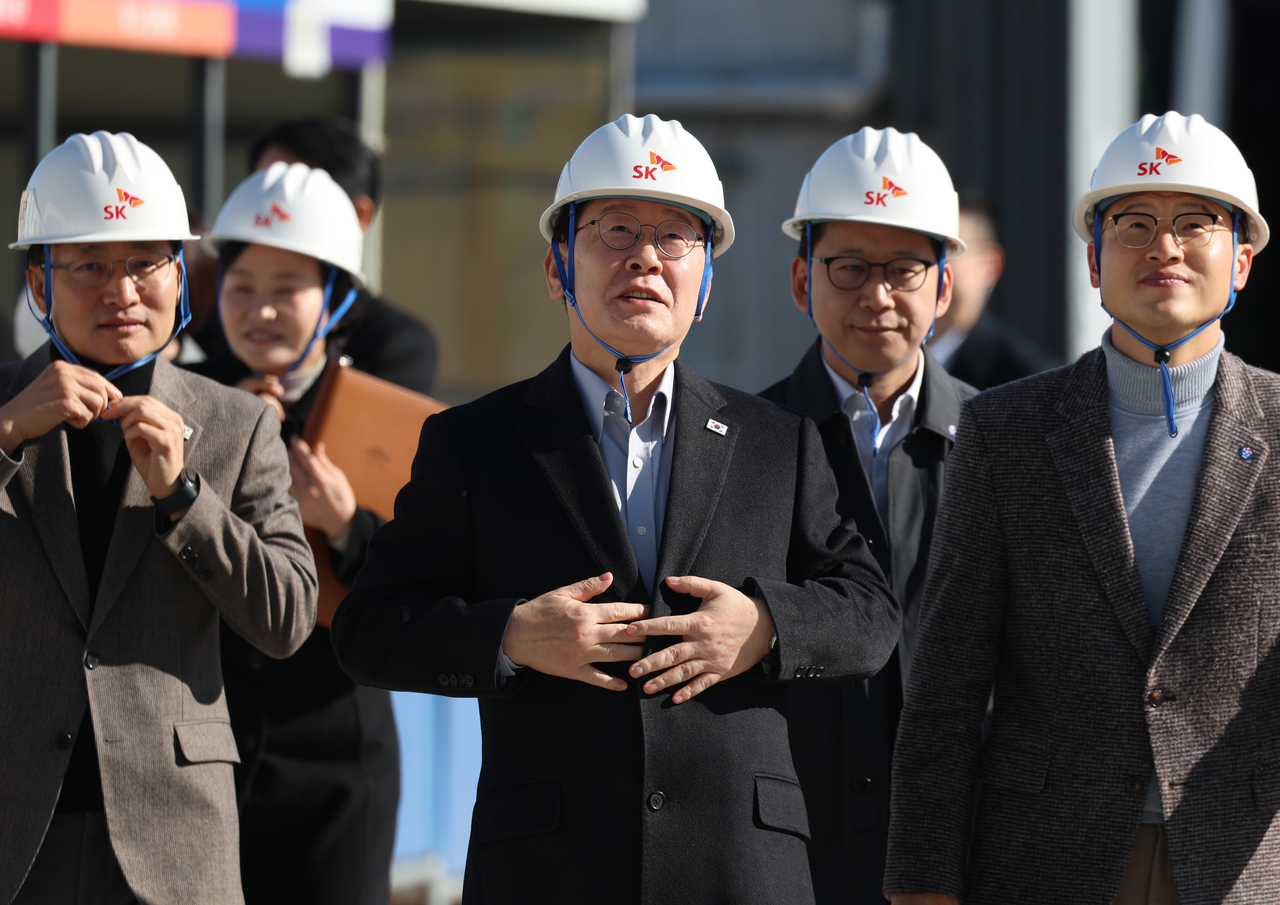
President Lee Jae Myung visited the SK AI Data Center construction site in Ulsan on Saturday to review progress on the Yeongnam region's mega project and pledge government support. Lee particularly flagged a shortage of skilled workers needed to build semiconductor factories and data centers, saying the government would develop measures to secure the necessary workforce.
At the site, Lee said, "Just as the Gyeongbu Expressway once opened the path to South Korea's industrialization, the AI transformation of this country will be driven by an artificial intelligence highway."
The visit came two weeks after Lee attended the groundbreaking ceremony for the Chungcheong region's mega project at Samsung Electronics' Onyang Campus in Asan, South Chungcheong Province, on Nov. 12, marking his second consecutive week visiting a large-scale investment project site.
Lee recalled that his first industrial site visit after taking office in June last year had been the launch ceremony for the Ulsan AI data center, and said, "It is already nearly complete. I would like to extend my special thanks to the SK officials who made the bold investment decision and pushed the project forward with such speed."
He added that "AI data centers are a major source of demand for semiconductors and a core piece of infrastructure supporting physical AI — including robots and autonomous vehicles," and said he hoped the successful execution of the Ulsan AI data center project would serve as a catalyst drawing additional investment from global AI companies.
Lee also highlighted the significance of advanced-industry investment spreading beyond the Greater Seoul area to the regions.
"AI infrastructure investment had been concentrated mainly in the metropolitan area, but this time it is being led by the regions," he said. "This will become a real-world example proving that new growth momentum can be created outside the capital."
Lee said that "all manner of problems in South Korea stem from overconcentration in the metropolitan area," adding that mega projects would serve as "an important and central mechanism for creating new opportunities in the regions and solving the national challenge of balanced development."
Lee singled out the shortage of workers needed to build large-scale advanced industrial facilities as a key challenge.
"Across the board, the briefings I receive say that skilled construction workers for advanced facilities are in very short supply," he said. "We still need to build semiconductor fabs, and there is already a significant labor shortage. As data center construction expands, the workforce problem will not be simple."
"Speed is everything in the current global competition," he said. "Speed is the key to winning internationally, and the government ministries will give serious thought to how we prepare the workforce."
Lee raised the labor issue even as he was being briefed on construction progress immediately after arriving at the site, asking whether construction workers were in short supply. When SK officials confirmed that workers were indeed scarce, he said he was concerned.
Lee also expressed gratitude for the local government's swift permitting support. Speaking to Ulsan Mayor Kim Sang-uk, he said, "You have worked very hard. It looks like there will be quite a lot more to do going forward," and asked the mayor to share views on what the central and local governments could do to be more helpful, promising to follow through.
Lee then received a closed-door briefing on the AI data center construction project.
Those present at the site included SK Telecom Chief Executive Jeong Jae-heon, SK Hyper Chief Executive Jeong Seok-geun and other SK Group officials, as well as Deputy Prime Minister and Minister of Science and ICT Bae Gyeong-hun, Presidential Chief of Staff Im Gwang-hyeon, National Strategic Investment Adviser Lee Won-ju and AI Future Planning Senior Secretary Lee Hae-min.
quq@heraldcorp.com