First US-China-Russia trilateral peace declaration highlighted
'More than $17 billion in commercial contracts secured'
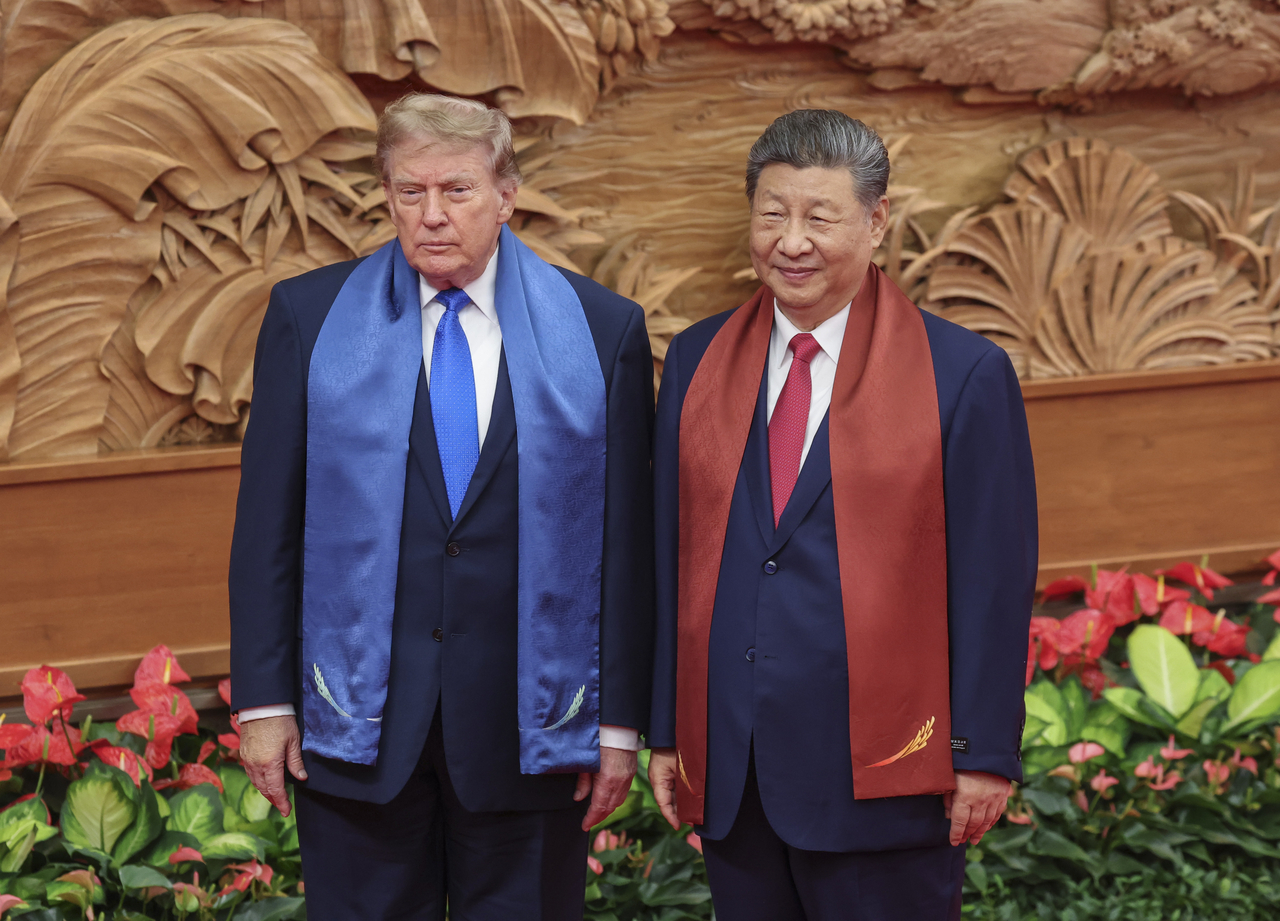
US President Donald Trump held a press conference Friday (local time), the day after returning from his Asia trip, declaring that the tour had produced "remarkable results." Trump highlighted diplomatic achievements — including a trilateral summit with China and Russia — along with major trade deals, in what appeared to be an effort to recover political standing at home following a bruising midterm election defeat.
Speaking at the White House for roughly an hour and a half, Trump outlined the outcomes of the Association of Southeast Asian Nations summit in Manila, the Philippines, and the Asia-Pacific Economic Cooperation summit in Shenzhen, China.
He said the four-day trip yielded meetings with more than 20 world leaders, two new trade agreements secured, and roughly 10 additional deals expected soon.
Trump said he attended four major international summits, reaffirmed US alliances across the region and advanced the cause of peace and security around the world.
He singled out the trilateral summit with Chinese President Xi Jinping and Russian President Vladimir Putin as the trip's signature achievement.
Trump called the three-way meeting "the most consequential international summit in recent years," adding that its outcome was "the first-ever trilateral peace declaration in history."
The four-point joint declaration issued after the US-China-Russia summit in Shenzhen on Thursday affirmed that a nuclear war cannot be won and must never be fought, and pledged dialogue on reducing nuclear risks and preventing proliferation. It did not, however, include any specific agreement on ending the war in Ukraine.
Asked why he refers to Putin and Xi as friends, Trump said he has "a fantastic relationship with Putin" and "a fantastic relationship" with Xi as well, and went on to say that "because of that, our country is safe."
Trump also described the substance of his bilateral talks with Xi, saying the Chinese president told him, "I thought your country was dead" and "I can't believe what you've done."
Trump noted that Xi personally greeted him on the tarmac, saying, "He wasn't greeting me — he was greeting our country in front of the plane." He added that "Sleepy Joe," a reference to former President Joe Biden, "was never greeted in front of the plane."
On his bilateral talks with Putin, Trump said he asked the Russian president whether he would have invaded Ukraine if Trump had been president, and that Putin replied, "No. That never would have happened."
Trump also devoted considerable time to laying out the economic gains he said the trip had produced.
He said the ASEAN and APEC summits yielded more than $17 billion in commercial contracts with key countries.
Among the specifics, Trump said Philippine Airlines agreed to purchase 20 Boeing aircraft, and that the Philippines would shift its agricultural and energy purchases toward American suppliers. On Thailand, he said the country agreed to eliminate tariff and non-tariff barriers on US products and to buy $2.6 billion worth of American agricultural goods annually.
Analysts say Trump's emphasis on diplomatic and trade achievements is not unrelated to his weakened domestic political standing following the Republican Party's heavy losses in the recent midterm elections.
On the midterm results, Trump said, "If my name had been on the ballot, it would have been a completely different outcome — but I wasn't on the ballot." The remark was widely read as an attempt to distance himself from the party's defeat.
Meanwhile, Trump repeatedly highlighted that the trip was made aboard a newly refitted Air Force One — a plane converted from an aircraft donated to the United States by the Qatari royal family.
He boasted that the return flight was "the longest flight Air Force One has ever made," praising the aircraft's speed and range for completing the journey without a refueling stop.
quq@heraldcorp.com